
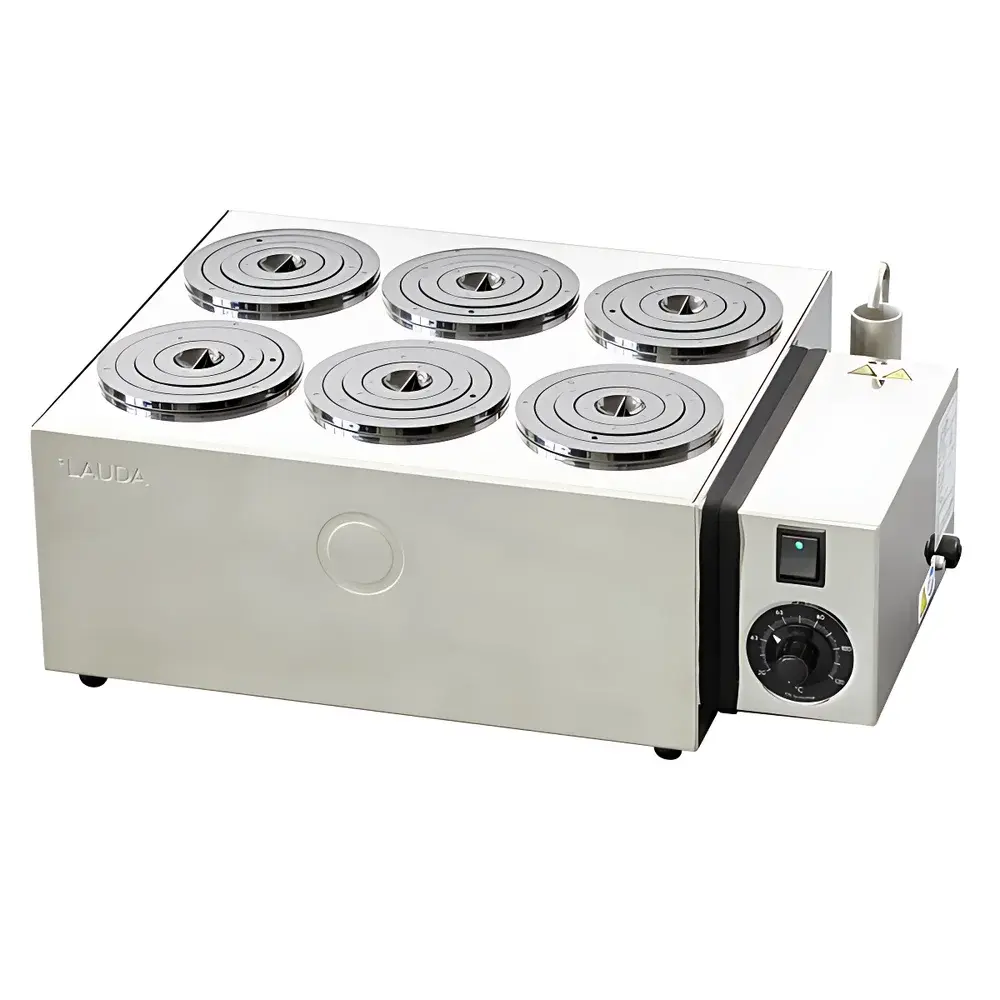
LAUDA Hydro H 11 V Stainless Steel Evaporation Water Bath
| Brand | LAUDA |
|---|---|
| Origin | Germany |
| Model | H 11 V |
| Temperature Range | 25–100 °C |
| Temperature Stability | ±3 °C |
| Bath Volume | 10.5 L |
| Heating Power | 1.5 kW |
| Dimensions (W×D×H) | 450×300×155 mm |
| Bath Opening Diameter | 91 mm |
| Bath Usable Depth | 100 mm |
| Number of Bath Openings | 6 |
| Weight | 6 kg |
| Power Supply | 230 V, 50/60 Hz |
| Material | Full Stainless Steel Construction |
| Safety Features | Low-Level Liquid Protection, Removable Heat-Resistant Plastic Ring Covers, Integrated Water Level Regulator, Perforated Stainless Steel Bath Bottom Plate |
Overview
The LAUDA Hydro H 11 V Stainless Steel Evaporation Water Bath is an engineered solution for controlled, gentle solvent removal in analytical, pharmaceutical, and synthetic chemistry laboratories. Designed around the principle of conductive heat transfer via a precisely regulated water medium, it enables reproducible evaporation at temperatures below the decomposition thresholds of thermally sensitive compounds—particularly critical during sample concentration prior to HPLC, GC, or mass spectrometry analysis. Unlike open-heating plates or oil baths, the H 11 V maintains uniform thermal distribution across all six bath wells, minimizing localized overheating and ensuring consistent evaporation kinetics across parallel samples. Its fully stainless steel construction—including the bath chamber, bottom perforated plate, lid components, and heating element housing—ensures long-term resistance to corrosion from aggressive solvents such as acetone, chloroform, ethyl acetate, and dilute acidic or basic aqueous solutions. The unit is explicitly engineered for integration into fume hoods, with low-profile dimensions (155 mm height) and sealed electrical interfaces compliant with IEC 61000-6-3 emission standards.
Key Features
- Stainless steel monocoque bath structure with electropolished interior surfaces for optimal cleanability and chemical inertness
- Six identical circular wells (91 mm diameter, 100 mm usable depth) enabling simultaneous processing of multiple flasks or beakers
- Manually adjustable single-point temperature controller with calibrated dial scale (25–100 °C range), offering direct visual setpoint confirmation without digital interface dependency
- Integrated water level regulator and automatic low-level cut-off circuitry preventing dry-run operation and heater damage
- Modular ring cover system composed of heat-resistant polyphenylsulfone (PPSU) inserts—individually removable to accommodate vessels from 25 mm to 100 mm outer diameter
- Perforated stainless steel bath bottom plate facilitating uniform water circulation and eliminating sediment accumulation beneath vessels
- Compact footprint (450 × 300 mm) and shallow profile optimized for under-hood installation and space-constrained benchtop environments
Sample Compatibility & Compliance
The H 11 V supports standard laboratory glassware including Erlenmeyer flasks (50–500 mL), round-bottom flasks, and tall-form beakers mounted directly on the ring inserts. Its temperature stability of ±3 °C (measured at setpoint under load per DIN 12879) meets routine QC requirements for non-GMP evaporation steps. While not certified for GLP/GMP production environments, the device complies with EN 61010-1:2019 (Safety Requirements for Electrical Equipment for Measurement, Control, and Laboratory Use) and carries CE marking. Its stainless steel wetted parts conform to ASTM A240/A240M for 304-grade austenitic stainless steel, ensuring compatibility with USP extractables testing protocols when used with purified water or validated solvents.
Software & Data Management
The LAUDA Hydro H 11 V operates as a standalone analog instrument without embedded firmware, data logging, or connectivity options. This design prioritizes operational simplicity, electromagnetic immunity in shared lab infrastructure, and long-term serviceability without software obsolescence concerns. All calibration and verification procedures are traceable to physical reference standards (e.g., certified RTD probes per ISO/IEC 17025-accredited labs). For labs requiring audit trails, external temperature monitoring systems (e.g., calibrated thermistor arrays connected to validated data loggers) may be deployed alongside the unit to fulfill FDA 21 CFR Part 11 documentation expectations where applicable.
Applications
- Routine concentration of reaction mixtures post-Suzuki or Heck couplings
- Preparative removal of volatile solvents prior to NMR sample preparation
- Lyophilization pre-concentration steps in biopolymer purification workflows
- Standard addition calibration curve preparation in environmental residue analysis (e.g., EPA Method 525.3)
- Controlled drying of thin-film substrates in materials science prototyping
- Evaporation of extraction eluates in natural product isolation pipelines
FAQ
Is the H 11 V suitable for use with halogenated solvents such as dichloromethane?
Yes—the full stainless steel construction (including heating element sheath and bath base plate) resists pitting and stress corrosion cracking commonly induced by chlorinated solvents when operated within specified temperature limits.
Can the unit maintain temperature stability during extended overnight runs?
With proper water level management and ambient lab temperature between 18–25 °C, the H 11 V demonstrates stable thermal performance over 12+ hour cycles; however, unattended operation requires validation of local safety protocols and integration with independent high-temperature cutoff devices.
Does LAUDA provide calibration certificates for this model?
As an analog-controlled instrument, formal factory calibration certificates are not issued; users are advised to perform periodic verification using NIST-traceable thermometers per internal SOPs aligned with ISO/IEC 17025 principles.
What maintenance is required to ensure longevity?
Monthly descaling with 5% citric acid solution (followed by triple rinsing), quarterly inspection of ring cover integrity, and annual verification of low-level sensor responsiveness constitute the recommended maintenance schedule.
Is replacement of the heating element possible in-field?
Yes—the modular heater assembly is accessible via bottom-panel removal and can be replaced using standard Torx T20 tools without specialized service intervention.



