
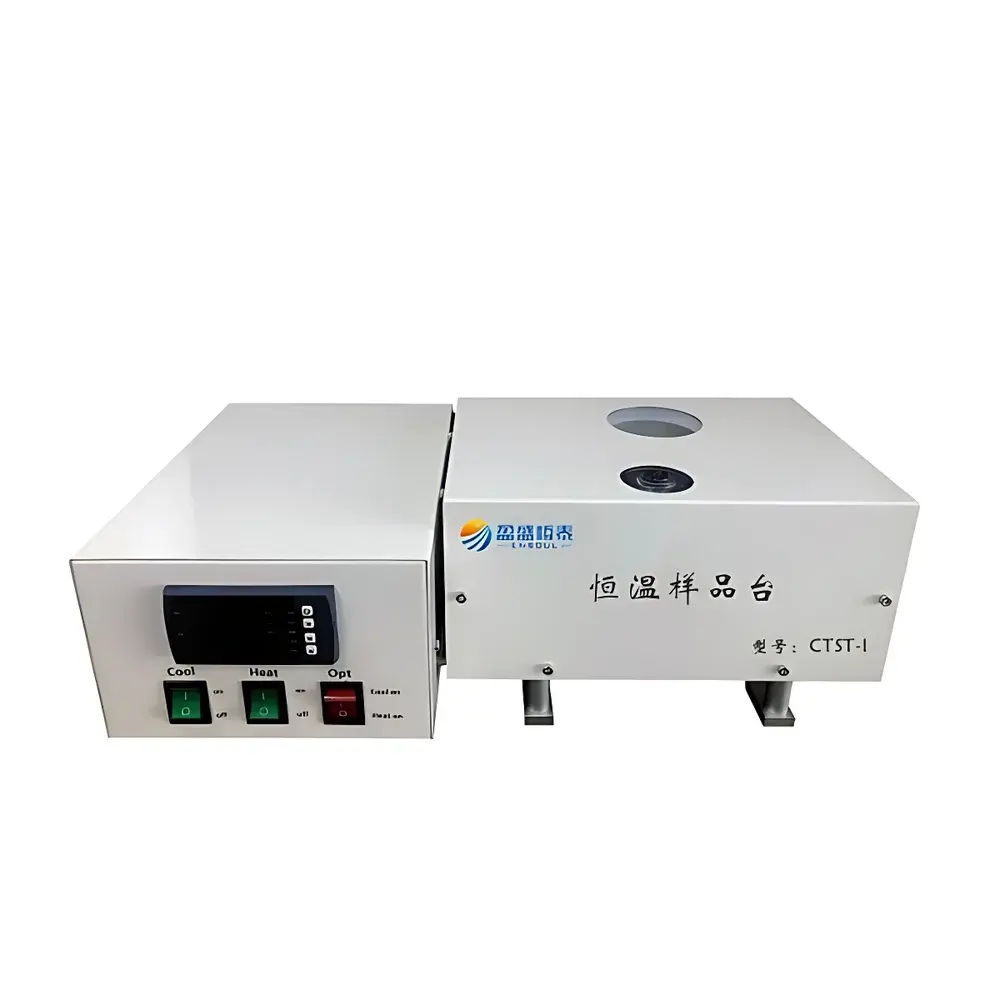
CTST-I Constant-Temperature Sample Stage for FTC Texture Analyzers
| Origin | Beijing, China |
|---|---|
| Manufacturer Type | Authorized Distributor |
| Regional Origin | Domestic (China) |
| Model | CTST-I |
| Pricing | Available Upon Request |
Overview
The CTST-I Constant-Temperature Sample Stage is an engineered thermal control accessory designed exclusively for integration with FTC (Food Technology Corporation) texture analyzers. It enables precise, programmable temperature regulation of samples during mechanical property testing—critical for evaluating thermally sensitive materials whose textural behavior changes significantly with thermal state. Based on Peltier-based thermoelectric heating and cooling technology, the CTST-I maintains stable, uniform sample surface temperatures across a continuous range from −10 °C to +80 °C (±0.3 °C stability over 5 min), facilitating reproducible rheomechanical measurements under controlled thermal conditions. This capability supports fundamental research into thermal transitions—including gelation onset, starch retrogradation, fat crystallization/melting, protein denaturation, and polymer softening—within food science, dairy R&D, confectionery development, and functional ingredient characterization.
Key Features
- Peltier-driven dual-mode thermal control: simultaneous heating and cooling with independent PID regulation for rapid thermal equilibration (typical ramp rate: 1.2 °C/min)
- Integrated high-accuracy RTD sensor (PT100) embedded in the sample platform for real-time, closed-loop temperature feedback
- Programmable thermal profiles: user-defined temperature setpoints, dwell times, and ramp sequences synchronized with texture analyzer trigger signals
- Low-thermal-mass aluminum alloy platform with precision-machined mounting interface compatible with standard FTC probe holders and fixture adapters
- Thermal isolation design minimizes ambient heat transfer; optional insulated lid available for extended low-temperature operation
- RS-232 and USB communication interfaces for bidirectional synchronization with FTC software (Texture Pro, TA-HD Plus, or TA.XTplus)
Sample Compatibility & Compliance
The CTST-I accommodates flat-bottomed samples up to Ø90 mm × 40 mm height in standard configuration, supporting both solid, semi-solid, and viscoelastic matrices without requiring custom fixtures. Compatible sample forms include meat emulsions, baked doughs, gelled desserts, chilled dairy spreads, frozen confections, hydrocolloid films, and pharmaceutical gels. All thermal control electronics comply with IEC 61000-6-3 (EMC emission standards) and IEC 61010-1 (safety requirements for laboratory equipment). Temperature calibration traceability follows ISO/IEC 17025–accredited procedures, and system validation supports GLP-compliant documentation per FDA 21 CFR Part 11 when used with audit-trail-enabled FTC software versions.
Software & Data Management
The CTST-I operates natively within FTC’s Texture Pro v3.0+ and TA-HD Plus environments via dedicated driver modules. Real-time temperature data streams synchronously with force–displacement acquisition at 200 Hz, enabling direct overlay of thermal traces onto texture curves (e.g., hardness vs. temperature). Exported datasets include time-stamped columns for temperature, load, distance, and calculated parameters (e.g., Young’s modulus, work of shear, fracture energy), formatted as CSV or Excel-compatible .xlsx files. Batch analysis templates support automated generation of temperature–texture response surfaces, Arrhenius plots for activation energy estimation, and statistical comparison across thermal treatment groups (ANOVA/Tukey HSD).
Applications
- Quantifying temperature-dependent hardness transitions in cheese during cold storage or ripening
- Evaluating melt resistance and collapse onset in chocolate coatings across 15–35 °C ranges
- Mapping gel-sol transition temperatures in pectin, agar, and carrageenan systems
- Assessing textural stability of plant-based meat analogues under simulated cooking/cooling cycles
- Characterizing cold-induced brittleness in ice cream matrices and recrystallization kinetics
- Validating thermal robustness of edible films and biopolymer packaging under accelerated aging protocols
FAQ
Is the CTST-I compatible with non-FTC texture analyzers?
No—the CTST-I is mechanically and electronically optimized for FTC systems only; physical mounting dimensions, signal protocols, and firmware handshake routines are proprietary to FTC hardware platforms.
What is the minimum sample mass required for stable thermal control?
For optimal thermal uniformity, samples should weigh ≥15 g and exhibit thermal conductivity ≥0.2 W/(m·K); low-mass or highly insulating samples (e.g., aerated foams) may require extended equilibration time.
Can temperature ramps be triggered automatically at specific deformation points during a test?
Yes—advanced scripting in Texture Pro allows conditional temperature step initiation based on real-time force or displacement thresholds (e.g., initiate cooling upon 5% compression strain).
Does the unit include NIST-traceable calibration documentation?
A factory calibration certificate (including PT100 verification at three points: −5 °C, 25 °C, 60 °C) is supplied; full ISO/IEC 17025 calibration services are available through authorized FTC service centers.
Is condensation management addressed for sub-zero operation?
Yes—the platform includes a heated perimeter ring and optional desiccant chamber interface to suppress moisture accumulation during refrigerated testing.
Related Products







