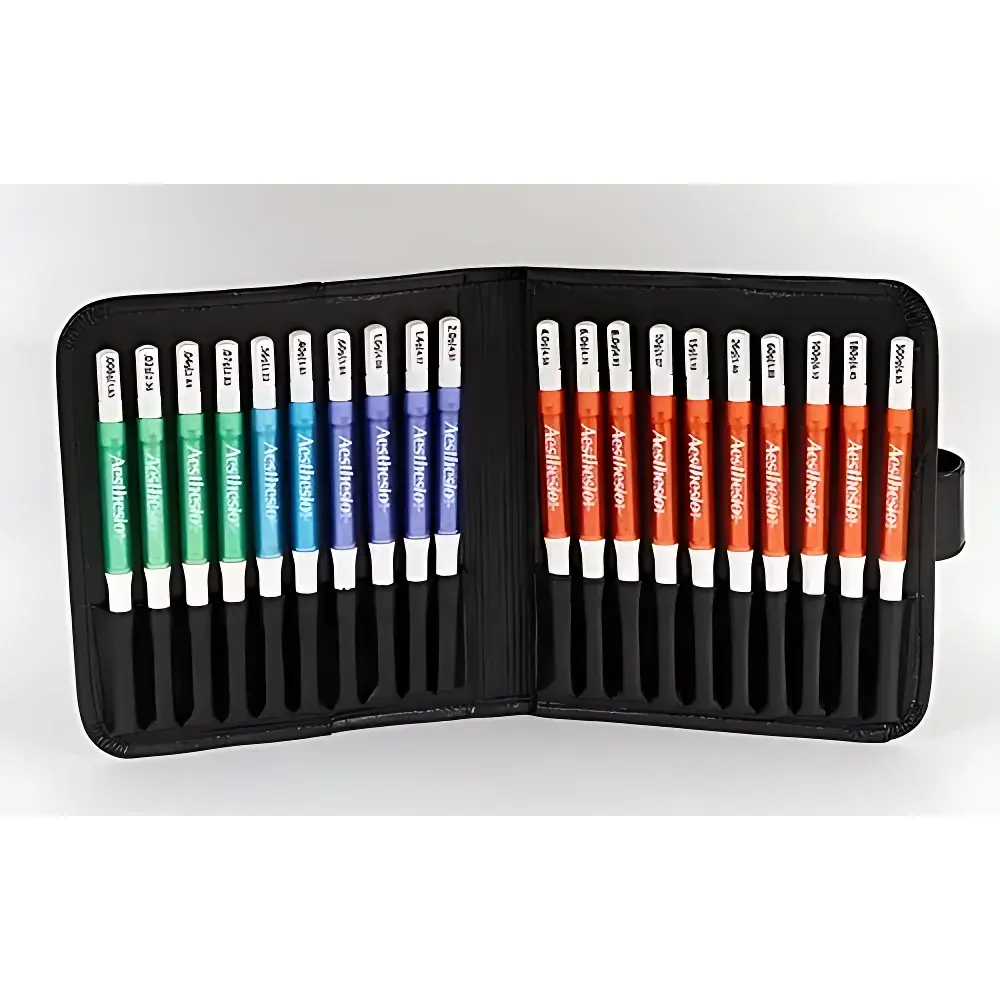
Danmic Aesthesio Von Frey Filament Set for Rodent Mechanical Allodynia and Hyperalgesia Assessment
| Origin | USA |
|---|---|
| Manufacturer Type | Authorized Distributor |
| Origin Category | Imported |
| Model | Aesthesio |
| Pricing | Available Upon Request |
Overview
The Danmic Aesthesio Von Frey Filament Set is a standardized, calibrated mechanical sensory testing system engineered for quantitative assessment of tactile allodynia and mechanical hyperalgesia in rodent models. Based on the Semmes-Weinstein monofilament principle, it applies controlled, reproducible forces to the plantar surface of hind paws via calibrated nylon filaments—each manufactured to precise bending thresholds defined by ASTM F2475-22 (Standard Practice for Calibration of Monofilaments). The set comprises 20 filaments spanning a force range from 0.008 g (0.078 mN) to 300 g (2.94 N), enabling graded stimulation across physiological and pathological mechanosensory thresholds. This method relies on the quantifiable paw-withdrawal reflex in response to calibrated mechanical displacement—a behaviorally robust, non-invasive endpoint widely accepted in preclinical pain research, neuropharmacology, and peripheral nerve injury studies.
Key Features
- 20 individually calibrated nylon monofilaments traceable to NIST-certified reference standards, with force values labeled directly on each filament handle
- Force range covering sub-threshold innocuous touch (0.008 g) through noxious mechanical pressure (300 g), supporting both baseline sensitivity profiling and pathological hypersensitivity detection
- Ergonomic handheld design with indexed filament storage tray for rapid, error-resistant selection during high-throughput behavioral testing
- Consistent filament geometry (diameter and length-to-bend ratio) validated per ISO 11979-6 for mechanical reproducibility across repeated applications
- Compatible with standard rodent activity cages (sold separately) and automated video-tracking systems for synchronized behavioral annotation
- Reusable filaments with documented longevity exceeding 500 bends per filament under controlled humidity (20–60% RH) and temperature (20–25°C)
Sample Compatibility & Compliance
The Aesthesio system is validated for use in C57BL/6, CD-1, Sprague-Dawley, and Wistar rats and mice aged ≥6 weeks. Testing follows the “up-down” method (Dixon, 1980) or the “non-parametric staircase” protocol recommended by the International Association for the Study of Pain (IASP) Task Force on Animal Models of Pain. Data generated are compliant with GLP documentation requirements when paired with auditable test logs and operator training records. The methodology aligns with NIH Office of Laboratory Animal Welfare (OLAW) guidelines and supports adherence to ARRIVE 2.0 reporting standards. While not an FDA-cleared device, its use in IND-enabling toxicology and efficacy studies conforms to ICH S5(R3) and USP principles for nonclinical safety evaluation.
Software & Data Management
The Aesthesio set operates as a hardware-only platform requiring manual recording or integration with third-party behavioral analysis software (e.g., EthoVision XT, Noldus; ANY-maze, Stoelting). Users may export raw withdrawal latency and threshold data in CSV or Excel format for statistical analysis using GraphPad Prism, R, or SAS. When used in regulated environments, laboratories implement electronic lab notebooks (ELNs) with 21 CFR Part 11-compliant audit trails to document filament calibration history, animal ID, session timestamps, observer blinding status, and environmental parameters (light cycle, ambient noise ≤55 dB, room temperature 22 ± 2°C). Danmic provides a Certificate of Conformance with each shipment, including lot-specific calibration verification reports.
Applications
- Preclinical evaluation of analgesic compounds targeting TRPV1, Nav1.7, or P2X3 receptors
- Longitudinal monitoring of neuropathic pain progression in chronic constriction injury (CCI), spared nerve injury (SNI), or streptozotocin-induced diabetic neuropathy models
- Functional phenotyping of genetically modified mouse lines with altered mechanoreceptor expression (e.g., Piezo2 KO, MrgprB4-Cre lines)
- Assessment of central sensitization following spinal cord injury or inflammatory arthritis (CFA model)
- Validation of novel transdermal delivery systems via changes in mechanical withdrawal thresholds
- Teaching modules in graduate neuroscience and pharmacology curricula demonstrating somatosensory processing principles
FAQ
How often should Von Frey filaments be recalibrated?
Calibration verification is recommended before each experimental cohort and after every 100 uses per filament. Full recalibration by an accredited metrology lab is advised annually or following exposure to temperatures >35°C or relative humidity >75%.
Can the Aesthesio set be used for non-rodent species?
While optimized for murine and rat plantar testing, limited validation exists for guinea pig and rabbit hindlimb application. Force ranges must be re-validated empirically for larger or thicker-skinned species.
Is the set compatible with automated stimulus delivery systems?
Yes—filament handles conform to standard 8-mm diameter mounting interfaces. Third-party motorized actuators (e.g., Ugo Basile Dynamic Plantar Aesthesiometer adapters) can be integrated with custom firmware for programmable ramped-force protocols.
What environmental controls are required during testing?
Animals must undergo 30 min acclimatization in the testing room under 12-h light/dark cycle, low ambient noise (<55 dB), and stable temperature (22 ± 2°C). Testing surfaces must be elevated wire mesh (0.5 cm² aperture) to permit unobstructed paw access and minimize stress-induced artifacts.
Does Danmic provide training or SOP templates?
Yes—Danmic offers downloadable GLP-aligned SOPs, video-based operator certification modules, and live virtual workshops covering filament handling, up-down method execution, and inter-observer reliability assessment (Cohen’s kappa ≥0.85 target).