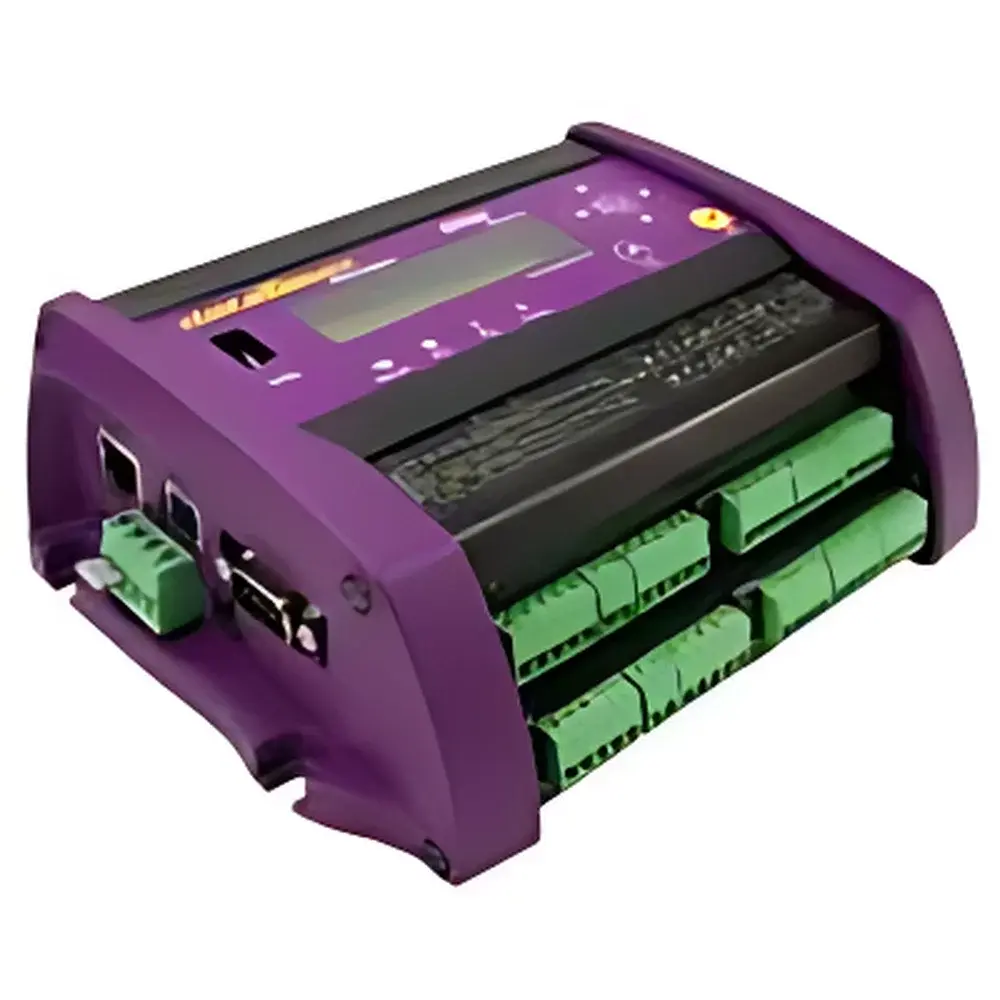
dataTaker DT80 Series 2 Intelligent Data Acquisition Unit
| Origin | Australia |
|---|---|
| Manufacturer Type | Authorized Distributor |
| Origin Category | Imported |
| Model | DT80 Series 2 |
| Pricing | Upon Request |
Overview
The dataTaker DT80 Series 2 is an industrial-grade, autonomous intelligent data acquisition unit engineered for high-reliability long-term monitoring in unattended or harsh environments. Built on a robust embedded Linux architecture, it employs 18-bit analog-to-digital conversion with dual-channel isolation to ensure signal integrity across electrically noisy industrial and environmental sites. Its core measurement principle combines precision analog sampling (±30 V range, programmable gain), high-resolution digital I/O, serial sensor protocol decoding (SDI-12, Modbus RTU/ASCII), and deterministic real-time scheduling—enabling synchronized multi-sensor acquisition with microsecond-level timestamping accuracy. Designed for deployment in remote infrastructure—including meteorological stations, hydrological gauging sites, geotechnical arrays, and industrial process skids—the DT80 Series 2 operates independently for months on low-power DC input (9–30 VDC), features an integrated backlit LCD for local status verification, and supports full firmware and configuration updates over-the-air via Ethernet or USB.
Key Features
- 18-bit resolution analog inputs: up to 15 single-ended or 10 isolated differential channels (±30 V range, software-selectable excitation)
- 12 configurable digital I/O channels supporting TTL/CMOS logic, pulse counting (up to 1 MHz), quadrature encoder input, and programmable edge-triggered alarms
- Dual independent RS-232/RS-422/RS-485 serial sensor ports supporting SDI-12 (multi-node networks), Modbus RTU/ASCII master/slave, and ASCII-based smart sensor protocols
- Onboard 5 million point non-volatile memory with user-defined partitioning: allocate separate memory regions for different logging plans, event-triggered archives, or statistical summaries
- Integrated Ethernet interface with embedded HTTP server, FTP client/server, SMTP email alerts, and DHCP/Static IP support—enabling browser-based access without client-side software
- USB host port for direct U disk data export, firmware updates, and external power backup; USB device mode for PC connection and real-time streaming
- Programmable 12 VDC sensor power outputs with current limiting and on/off control per channel; optional relay output module for actuator interfacing
- Real-time clock with battery backup, NTP synchronization support, and millisecond-accurate timestamping compliant with ISO 8601 and IEC 61850-8-1 time stamping conventions
Sample Compatibility & Compliance
The DT80 Series 2 interfaces natively with a broad spectrum of analog and digital sensors used in environmental, civil, and industrial monitoring—including thermistors, PT100/PT1000 RTDs, 4–20 mA transmitters, strain gauge bridges (with internal 2.5 V excitation), pH/ORP electrodes, load cells, anemometers, rain gauges, and water level transducers. It supports SDI-12 sensor networks (up to 62 devices per bus) and Modbus-compatible PLCs, SCADA RTUs, and CAN-enabled devices via optional CANgate gateway (ISO 11898-2 compliant). The unit meets IEC 61000-4 electromagnetic compatibility standards (ESD, surge, fast transient immunity), operates within –25 °C to +70 °C ambient range, and carries CE, RCM, and UKCA markings. Firmware and configuration management adhere to principles aligned with IEC 62443-3-3 for secure device lifecycle management, and audit trails for configuration changes can be exported for GLP/GMP documentation workflows.
Software & Data Management
Configuration, calibration, and logging plan development are performed using dataTaker’s free dEX software (Windows/macOS/Linux), which provides graphical plan builder, sensor library integration, engineering unit mapping, and statistical function scripting (min/max/avg/std dev/rate-of-change). All acquired data is stored in open CSV or binary formats with embedded metadata (sensor ID, units, scaling coefficients, timestamps). The built-in web server delivers live data views, historical charts, and database exports via standard HTTP GET requests—compatible with third-party platforms including Grafana, Node-RED, and custom Python/PHP dashboards. FTP auto-upload supports scheduled transfers with retry logic and file rotation; email alerts include embedded CSV snippets or full log attachments. Data integrity is preserved through CRC-32 checksums on all stored records and write-protected memory partitions.
Applications
- Meteorological monitoring networks: temperature, humidity, solar irradiance, wind speed/direction, barometric pressure, and precipitation accumulation with NIST-traceable calibration traceability
- Hydrological telemetry: river stage, groundwater level, turbidity, conductivity, dissolved oxygen, and flow meter pulse integration for USGS-compliant reporting
- Geotechnical instrumentation: piezometer arrays, inclinometer digitizers, crack meters, and vibrating-wire sensor networks requiring high common-mode rejection and low-drift amplification
- Industrial asset monitoring: transformer oil temperature, pump vibration signatures (via analog acceleration inputs), cabinet humidity, and power quality parameters in substation automation
- Agricultural IoT deployments: soil moisture profiles (capacitance/TDR), canopy temperature, irrigation valve status, and weather station aggregation at farm-scale edge nodes
FAQ
Does the DT80 Series 2 support TLS/SSL encryption for secure data transmission?
Yes—firmware v3.5+ enables HTTPS for web interface access and FTPS for encrypted file transfers, configurable via dEX or CLI.
Can the DT80 operate as a Modbus TCP server?
No—it functions as a Modbus RTU/ASCII master or slave over serial; Modbus TCP bridging requires external gateway hardware.
Is there a maximum recommended cable length for SDI-12 sensor buses?
For reliable operation under typical EMI conditions, total bus length should not exceed 200 m with shielded twisted-pair cabling and proper termination.
How is time synchronization maintained during extended network outages?
The onboard RTC maintains accuracy within ±2 seconds per month; NTP resync occurs automatically upon network restoration.
Are firmware updates backward-compatible with existing dEX configurations?
Yes—configuration files (.cfg) retain full compatibility across minor firmware revisions; major version upgrades include automated migration tools.