
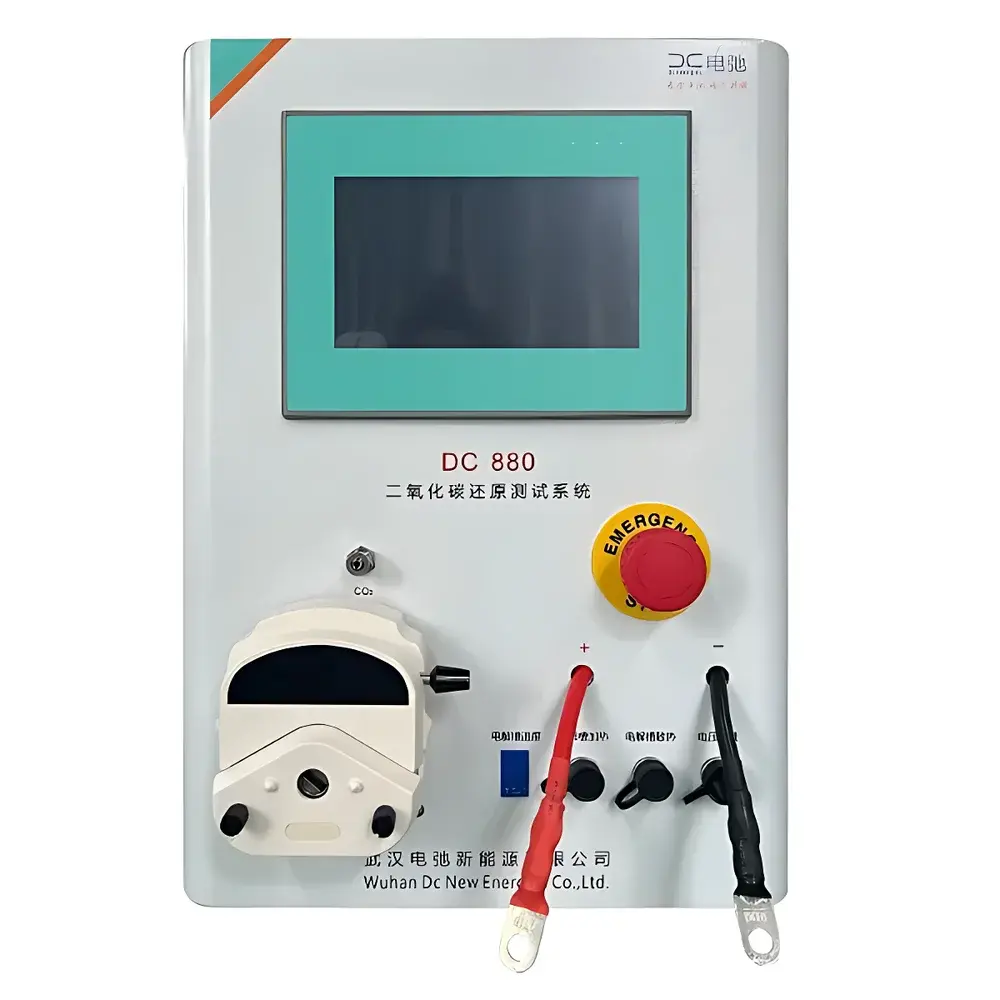
DC 880 Carbon Dioxide Electroreduction Testing System
| Brand | DC-Energies |
|---|---|
| Model | DC 880 |
| Origin | Wuhan, China |
| Category | Electrochemical CO₂ Reduction (CO₂RR) Flow Cell Test System |
| Gas Flow Control | Anode-side CO₂/N₂/H₂ and cathode-side liquid/gas flow management |
| Backpressure Regulation | Manual dual-chamber (anode/cathode) pressure control up to 10 bar |
| Temperature Control | Heated/insulated tubing & CO₂RR flow cell fixture (ambient to 80 °C, ±0.5 °C stability) |
| Pressure Monitoring | Integrated digital pressure transducers (0–10 bar, 0.01 bar resolution) |
| Compatibility | Requires external potentiostat/galvanostat for Faradaic efficiency, long-term stability, and product quantification assays |
| Compliance | Designed for ASTM D7467-22 (electrochemical gas-phase reaction systems), ISO 17025-compliant test environment support |
Overview
The DC 880 Carbon Dioxide Electroreduction Testing System is an engineered platform for controlled, reproducible investigation of electrocatalytic CO₂ reduction reactions (CO₂RR) under elevated pressure and temperature conditions. Built upon a dual-compartment flow cell architecture, the system enables precise decoupling of anodic oxidation (e.g., water oxidation or organic substrate oxidation) and cathodic CO₂ reduction processes. It operates on the principle of continuous-flow electrochemistry with integrated thermal and pressure management—critical for stabilizing reactive intermediates, suppressing hydrogen evolution, and enhancing C₂+ product selectivity (e.g., ethylene, ethanol, acetate). Unlike ambient-pressure H-cell configurations, the DC 880 supports pressurized operation up to 10 bar, facilitating higher CO₂ solubility, improved mass transport, and thermodynamically favorable pathways for multi-proton/electron transfer steps. The system is not a standalone electrochemical analyzer; rather, it serves as a rigorously calibrated interface between commercial potentiostats and gas/liquid product analysis instrumentation (e.g., GC-TCD/FID, NMR, IC).
Key Features
- Dual-channel independent backpressure regulation: Manual precision valves allow discrete adjustment of anode and cathode chamber pressures—essential for maintaining membrane electrode assembly (MEA) integrity and preventing crossover during high-current-density operation.
- Active thermal management: All fluidic pathways—including gas supply lines, electrolyte loops, and the CO₂RR flow cell fixture—are jacketed, heated, and insulated. Temperature is monitored in real time via PT100 sensors (±0.5 °C accuracy) and maintained within 80 °C maximum operating range.
- Integrated pressure monitoring: Digital pressure transducers with 0.01 bar resolution provide continuous logging of inlet, outlet, and chamber pressures—enabling correlation of pressure-dependent Faradaic efficiency shifts and kinetic overpotential trends.
- Modular gas/liquid delivery: Anode gas flow (O₂, air, or inert sweep) and cathode CO₂ feed are independently metered using mass flow controllers (MFCs); liquid electrolyte circulation is driven by peristaltic pumps with adjustable flow rates (0.1–10 mL/min).
- Standardized mechanical interface: 1/4″-28 UNF ports and Swagelok-compatible fittings ensure compatibility with third-party electrochemical cells (e.g., zero-gap MEA cells, H-cells with gas diffusion electrodes) and downstream analytical hardware.
Sample Compatibility & Compliance
The DC 880 accommodates standard flow cell geometries including serpentine, interdigitated, and parallel-channel designs, supporting catalyst-coated membranes (CCMs) up to 5 cm² active area. It is compatible with aqueous KHCO₃, KCl, and non-aqueous EMIM-BF₄ electrolytes, as well as solid polymer electrolytes (SPEs). For regulatory alignment, the system’s pressure-rated components conform to ASME B31.3 process piping standards; its thermal control architecture supports GLP-compliant experimental documentation when paired with validated data acquisition software. While not certified for hazardous area use (ATEX/IECEx), it meets IEC 61010-1 safety requirements for laboratory electrical equipment. System design facilitates adherence to ASTM D7467-22 (Standard Practice for Evaluating Electrocatalysts for CO₂ Reduction) and supports traceable calibration protocols required under ISO/IEC 17025-accredited laboratories.
Software & Data Management
The DC 880 operates without proprietary firmware; all control signals (temperature setpoints, pressure limits, flow rates) are relayed via analog 0–10 V or 4–20 mA interfaces, enabling seamless integration with LabVIEW, Python-based control scripts (using PyVISA or DAQmx), or commercial SCADA platforms. Real-time sensor data—including pressure differentials, inlet/outlet temperatures, and flow rates—is timestamped and exportable in CSV or HDF5 format. When used with electrochemical workstations supporting 21 CFR Part 11 compliance (e.g., BioLogic SP-300, Gamry Interface 5000P), full audit trails—including parameter changes, operator IDs, and instrument calibration logs—can be maintained for GMP-aligned research environments.
Applications
- High-pressure CO₂RR kinetics studies targeting C₂+ products (acetate, ethanol, n-propanol) under industrially relevant current densities (>200 mA/cm²).
- Stability benchmarking of gas diffusion electrodes (GDEs) and membrane electrode assemblies (MEAs) over >100 h continuous operation.
- Faradaic efficiency mapping across voltage, pressure, temperature, and electrolyte concentration gradients.
- Two-step CO₂-to-acetate synthesis workflows integrating upstream CO electrolysis and downstream CO₂ reduction modules.
- Method development for online product quantification using coupled GC–MS or differential electrochemical mass spectrometry (DEMS).
FAQ
Does the DC 880 include an integrated potentiostat?
No. The system requires connection to an external electrochemical workstation for current/voltage control and transient measurement.
What is the maximum allowable operating pressure?
10 bar absolute pressure for both anode and cathode compartments, with pressure-rated stainless steel manifolds and fluoropolymer-sealed fittings.
Can the system be used with membraneless flow cells?
Yes—modular port configuration supports H-cell derivatives, filter-press cells, and custom two-compartment designs with appropriate sealing and pressure compensation.
Is temperature control available for the electrolyte reservoir?
Yes; the recirculating electrolyte loop includes an inline heater-cooler module with PID-controlled setpoint regulation (ambient to 60 °C).
How is gas composition verified pre- and post-electrolysis?
The system provides standardized sampling ports upstream/downstream of the flow cell for offline GC analysis or integration with online gas chromatographs equipped with thermal conductivity (TCD) and flame ionization (FID) detectors.






