
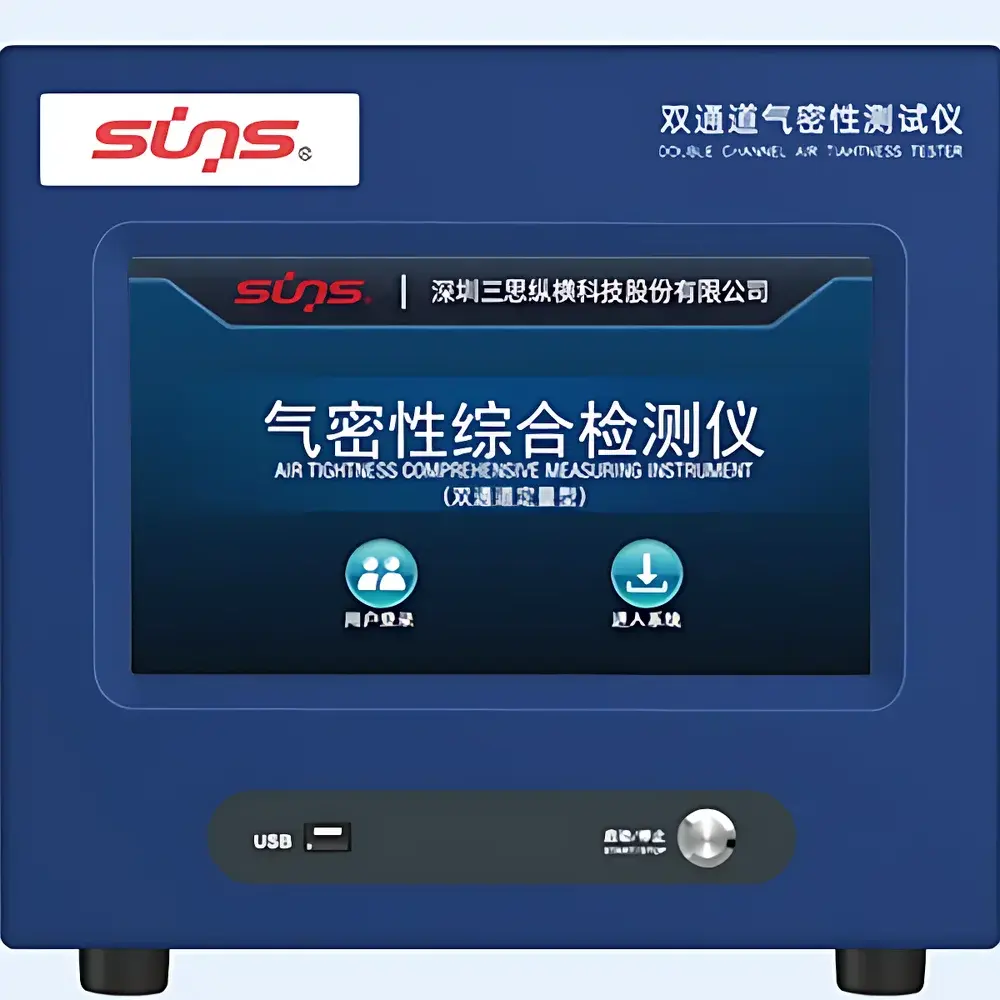
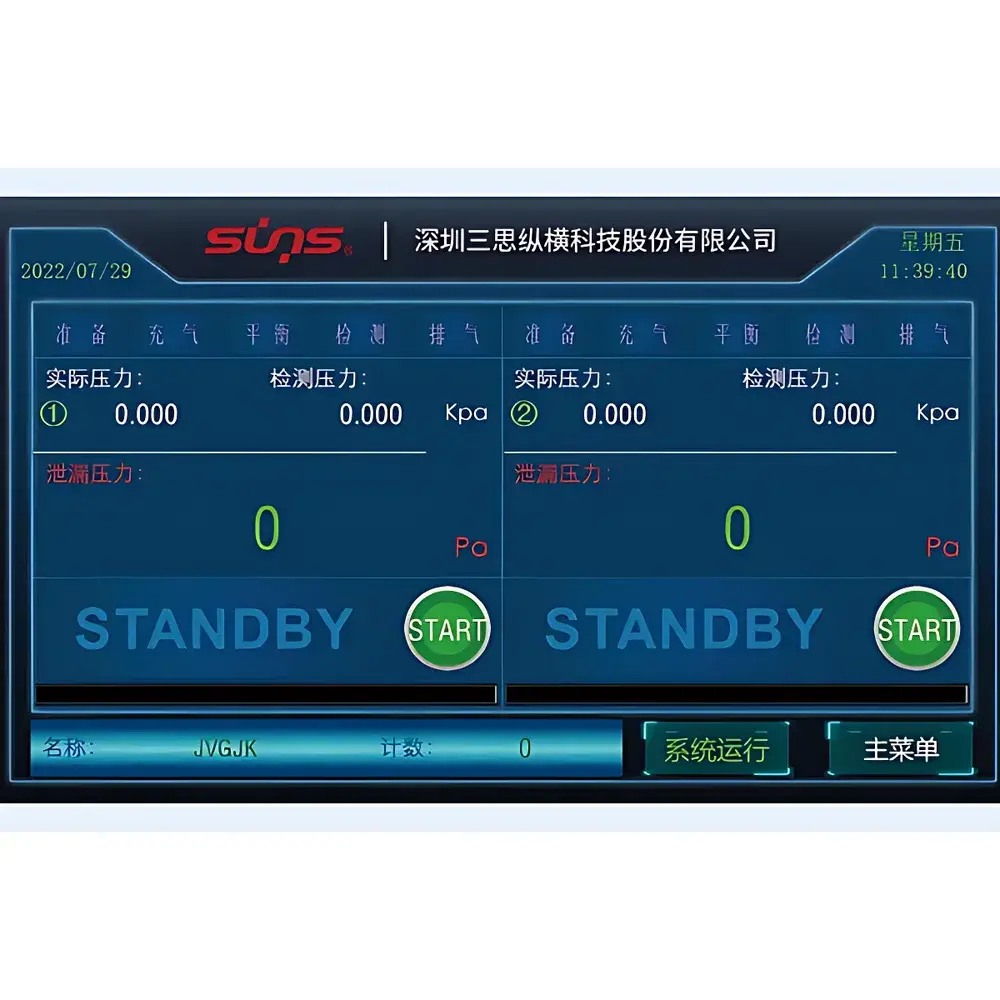
SUNS Dual-Station Direct-Pressure Leak Tester
| Brand | SUNS |
|---|---|
| Origin | Shenzhen, China |
| Manufacturer Type | Original Equipment Manufacturer (OEM/ODM) |
| Country of Origin | China |
| Model | Dual-Station Direct-Pressure Leak Tester |
| Quotation | Upon Request |
| Test Pressure | 22 kPa |
| Compliance Support | MES Integration, Barcode Scanner Interface, PC-Based Host Software |
| Target Application | IP68 Waterproof Integrity Testing for Smartphone Frames |
Overview
The SUNS Dual-Station Direct-Pressure Leak Tester is an industrial-grade, benchtop pneumatic leak detection system engineered for high-throughput, non-destructive verification of hermetic integrity in precision enclosures. It operates on the direct-pressure decay principle: the test part is pressurized to a defined setpoint (up to 22 kPa), isolated from the pressure source, and monitored for pressure loss over a user-defined stabilization and measurement period. This method provides quantitative, repeatable leak rate estimation (typically expressed in Pa·s or mL/min equivalent) without requiring reference standards or vacuum chambers. Designed specifically for final assembly line validation of consumer electronics—particularly smartphone midframes subject to IP68 certification—the instrument delivers deterministic pass/fail outcomes aligned with IEC 60529 and ISO 12207-based leakage thresholds. Its dual-station architecture enables concurrent testing of two identical parts, effectively doubling throughput while maintaining independent pressure control, real-time monitoring, and individual result logging per station.
Key Features
- Dual independent test stations with isolated pressure circuits, enabling simultaneous yet autonomous evaluation of two samples
- High-resolution digital pressure transducers with temperature-compensated output, supporting stable 22 kPa maximum test pressure with ≤0.1% FS repeatability
- Integrated solenoid valve manifold with <10 ms actuation response time, minimizing dead volume and enhancing measurement fidelity
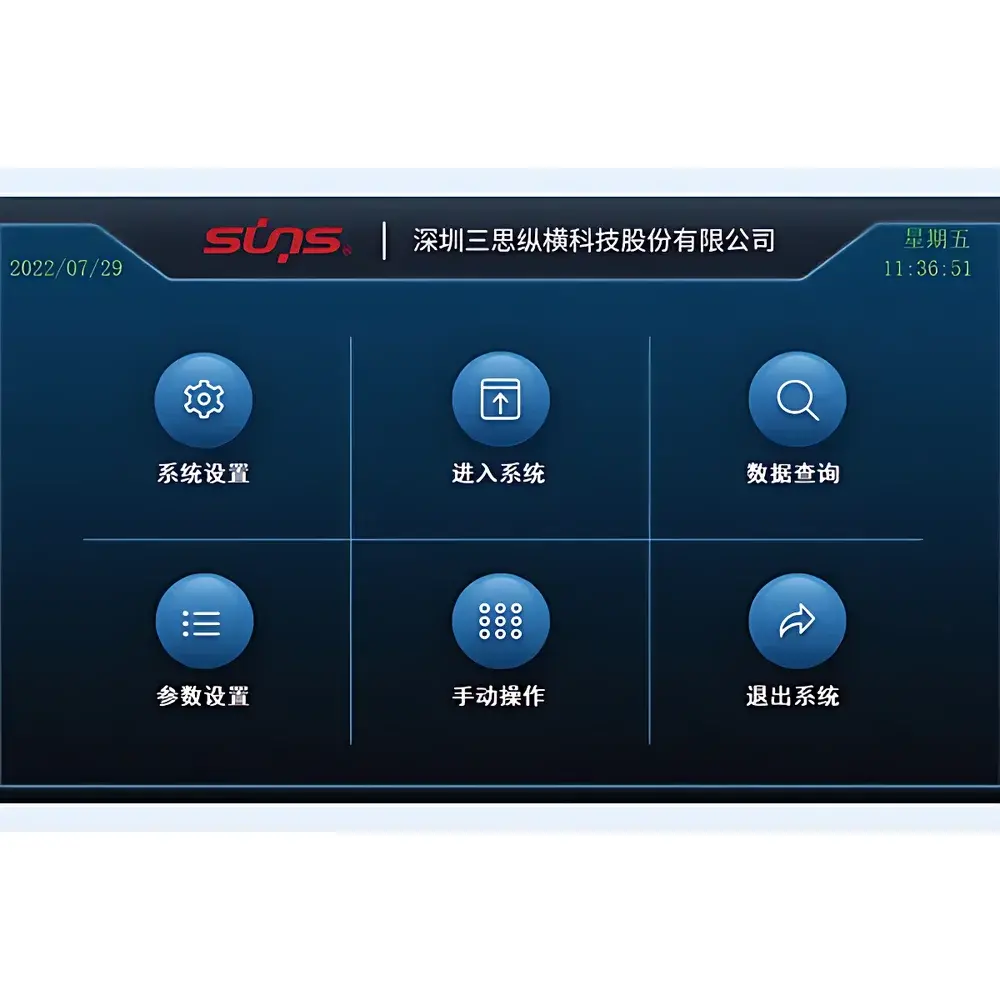
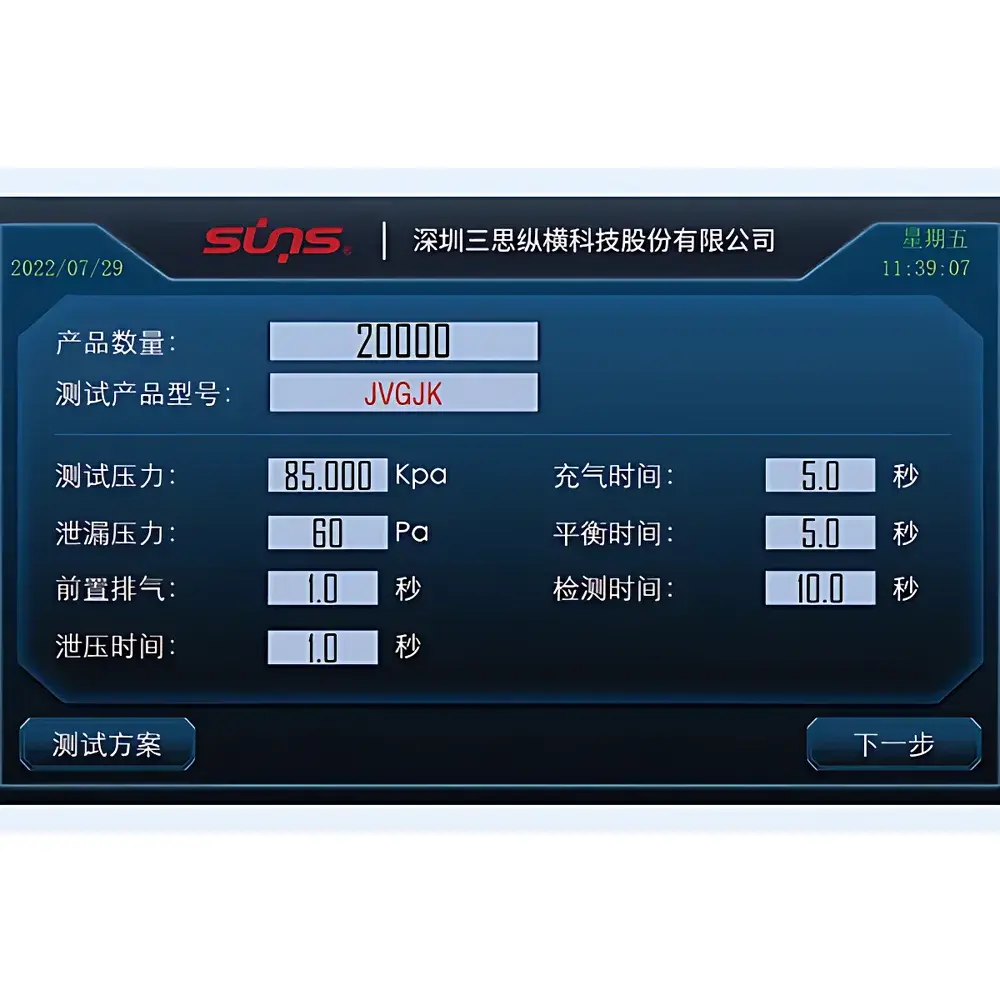
- Programmable test sequence logic: pre-pressurization, stabilization, measurement, venting, and purge phases—all configurable via intuitive touchscreen interface
- RS-232, Ethernet (TCP/IP), and USB 2.0 communication interfaces for factory automation integration
- Embedded real-time clock and audit trail functionality compliant with basic GLP documentation requirements
Sample Compatibility & Compliance
The tester accommodates rigid or semi-rigid housings with internal volumes ranging from 5 cm³ to 500 cm³—covering standard smartphone midframes, wearable device casings, and small IoT enclosures. Fixturing is modular and customizable via CNC-machined aluminum tooling plates compatible with common pneumatic sealing fixtures (e.g., O-ring compression, diaphragm clamping). The system supports calibration traceability to national metrology institutes (NMI) through documented pressure sensor calibration certificates. While not certified to ISO/IEC 17025 out-of-box, it meets functional requirements for in-house verification per ISO 20486 (leak testing—pressure decay method) and aligns with production-level validation protocols referenced in IEC 60529 Annex B (IP code testing procedures). Optional firmware upgrades support FDA 21 CFR Part 11–compliant electronic signatures and audit trails when deployed in regulated medical device manufacturing environments.
Software & Data Management
The embedded controller runs a deterministic real-time OS with deterministic cycle timing (<1 ms jitter). An optional Windows-based host software package provides comprehensive data acquisition, visualization, and export capabilities: real-time pressure vs. time curve overlay for both stations; statistical process control (SPC) charting (X̄–R, Cp/Cpk); CSV and PDF report generation with embedded timestamps, operator ID, and serial number tagging. The software natively supports MES integration via OPC UA or custom TCP socket protocol, enabling bidirectional communication with factory execution systems (FES). Barcode scanner input (USB HID or RS-232) auto-populates test records with part numbers, lot IDs, and work order references—eliminating manual entry errors and ensuring full traceability across production batches.
Applications
- Final QA verification of IP68-rated smartphone and tablet midframes prior to sealing and sub-assembly
- In-line leak screening of waterproof smartwatch housings, earbud charging cases, and fitness trackers
- Process development and tolerance validation for laser welding, ultrasonic bonding, and adhesive dispensing operations affecting enclosure integrity
- Supplier qualification testing where quantitative leak rate thresholds replace subjective bubble-test pass/fail criteria
- Reliability lab use for accelerated life testing correlation studies—linking pressure decay trends to thermal cycling or mechanical shock exposure
FAQ
What is the maximum allowable internal volume for reliable testing?
The system is optimized for parts with internal volumes between 5 cm³ and 500 cm³. Volumes outside this range may require customized pressure ramp profiles and extended stabilization times to maintain measurement accuracy.
Does the instrument support automatic pass/fail decision logic based on user-defined leak thresholds?
Yes—thresholds can be configured independently per station as absolute pressure drop (Pa), normalized leak rate (mL/min at standard conditions), or time-to-failure (seconds), with configurable hysteresis and retest logic.
Can test data be exported to enterprise quality management systems (QMS)?
Yes—via CSV, XML, or direct SQL insertion using the optional host software’s API module, supporting integration with ETQ Reliance, MasterControl, and similar QMS platforms.
Is calibration documentation provided with shipment?
Each unit ships with a factory calibration certificate for the primary pressure sensor, traceable to CNAS-accredited laboratories. Annual recalibration is recommended per ISO 9001 clause 7.1.5.2.
What environmental conditions are required for stable operation?
Ambient temperature: 15–30 °C; relative humidity: 30–70% RH non-condensing; supply air: clean, dry, oil-free, 0.4–0.7 MPa regulated.



