
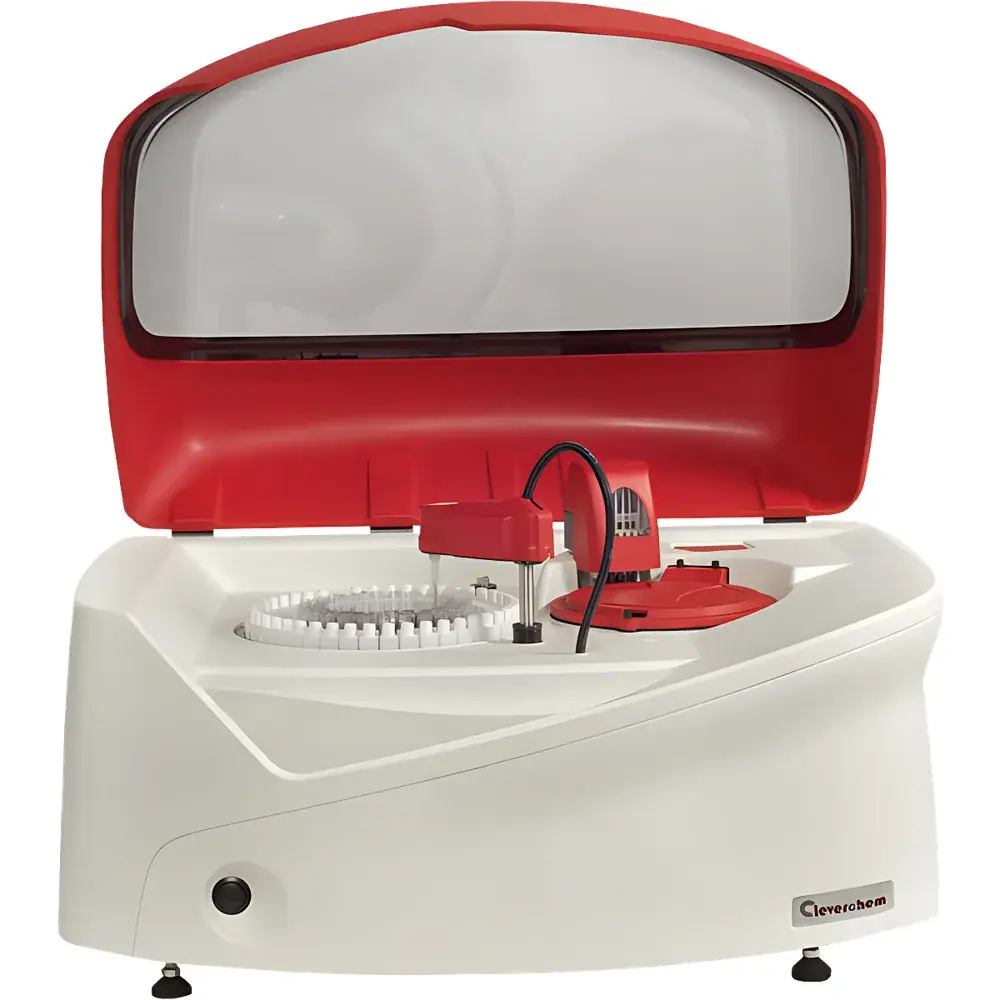
DeChem-Tech Cleverchem Anna Automated Discrete Analyzer
| Brand | DeChem-Tech |
|---|---|
| Origin | Germany |
| Product Type | Discrete Analyzer |
| Wavelength Range | 400–900 nm |
| Sample Volume per Vial | 5 mL |
| Reagent Positions | 49 |
| Cuvette Path Length | 10 mm |
| Light Source | Tungsten-Halogen Lamp |
Overview
The DeChem-Tech Cleverchem Anna is a fully automated discrete analyzer engineered for high-precision, high-throughput colorimetric and photometric analysis in environmental, agricultural, food, clinical, and industrial laboratories. Unlike continuous flow or segmented flow systems, the Cleverchem Anna implements true discrete analysis—mimicking manual benchtop methodology by dispensing precise microliter volumes of sample, reagents, and chromogenic agents into individual quartz cuvettes. Each reaction proceeds under controlled timing and temperature conditions, followed by photometric measurement at user-selectable wavelengths (400–900 nm) using a stable tungsten-halogen light source and precision optical detection. The system’s core architecture adheres to the fundamental principles of Beer-Lambert law-based quantification, where analyte concentration is linearly proportional to absorbance measured after complete color development. Designed for regulatory-compliant workflows, it supports method validation per ISO 8466-1, ASTM D3557, EPA 365.2, and USP , making it suitable for GLP and routine QC environments requiring traceable, auditable results.
Key Features
- Discrete analysis platform with 49-position sample carousel and 49 independent reagent positions—enabling simultaneous multi-parameter assays without cross-contamination;
- High-speed throughput: up to 200 determinations per hour across configurable assay protocols;
- Reusability-engineered 64-position quartz cuvette rotor with 10-mm optical path length and automated 7-step cleaning cycle—including acid wash, deionized water rinse, air-dry, and post-cleaning photometric verification prior to reuse;
- Micro-volume operation: typical sample and reagent consumption in the 10–200 µL range, minimizing reagent costs and hazardous waste generation;
- Integrated refrigerated reagent compartment (optional activation) maintaining reagents at 4–8 °C to ensure stability of temperature-sensitive chemistries;
- Sealed waste collection system with liquid-level sensing and vapor containment—designed to meet OSHA HAZCOM and EU CLP requirements for operator safety and secondary environmental protection;
- True blank correction capability: software-supported sample blank and reagent blank subtraction to eliminate matrix interference and background chromogenic effects;
- USB 2.0 interface for direct connection to laboratory PCs; compatible with Windows-based control and data acquisition software supporting audit trail, electronic signatures, and 21 CFR Part 11 compliance modules.
Sample Compatibility & Compliance
The Cleverchem Anna accepts liquid samples across diverse matrices—including aqueous environmental extracts (seawater, wastewater, drinking water), soil leachates, plant digests, fertilizer solutions, food homogenates, tobacco extracts, and fermented beverages—without requiring physical filtration in most standard applications. Its open method architecture allows implementation of over 120 validated standard methods from APHA, ISO, DIN, ASTM, and EPA compendia. Instrument qualification includes IQ/OQ documentation packages aligned with ISO/IEC 17025:2017 and GxP laboratory requirements. All optical and fluidic subsystems are calibrated using NIST-traceable standards, and performance verification is supported via daily photometric checks, carryover testing, and linearity assessment across defined dynamic ranges.
Software & Data Management
The included Cleverchem Control Software (v5.x) provides intuitive graphical workflow design, real-time monitoring of aspiration, mixing, incubation, and measurement steps, and integrated calibration curve generation using linear, quadratic, or log-log regression models. Raw absorbance data, peak kinetics, and error flags are stored in structured SQLite databases with timestamped metadata. Export options include CSV, PDF analytical reports, and XML for LIMS integration. Audit trail functionality logs all user actions—including method edits, calibration updates, and result overrides—with immutable timestamps and operator ID attribution. Optional 21 CFR Part 11 add-on enables role-based access control, electronic signature enforcement, and secure archival of raw instrument files for FDA-regulated environments.
Applications
- Water & Wastewater: Total nitrogen (TN), total phosphorus (TP), ammonia-N, nitrate-N, nitrite-N, orthophosphate, silicate, sulfate, sulfide, chloride, hexavalent chromium, acidity, alkalinity, hardness, Fe, Mn, Al, Cu, Zn, Mg, cyanide, phenols;
- Soil & Plant Tissue: Ammonium-N, nitrate-N, nitrite-N, orthophosphate, available N/P/K, boron, total N/P, sulfate, chloride, alkalinity;
- Fertilizers: NH₄⁺-N, NO₃⁻-N, orthophosphate, soluble P₂O₅, sulfate, chloride, boron;
- Food & Beverage: TN, TP, SO₂, Cr(VI), cyanide, nitrate/nitrite, acidity, reducing sugars, organic acids (acetic, citric, lactic, malic);
- Tobacco & Fermentation Products: Nicotine, hydrogen cyanide, volatile alkaloids, total/reducing sugars, nitrate, phosphate, sulfate.
FAQ
What distinguishes discrete analysis from flow injection or segmented flow methods?
Discrete analysis isolates each sample-reagent reaction in a dedicated cuvette, eliminating memory effects and enabling flexible, non-sequential assay scheduling—critical for heterogeneous sample batches and multi-analyte panels.
Can the Cleverchem Anna be validated for ISO 17025 accreditation?
Yes—the system supports full method validation (specificity, linearity, LOD/LOQ, precision, accuracy, robustness) and provides IQ/OQ documentation templates compliant with ILAC-G8 and EURACHEM guidelines.
Is reagent refrigeration mandatory?
No—refrigeration is optional and programmable per reagent channel; it is recommended only for unstable reagents such as diazotization mixtures or enzymatic kits.
How is carryover controlled between samples?
Through the 7-step cuvette cleaning protocol, combined with air-gap aspiration, probe rinsing in dual solvent stations, and real-time photometric cuvette verification before reuse.
Does the software support custom method development?
Yes—users can define custom reaction sequences, incubation times, wavelength selections, and calibration models without vendor assistance or firmware modification.
Related Products




