
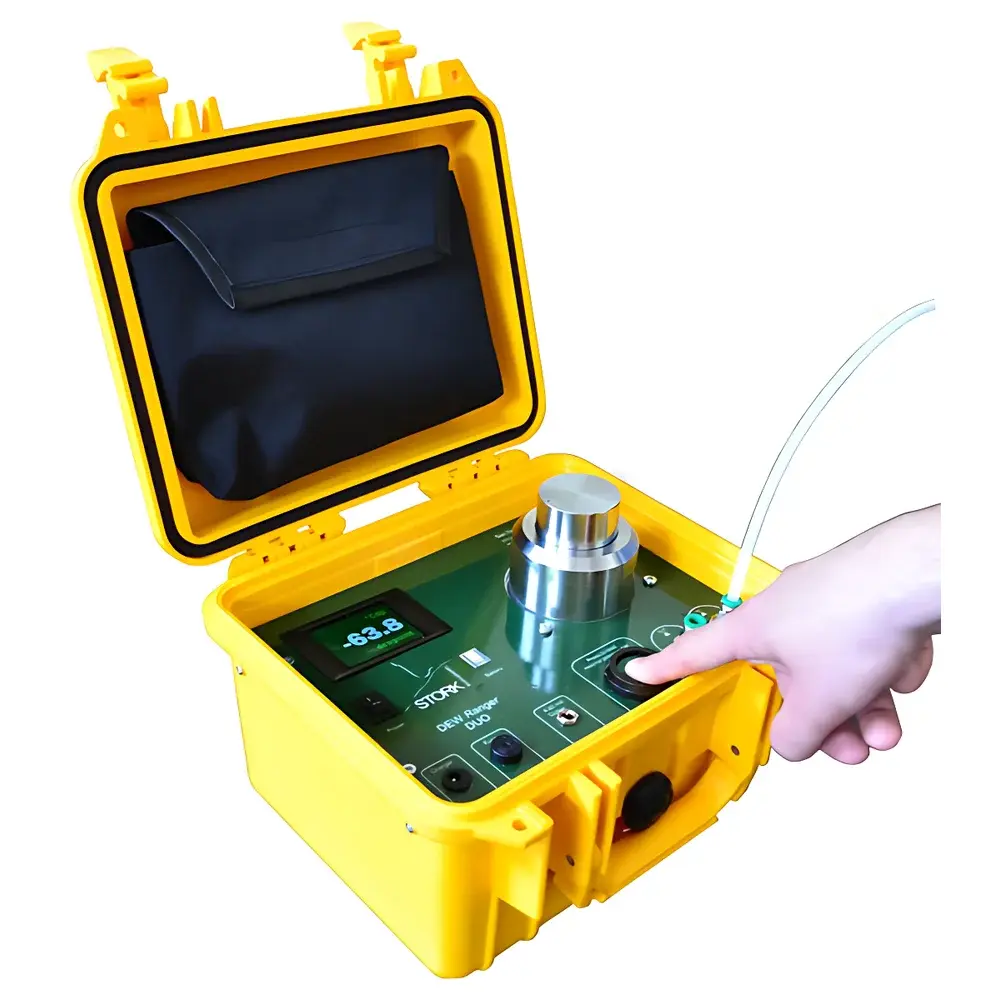
DewRanger DUO Portable Dew Point Meter
| Origin | Poland |
|---|---|
| Manufacturer Type | Authorized Distributor |
| Origin Category | Imported Instrument |
| Model | DEWRanger DUO |
| Product Type | Portable Dew Point Meter |
| Measurement Principle | Dual-Ceramic Nanofilm Capacitive Sensor |
| Operating Temperature | −20 °C to +50 °C |
| Accuracy | ±2 °C |
| Repeatability | 0.5 °C |
| Dew Point Range | −100 °C to +20 °C |
| Flow Rate | 1–5 L/min |
| Gas Connection | 6 mm Push-to-Connect Fitting |
| Tubing | 6 mm PTFE |
| Max Operating Pressure | 3 MPa (Swagelok-compatible) |
| Display | Backlit LCD |
| Output | 4–20 mA Analog |
| Power Supply | Rechargeable Li-ion Battery |
| Enclosure | Yellow Polypropylene Housing |
| IP Rating | IP67 |
| Calibration Certificate | Traceable to NIST/PTB Standards |
| Dimensions (W×H×D) | 270 × 174 × 246 mm |
| Weight | 4.4 kg |
Overview
The DewRanger DUO Portable Dew Point Meter is an industrial-grade, field-deployable moisture analyzer engineered for high-reliability dew point measurement in compressed gases and process streams. Utilizing dual-ceramic nanofilm capacitive sensing technology, it delivers stable, low-drift detection across an extended range of −100 °C to +20 °C dew point — a critical capability for verifying gas dryness in applications where trace moisture compromises system integrity or product quality. Unlike chilled-mirror or aluminum oxide sensors, the DewRanger DUO’s ceramic nanofilm architecture provides inherent resistance to contamination, condensation hysteresis, and chemical interference from hydrocarbons, CO₂, or acidic species commonly encountered in natural gas processing, specialty gas distribution, and cleanroom nitrogen supply lines. Its compact, ruggedized design supports direct on-line monitoring without external power sources or conditioning hardware, enabling rapid verification during commissioning, maintenance shutdowns, or routine QA/QC audits.
Key Features
- Extended dew point measurement range: −100 °C to +20 °C DP, validated per ISO 8573-3 and ASTM D6304 Annex B protocols
- Dual-ceramic nanofilm sensor with integrated temperature compensation — eliminates need for external ambient probes or manual correction tables
- True portable operation: fully self-contained with rechargeable lithium-ion battery supporting >12 hours continuous measurement at 2 L/min flow
- IP67-rated polypropylene enclosure with ergonomic carry handle and shock-absorbing corners — certified for outdoor use, offshore platforms, and unheated industrial environments
- Real-time analog output (4–20 mA) with linear scaling configurable via onboard menu; compatible with PLCs, SCADA systems, and distributed control networks
- Quick-connect 6 mm push-fit gas interface and pre-attached PTFE tubing minimize installation time and eliminate leakage-prone threaded fittings
- Backlit graphical LCD with intuitive icon-driven navigation and simultaneous display of dew point, process temperature, and battery status
Sample Compatibility & Compliance
The DewRanger DUO is validated for use with non-corrosive, non-particulate gas matrices including compressed air, nitrogen, argon, helium, hydrogen, natural gas (dry), and instrument-grade SF₆. It complies with ISO 8573-1 Class 0–4 purity requirements for compressed air and meets the sampling interface specifications outlined in ISO 8573-3:2019 for dew point instrumentation. All units ship with a manufacturer-issued calibration certificate traceable to national metrology institutes (NIST and PTB), satisfying audit requirements under ISO/IEC 17025, FDA 21 CFR Part 11 (when used with compliant data logging), and EU GMP Annex 15. The sensor housing and gas path are inert to moisture adsorption, ensuring measurement stability during repeated exposure to saturated or sub-zero dew point conditions.
Software & Data Management
While the DewRanger DUO operates autonomously without software dependency, optional PC configuration utility (Windows/macOS) enables firmware updates, calibration offset adjustment, and output scaling configuration. Logged measurement sessions — including timestamped dew point, temperature, pressure (via optional external transducer), and battery voltage — can be exported as CSV for integration into LIMS or statistical process control (SPC) platforms. Audit trails are maintained locally in non-volatile memory, supporting GLP/GMP traceability. The device stores up to 10,000 measurement records with automatic overwrite protection and user-defined session tagging.
Applications
- Verification of dryer performance in petrochemical and refinery off-gas treatment systems
- Pre-commissioning moisture validation in LNG transfer lines and cryogenic storage vessels
- QA release testing of medical oxygen and surgical nitrogen per ISO 8573-1 and EN 13544-1
- Monitoring purge gas dryness in semiconductor fab tool chambers and vacuum pump forelines
- Field validation of desiccant and membrane dryer efficiency in aerospace ground support equipment
- Moisture surveillance in nuclear power plant instrument air networks per IEEE 323 and ASME NQA-1
FAQ
What calibration standards are used for factory certification?
Each DewRanger DUO is calibrated against primary reference standards traceable to NIST SRM 2810 (dew point generator) and PTB’s humidity reference chamber, with uncertainty budgets documented per ISO/IEC 17025.
Can the sensor be cleaned in situ if exposed to oil mist?
The dual-ceramic nanofilm sensor is inherently oil-resistant; however, persistent hydrocarbon loading requires solvent rinse with isopropanol followed by 30-minute dry purge at 5 L/min — full recovery verified via two-point check at −40 °C and −70 °C DP.
Is the 4–20 mA output intrinsically safe for Zone 1 hazardous areas?
No — the DewRanger DUO is not ATEX or IECEx certified. For hazardous area deployment, it must be installed outside the classified zone with signal routed through approved isolators or barriers.
How often is recalibration recommended under routine industrial use?
Annual recalibration is advised for QC-critical applications; biannual verification is sufficient for non-regulated monitoring when supported by daily zero checks using dry nitrogen.
Does the instrument compensate for pressure variations during measurement?
Yes — the internal algorithm applies real-time pressure correction using the ideal gas law, provided operating pressure remains within the specified 0.1–3 MPa range and is stable within ±0.05 MPa during sampling.



