
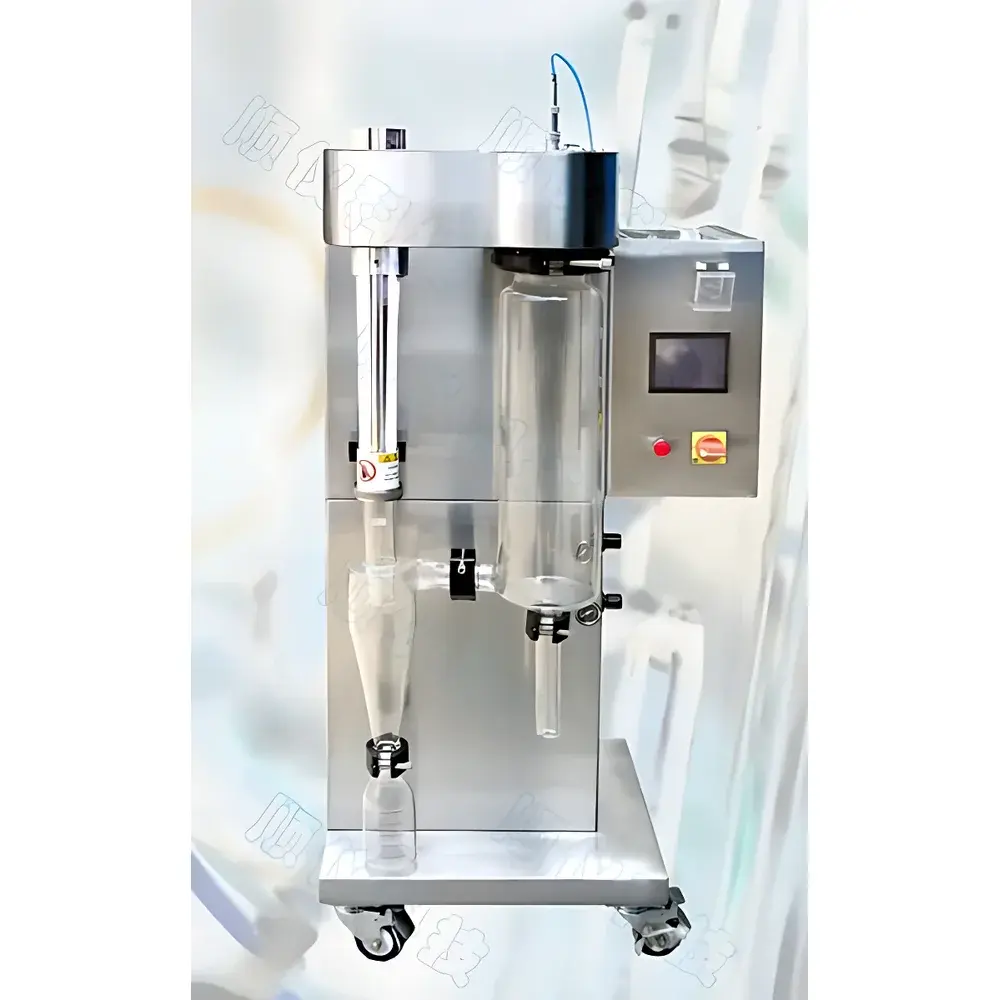
SUNYITECH SP-1500 Benchtop Spray Dryer
| Origin | Shanghai, China |
|---|---|
| Manufacturer Type | Authorized Distributor |
| Origin Category | Domestic (China) |
| Model | SP-1500 |
| Pricing | Upon Request |
| Evaporation Capacity | 1500 mL/h |
| Inlet Air Temperature Range | 30–280 °C |
| Outlet Air Temperature Range | 30–120 °C |
| Temperature Control Accuracy | ±1 °C |
| Drying Residence Time | 1.0–1.5 s |
| Feed Rate (Peristaltic Pump) | 30–2000 mL/h |
| Air Flow Rate | 0–330 m³/h (Max), 686 Pa Max Static Pressure |
| Compressor Output | 4.2 m³/h @ 2–5 bar, 0.2 kW |
| Two-Fluid Nozzle Standard Orifice | 0.75 mm (Optional: 0.5–2.0 mm) |
| Jet Cleaner (Needle Clearing System) | Adjustable Frequency, Internal 2.3 bar Air Supply |
| Power Supply | 3.5 kW, AC 220/240 V, 50/60 Hz, 13 A |
| Dimensions (L×W×H) | 650 × 500 × 1550 mm |
| Net Weight | 120 kg |
| Noise Level | <50 dB(A) |
| Glass Construction | High-Borosilicate, Heat-Resistant, Transparent |
| Control Interface | Color LCD Touchscreen, Bilingual (English/Chinese), PID-Based Real-Time Temperature Regulation |
| Air Intake Filtration | Integrated HEPA-Class Pre-Filter |
| Safety Interlock | Heater activation disabled unless blower is operational |
Overview
The SUNYITECH SP-1500 Benchtop Spray Dryer is a self-contained, laboratory-scale spray drying system engineered for reproducible, scalable powder synthesis from liquid feedstocks—including aqueous solutions, organic solvents, suspensions, and emulsions. Operating on the principle of rapid solvent evaporation via concurrent-flow atomization, the SP-1500 introduces feed material into a heated, high-velocity airstream using a two-fluid nozzle. Within 1.0–1.5 seconds, droplets undergo complete surface drying and form free-flowing microspheres or amorphous particles—enabling direct transition from solution to dry powder without intermediate lyophilization or vacuum drying steps. Its compact footprint (650 × 500 × 1550 mm) and integrated design eliminate dependency on external compressed air sources, chillers, or exhaust ducting, making it suitable for ISO Class 7 clean benches, fume hoods, and regulated R&D laboratories requiring GLP-compliant documentation.
Key Features
- Full-color 7-inch LCD touchscreen interface with bilingual (English/Chinese) navigation, supporting both fully automated PID-controlled operation and manual parameter override for method development.
- Precision temperature regulation: inlet air temperature stability maintained within ±1 °C across the full 30–280 °C range, critical for thermolabile compounds such as proteins, peptides, and polymer nanoparticles.
- Optically transparent high-borosilicate glass drying chamber, cyclone separator, and collection vessel—enabling real-time visual monitoring of atomization behavior, wall deposition, and powder formation dynamics.
- Two-fluid (air-assisted) nozzle assembly fabricated from ASTM A276 Grade 316 stainless steel; standard 0.75 mm orifice with optional 0.5–2.0 mm configurations to tune droplet Sauter mean diameter (SMD) and final particle size distribution.
- Automated jet-cleaning system (“needle clearing”) with user-adjustable frequency and internal 2.3 bar compressed air supply—prevents nozzle clogging during prolonged runs with viscous or particulate-laden feeds.
- Peristaltic feed pump calibrated for low-volume processing (minimum 30 mL feed volume), supporting early-stage formulation screening with limited API or biopolymer stock.
- Integrated oil-free scroll compressor (4.2 m³/h @ 2–5 bar) and HEPA-class inlet air filtration—ensuring consistent atomizing gas quality and minimizing sample contamination risk.
- Hardware-level safety interlocks: heating elements remain de-energized until blower achieves rated airflow, preventing thermal runaway and glass fracture.
Sample Compatibility & Compliance
The SP-1500 accommodates a broad spectrum of feed materials: water-based colloids (e.g., silica sols, chitosan hydrogels), organic-phase precursors (e.g., PLGA in dichloromethane), protein-containing buffers (e.g., BSA in PBS), and nanoemulsions stabilized by nonionic surfactants. All wetted surfaces contacting process air or feed are constructed from USP Class VI-certified borosilicate glass or electropolished 316 stainless steel—meeting extractables/leachables requirements per USP and ISO 10993-12. The system supports audit-ready operation under GLP and GMP environments when paired with validated SOPs; its digital control log retains timestamped records of all setpoints, actual temperatures, airflow rates, and run durations—facilitating 21 CFR Part 11 compliance when deployed with compliant electronic signature workflows.
Software & Data Management
Embedded SUNYITECH temperature and flow control firmware provides continuous logging of up to 10,000 data points per run, exportable via USB to CSV format. Parameter history—including inlet/outlet temperatures, feed rate, and blower RPM—is time-synchronized and traceable to individual batch IDs. Optional Ethernet connectivity enables remote monitoring and integration into centralized LIMS or MES platforms. All firmware updates are delivered via signed binary packages with SHA-256 checksum verification to ensure integrity and regulatory defensibility.
Applications
- Pharmaceutical solid dosage development: preparation of inhalable dry powders, amorphous solid dispersions, and excipient-coated nanocrystals.
- Food science: encapsulation of probiotics, flavors, and omega-3 oils into matrix-protected microparticles.
- Materials research: synthesis of battery cathode precursors (e.g., NMC, LFP), catalyst supports, and metal oxide nanoparticles.
- Academic labs: teaching unit operations in chemical engineering curricula, including mass transfer, heat transfer, and particle formation kinetics.
- Biotechnology: gentle drying of labile enzymes, monoclonal antibodies, and viral vectors while preserving conformational integrity.
FAQ
What is the minimum feed volume required for a valid run?
The system supports reliable operation with as little as 30 mL of feed solution when using the low-flow peristaltic pump configuration.
Can the SP-1500 handle organic solvents safely?
Yes—when operated inside a certified explosion-proof fume hood and configured with nitrogen inerting (optional retrofit), it complies with OSHA 1910.106 and ATEX Zone 2 guidelines for Class I, Division 1 solvent handling.
Is the glassware autoclavable?
All borosilicate components are rated for repeated autoclaving at 121 °C / 15 psi; however, thermal shock must be avoided during cooldown to prevent microfracture.
Does the system meet ISO 22000 or FDA food-grade requirements?
While not certified as a food-grade production line, its material compatibility, cleanability, and documentation capabilities align with prerequisite programs under ISO 22000 and FDA Food Safety Modernization Act (FSMA) preventive controls.
How is particle size distribution controlled?
Primary control variables include nozzle orifice diameter, feed concentration, inlet temperature, and atomizing gas pressure—each influencing droplet size, drying kinetics, and final morphology per the classic Friedlander nucleation model.



