
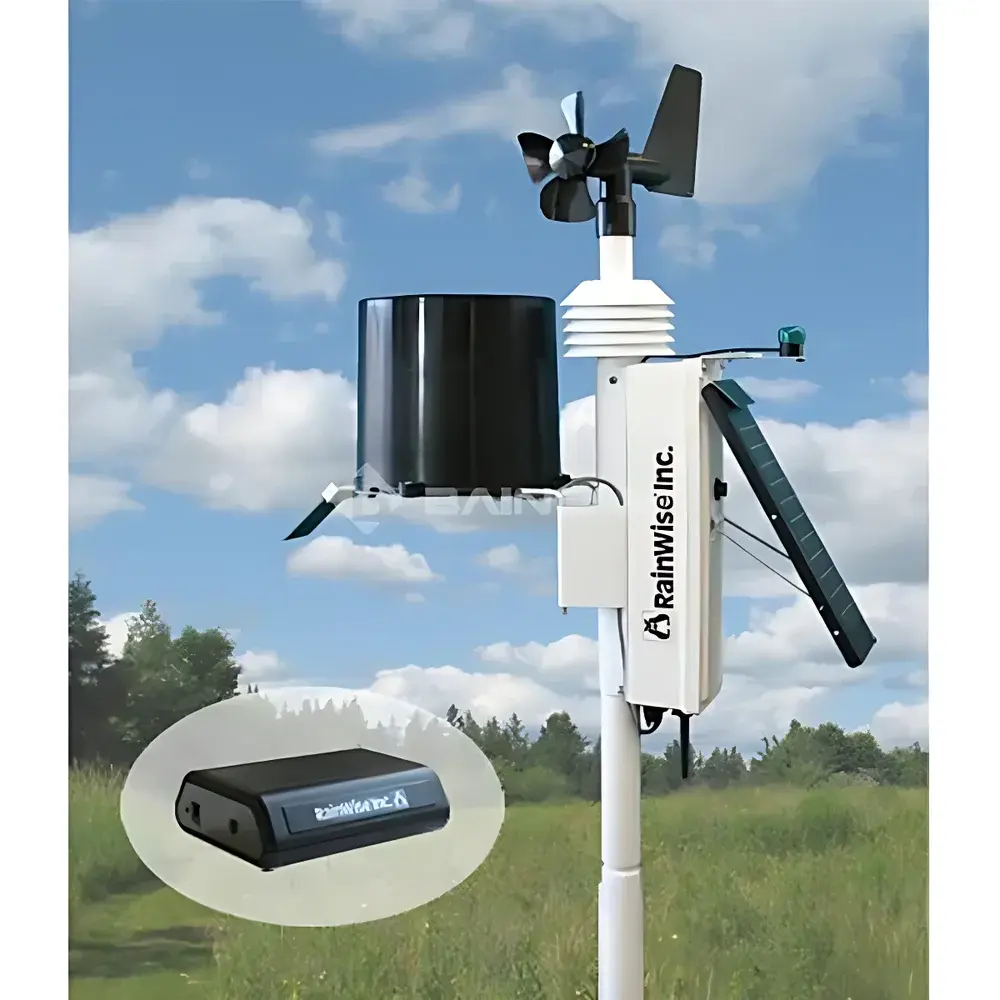
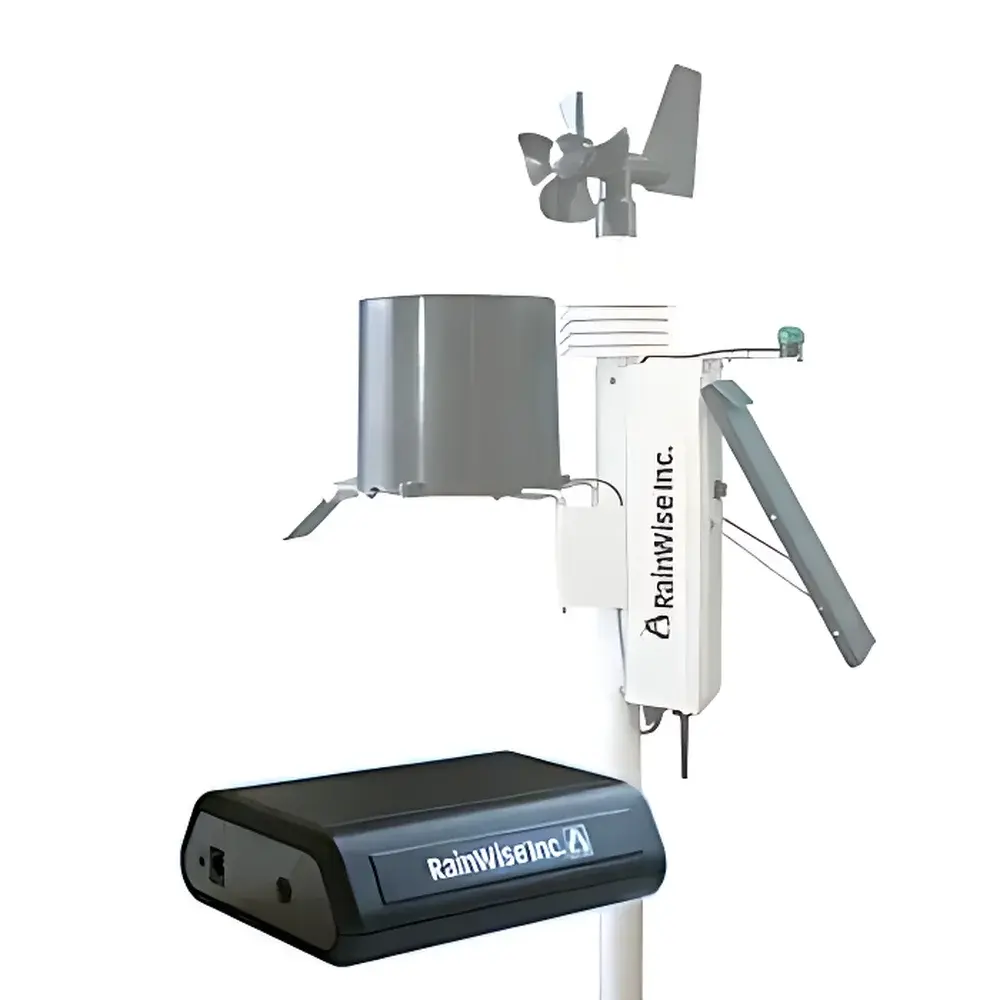
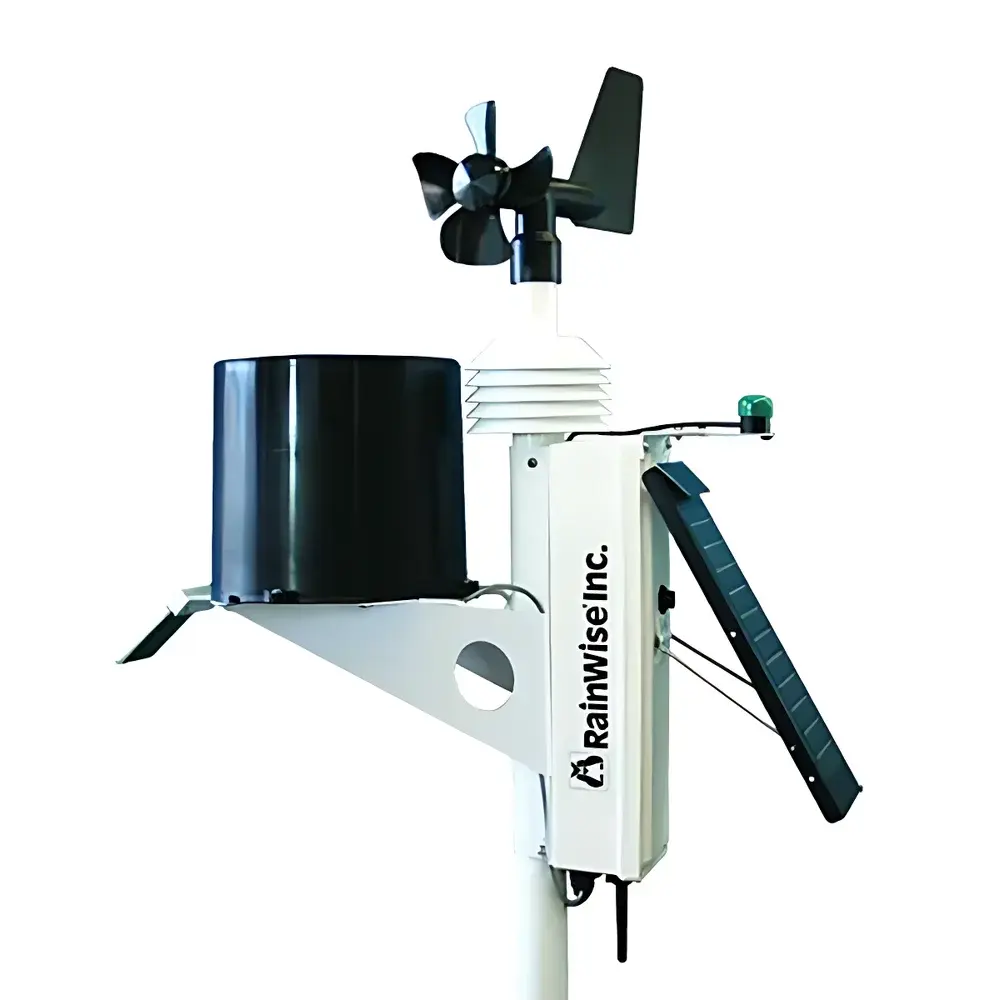
RainWise AgroMET Wireless Agricultural Weather Station
| Brand | RainWise |
|---|---|
| Origin | USA |
| Model | AgroMET |
| Instrument Type | Portable Weather Station |
| Communication | 2.4 GHz Spread-Spectrum Radio (up to 1.6 km line-of-sight) |
| Data Transmission | IP-100 Gateway → RainWiseNet™ Cloud Platform |
| Power | Integrated Solar Panel + Rechargeable Battery (60-day autonomy in darkness) |
| Calibration Traceability | NIST-traceable for Wind, Temp/RH, Barometric Pressure |
| Enclosure Materials | Stainless Steel, Fiberglass, UV-stabilized PVC |
| Height | 83 cm |
| Weight | 3.2 kg |
| Sensor Suite | Anemometer, Wind Vane, Thermistor & Capacitive RH Sensor (in NWS-style radiation-shielded ventilated radiation shield), Tipping-Bucket Rain Gauge, Leaf Wetness Sensor, Pyranometer (Solar Radiation) |
Overview
The RainWise AgroMET Wireless Agricultural Weather Station is a purpose-built, NIST-traceably calibrated environmental monitoring system engineered for precision agriculture, horticultural research, and integrated pest management (IPM) applications. Operating on fundamental meteorological measurement principles—including cup-and-vane anemometry for wind speed/direction, capacitive relative humidity sensing with passive aspirated ventilation per NOAA/NWS design standards, thermistor-based temperature measurement, tipping-bucket precipitation accumulation, leaf surface capacitance for wetness duration, and silicon photodiode-based pyranometry for global solar irradiance—the AgroMET delivers scientifically valid, field-deployable data without dependency on local computing infrastructure. Its architecture eliminates wired sensor interconnects to mitigate lightning-induced surge risks, while the integrated 2.4 GHz spread-spectrum radio ensures robust, low-latency telemetry (2-second wind update rate) between the station and the IP-100 gateway—enabling real-time decision support for irrigation scheduling, fungicide application timing, frost prediction, and evapotranspiration modeling.
Key Features
- Self-sustaining power architecture: Monocrystalline solar panel rated for operation at latitudes ≤60°N/S; maintains full functionality for ≥60 days under continuous darkness via sealed rechargeable battery.
- NIST-traceable calibration for critical parameters: Wind speed/direction sensors, temperature/humidity modules, and barometric pressure transducers are factory-calibrated against National Institute of Standards and Technology reference standards.
- Passive radiation shielding: Temperature and relative humidity sensors housed in a ventilated, double-louvered radiation shield modeled after the U.S. National Weather Service (NWS) standard design—ensuring minimal solar loading error and high thermal equilibrium stability.
- Lightning-resilient topology: Wireless sensor-to-gateway architecture eliminates conductive paths; all sensors incorporate transient voltage suppression (TVS) diodes for overvoltage protection.
- Field-proven durability: Structural components fabricated from marine-grade stainless steel, fiberglass-reinforced polymer, and UV-stabilized PVC—certified for continuous outdoor exposure across USDA Plant Hardiness Zones 1–13.
- Modular expandability: Compatible with CC-3000 data logger (USB 2.0/RS-232 interface, 2 MB flash memory, internal temperature sensor, embedded wireless receiver) and optional Weather Oracle display unit with adjustable brightness, multi-parameter visualization, and wall/table mounting options.
Sample Compatibility & Compliance
The AgroMET is designed for deployment in open-field agriculture, orchards, vineyards, greenhouses, and university agricultural extension sites. Its compact footprint (83 cm height, 3.2 kg mass) enables rapid installation on MK-III Mono mounting brackets—adaptable to flat roofs, sloped surfaces, or vertical walls without structural modification. All electronic assemblies comply with FCC Part 15 Subpart C (unlicensed 2.4 GHz ISM band operation) and IEC 60529 IP65 ingress protection rating. Sensor outputs adhere to WMO Guide to Instruments and Methods of Observation (CIMO Guide, 2022 edition) specifications for agricultural microclimate monitoring. Data integrity protocols meet GLP-aligned audit requirements, with timestamped, immutable records archived on RainWiseNet™—a cloud platform supporting ISO/IEC 27001-certified data storage and access controls.
Software & Data Management
Data acquisition and visualization are managed through three interoperable layers: (1) The IP-100 Ethernet gateway establishes secure TLS 1.2–encrypted communication with RainWiseNet™, enabling automatic upload of time-synchronized measurements (1-minute resolution default) with no manual intervention; (2) Weatherview32 software—provided in Home (free with CC-3000) and Professional editions—offers local archival, graphical trend analysis, METAR/SAT imagery integration, email/SMS alerting, and HTML export for regulatory reporting; (3) RainWiseNet™ portal supports role-based user access, historical data querying (≥10 years retention), API-driven integration with farm management information systems (FMIS), and compliance-ready audit logs per FDA 21 CFR Part 11 requirements for electronic records and signatures.
Applications
- Irrigation scheduling optimization via real-time ETo calculation using ASCE-standardized Penman-Monteith equations.
- Pesticide and fungicide application windows determined by leaf wetness duration, dew point depression, and relative humidity thresholds.
- Frost risk assessment through near-surface temperature gradients and inversion layer detection.
- Yield modeling inputs for crop simulation platforms (e.g., DSSAT, APSIM) requiring sub-daily meteorological forcing data.
- Validation of mesoscale numerical weather prediction (NWP) model output at field scale.
- Long-term climate trend analysis for USDA NRCS Conservation Planning and USDA Risk Management Agency (RMA) crop insurance verification.
FAQ
Is the AgroMET compatible with third-party farm management software?
Yes—RainWiseNet™ provides RESTful APIs supporting JSON/XML data exchange with major FMIS platforms including Climate FieldView, Granular, and FarmLogs.
What is the maximum operational altitude for the AgroMET?
The station is validated for continuous operation from sea level to 3,000 m elevation; barometric pressure sensor includes digital offset adjustment for site-specific altitude compensation.
Does the system support dual-unit display (metric/imperial)?
Weatherview32 and Weather Oracle both allow per-parameter unit selection (°C/°F, mm/in, kPa/inHg) with configurable default preferences.
How is data security ensured during cloud transmission?
All IP-100 to RainWiseNet™ communications use AES-256 encryption and certificate-pinned TLS 1.2 handshakes; stored data resides in SOC 2 Type II–audited AWS infrastructure.
Can the AgroMET be deployed in coastal environments with high salinity exposure?
Yes—stainless steel fasteners, fiberglass housing, and UV/PVC encapsulation meet ASTM B117 salt fog corrosion resistance standards for 5,000-hour exposure.
Related Products







