
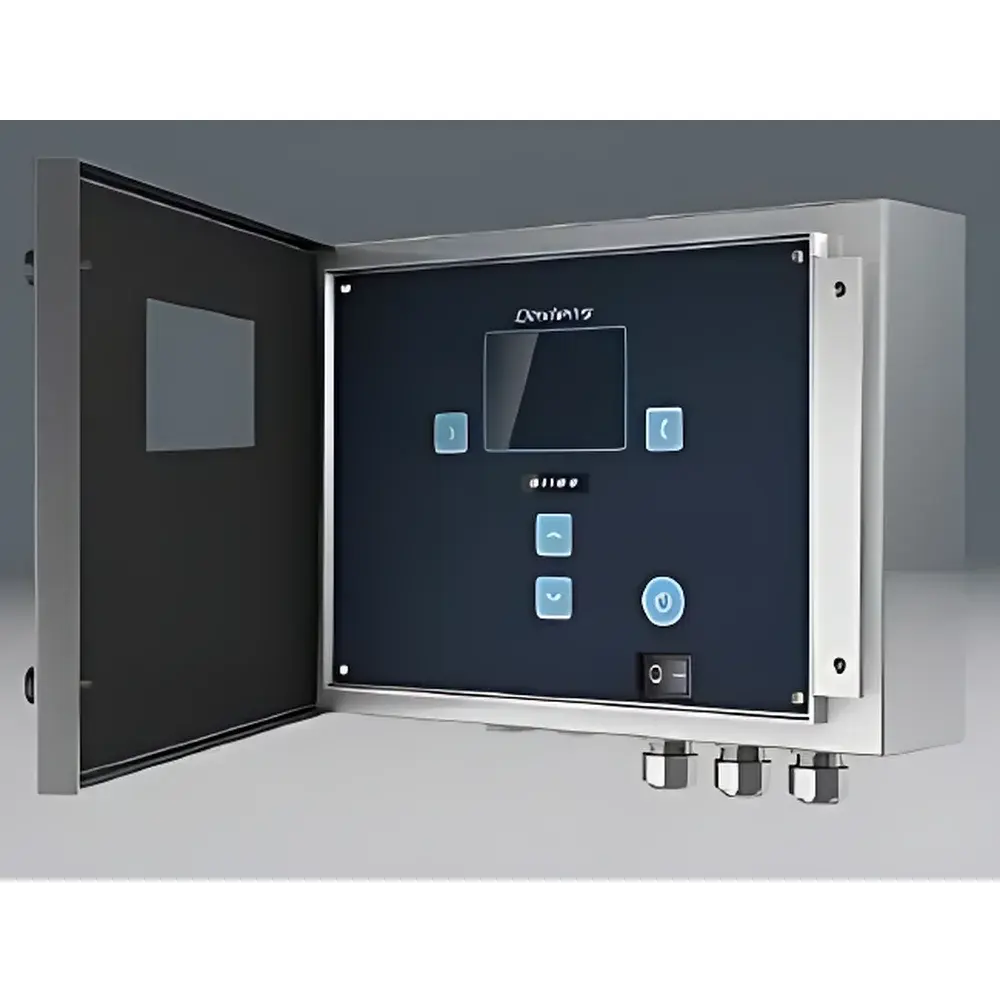
Dextens 61101 Online Dissolved Oxygen Analyzer
| Origin | Switzerland |
|---|---|
| Manufacturer Type | Authorized Distributor |
| Origin Category | Imported |
| Model | 61101 |
| Price Range | USD 11,000 – 13,800 (FOB) |
| Instrument Type | Online (Fixed-Installation) |
| Measurement Principle | Electrochemical Clark-type Polarographic Sensor |
| Measurement Range (Liquid) | 0.1 ppb – 200 ppm |
| Measurement Range (Gas) | 0.5 ppm(v/v) – 100% O₂ |
| Accuracy | ±1% of reading |
| Repeatability | ±0.05% of reading |
| Detection Limit | 2 ppb (liquid phase) |
| Power Supply | 85–230 VAC, 50/60 Hz |
| Power Consumption | ≤20 W |
| Operating Temperature | −5 °C to +50 °C |
| Enclosure Rating | Stainless Steel, IP65 / NEMA 4X |
| Weight | 3.0 kg |
| Dimensions | 230 mm × 180 mm × 75 mm |
| Display | Backlit LCD showing real-time DO concentration, temperature, timestamp, and membrane ID |
| Liquid Units | ppm, ppb, mg/L (resolution: 0.01 ppb) |
| Gas Units | % O₂, ppm(v/v), kPa (resolution: 0.01 ppm) |
| Membrane Kits | 82952, 82956, 82935 |
| Thermal Cut-off | Factory-set at +40 °C (adjustable via software) |
| Calibration | Single-point air calibration or direct zero/span calibration |
| Alarm Outputs | Dual configurable relay outputs (high/low or high/high |
| Communication | RS-232 and RS-485 (Modbus RTU protocol supported) |
| Sensor Compatibility | Dextens 51101 polarographic oxygen sensor |
Overview
The Dextens 61101 Online Dissolved Oxygen Analyzer is an industrial-grade, fixed-installation analytical instrument engineered for continuous, high-stability monitoring of dissolved oxygen (DO) in aqueous systems and trace oxygen in gas streams. Based on the Clark-type polarographic electrochemical principle, it employs a temperature-compensated, membrane-covered amperometric sensor—specifically the Dextens 51101 oxygen sensor—to generate a diffusion-limited current proportional to molecular oxygen concentration. Unlike portable meters, the 61101 is designed for permanent integration into process loops, wastewater treatment plants, pharmaceutical water systems (PW, WFI), bioreactors, and ultra-pure water distribution networks where regulatory compliance, long-term drift stability, and unattended operation are critical. Its measurement architecture supports both liquid-phase (0.1 ppb–200 ppm) and gas-phase (0.5 ppm–100% O₂) applications without hardware modification—enabling flexible deployment across hygienic, hazardous, or outdoor environments.
Key Features
- IP65/NEMA 4X stainless steel enclosure rated for harsh industrial and outdoor installations
- Real-time dual-parameter display: DO concentration and temperature with timestamped logging capability
- Configurable alarm relays (high/low or high/high) with dry-contact output (125 VAC / 20 VDC)
- Automatic range switching during calibration and measurement transitions
- Password-protected configuration interface prevents unauthorized changes to calibration, alarm thresholds, or system settings
- Intuitive front-panel membrane keypad with context-sensitive soft keys for rapid setup and diagnostics
- Thermal safety cutoff (factory default +40 °C, user-adjustable via embedded firmware)
- Low power consumption (≤20 W) compatible with standard 85–230 VAC, 50/60 Hz utility supply
- Support for interchangeable membrane cartridges (models 82952, 82956, 82935) optimized for specific matrix chemistries and fouling resistance
Sample Compatibility & Compliance
The 61101 analyzer accommodates a broad spectrum of sample matrices—including deionized water, reverse osmosis permeate, steam condensate, fermentation broth, municipal effluent, and compressed medical or instrument air. Its polarographic sensor design ensures minimal interference from common ions (Cl⁻, NO₃⁻, SO₄²⁻), pH shifts (pH 2–12), and low-conductivity media (<1 µS/cm). The system meets mechanical and environmental requirements of IEC 60529 (IP65), UL 50E (NEMA 4X), and EN 61000-6-2/-4 for electromagnetic compatibility. While not intrinsically safe, its enclosure permits use in non-classified zones adjacent to Class I Div 2 areas. For regulated industries, the instrument supports audit-ready calibration logs (with operator ID, timestamp, and deviation values) and complies with data integrity expectations aligned with FDA 21 CFR Part 11 when integrated with validated SCADA or LIMS platforms.
Software & Data Management
The embedded firmware provides full local control without PC dependency: calibration wizard, alarm threshold definition, unit selection (ppb/ppm/mg/L/%/kPa), and membrane life tracking. All configuration changes are logged with time stamps and require password authentication. Digital communication occurs via isolated RS-232 (for local diagnostics) and RS-485 (for multi-drop Modbus RTU networks), enabling seamless integration with PLCs, DCS, or centralized monitoring systems. Optional software tools support remote parameter backup, trend visualization over 30-day rolling buffers, and CSV export of calibrated measurement records. No proprietary drivers or cloud dependencies are required—data ownership remains fully on-site per ISO/IEC 27001-aligned infrastructure policies.
Applications
- Pharmaceutical water systems: Continuous verification of DO in purified water (PW) and water for injection (WFI) per USP and EU GMP Annex 1
- Biotechnology: Real-time dissolved oxygen control in mammalian and microbial bioreactors
- Power generation: Monitoring oxygen ingress in boiler feedwater and condensate return lines to prevent corrosion
- Municipal & industrial wastewater: Aeration basin optimization and effluent compliance reporting (e.g., EPA Method 360.1)
- Food & beverage: Sterile nitrogen blanketing verification and CIP rinse water quality assurance
- Electronics manufacturing: Ultra-high-purity rinse water monitoring for semiconductor wafer cleaning processes
FAQ
What sensor types are compatible with the 61101 analyzer?
The 61101 is exclusively designed for use with the Dextens 51101 polarographic oxygen sensor, which features replaceable membrane cartridges (82952, 82956, 82935) and electrolyte-filled cathode/anode chambers.
Can the instrument perform automatic temperature compensation?
Yes—integrated Pt1000 RTD input enables real-time, algorithmic temperature compensation across the full operating range (−5 °C to +50 °C), eliminating manual correction factors.
Is multi-point calibration supported?
The firmware supports single-point air-saturation calibration and direct zero/span calibration using certified gas standards; multi-point linearization is not implemented due to inherent linearity of the polarographic response within specified ranges.
How is data integrity ensured during extended unattended operation?
All calibration events, alarm triggers, and configuration changes are time-stamped and stored in non-volatile memory with write-protection; external data logging requires RS-485 connection to a validated historian system.
Does the analyzer meet GLP or GMP documentation requirements?
When deployed with controlled access, change management procedures, and electronic signature-enabled host systems, the 61101 satisfies core ALCOA+ principles (Attributable, Legible, Contemporaneous, Original, Accurate) as part of a broader validated environment.







