
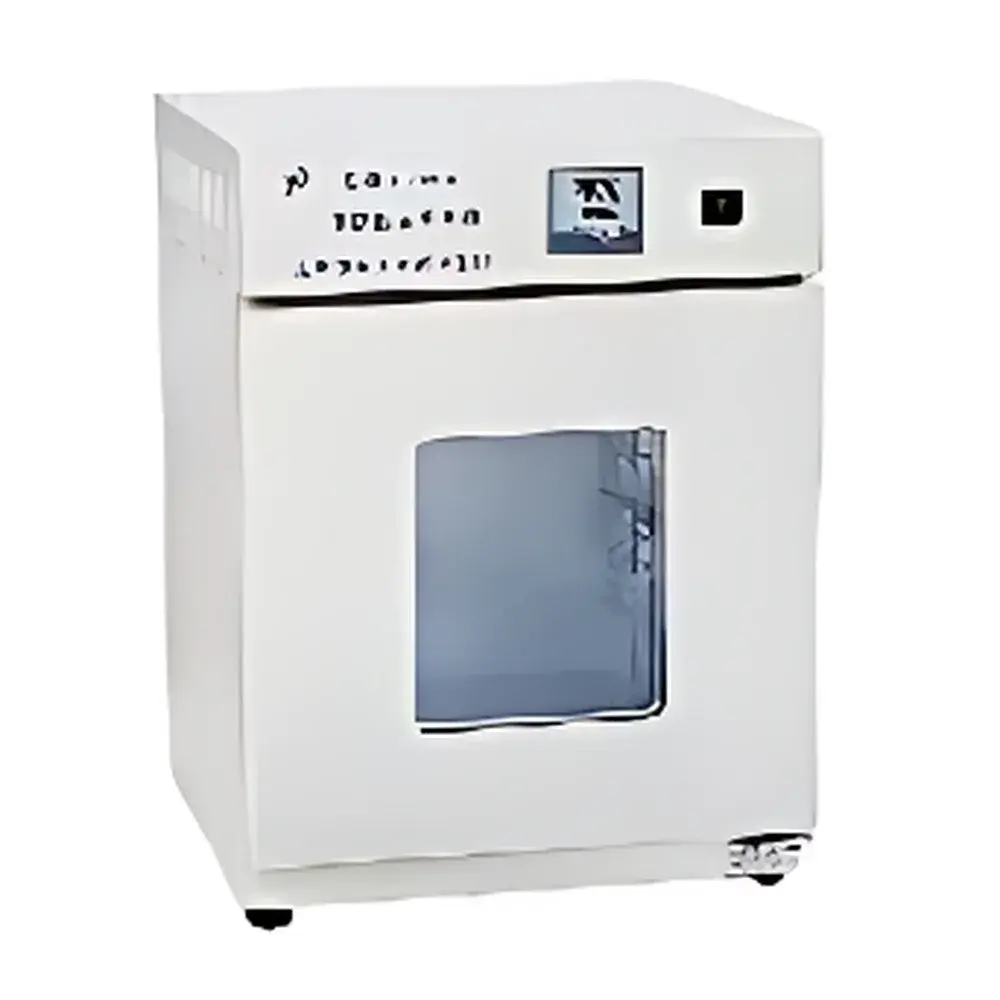
DHP-500BS Electric Constant Temperature Incubator with Stainless Steel Interior Chamber
| Origin | Shanghai, China |
|---|---|
| Manufacturer Type | Authorized Distributor |
| Country of Origin | China |
| Model | DHP-500BS |
| Power Supply | 220 V AC, 500 W |
| Internal Chamber Dimensions (W×D×H) | 500 × 500 × 600 mm |
| External Dimensions (W×D×H) | 600 × 685 × 950 mm |
| Price | USD 570 (FOB Shanghai) |
Overview
The DHP-500BS Electric Constant Temperature Incubator is an entry-level, convection-heated laboratory incubator engineered for stable thermal environments in microbiological, biochemical, and cell culture applications. It operates on resistive heating elements combined with a forced-air micro-circulation system to maintain uniform temperature distribution across its stainless steel interior chamber—critical for reproducible microbial growth, enzyme activity assays, and short-term cell maintenance. Unlike natural convection models, the DHP-500BS incorporates a low-turbulence fan-assisted airflow design that minimizes vibration transfer and reduces thermal stratification, achieving ±0.5 °C temperature uniformity (measured per ASTM E145–22 Annex A3) at setpoints between 5 °C above ambient and 65 °C. The unit is not designed for CO₂ control, humidity regulation, or sterile operation; it serves strictly as a dry, non-sterile, temperature-stabilized environment for routine cultivation and incubation protocols.
Key Features
- Stainless steel interior chamber (AISI 304 grade) — corrosion-resistant, non-porous, and compliant with ISO 13485 cleaning validation requirements for reusable lab equipment;
- Dual-layer tempered glass observation window integrated into the front door — provides optical clarity without compromising thermal insulation or structural integrity;
- High-efficiency silicone rubber gasket sealing system — ensures consistent door closure force and maintains chamber integrity during extended operation cycles;
- Microprocessor-based PID temperature controller with digital LED display — enables setpoint resolution of 0.1 °C and real-time deviation monitoring;
- Over-temperature safety cut-off (independent mechanical thermostat) — automatically de-energizes heating circuit if internal temperature exceeds user-defined limit by >3 °C;
- Front-accessible air inlet and rear-mounted exhaust vent — supports passive ventilation alignment with laboratory HVAC constraints.
Sample Compatibility & Compliance
The DHP-500BS accommodates standard laboratory vessels including Petri dishes (up to 150 mm diameter), test tubes (16–25 mm OD), multi-well plates (6–96-well), and Erlenmeyer flasks (up to 2 L). Its chamber geometry permits stacking of up to three full-size wire shelves (included), each rated for 15 kg static load. The unit complies with IEC 61010-1:2010 for electrical safety in laboratory equipment and meets EMC requirements per CISPR 11 Group 1, Class B. While not certified for GLP/GMP production environments, its construction and control architecture support audit-ready documentation under ISO/IEC 17025-accredited testing laboratories when operated within defined SOPs. No built-in data logging or 21 CFR Part 11 compliance features are included.
Software & Data Management
The DHP-500BS operates as a standalone analog-digital hybrid instrument with no embedded firmware update capability or network interface. Temperature setpoints and current readings are displayed locally via a 4-digit LED panel; no remote monitoring, USB export, or PC connectivity is supported. Users requiring traceable temperature records must employ external calibrated data loggers (e.g., compliant with NIST-traceable thermistors) placed within the working volume. The controller retains last-set temperature upon power interruption but does not feature battery-backed memory or event timestamping. For regulated workflows, integration with third-party environmental monitoring systems (EMS) is achievable via optional 4–20 mA analog output modules (sold separately).
Applications
This incubator is routinely deployed in academic teaching labs for bacterial colony isolation (e.g., E. coli, Bacillus subtilis), fungal spore germination studies, and yeast propagation. In food safety labs, it supports AOAC-approved enumeration methods (e.g., aerobic plate count per ISO 4833-1:2013) and shelf-life challenge testing. Industrial QC settings utilize it for stability assessment of probiotic cultures, starter cultures in dairy fermentation, and enzymatic reagent storage validation. It is also employed in agricultural research for seed germination kinetics under controlled thermal regimes and in biotechnology pilot-scale processes where precise, non-humidified warming is required prior to downstream processing.
FAQ
What is the maximum operating temperature of the DHP-500BS?
The unit is rated for continuous operation up to 65 °C — exceeding this value may degrade gasket elasticity and compromise long-term seal performance.
Is the stainless steel chamber electropolished or passivated?
No — the interior surface is mechanically polished AISI 304 stainless steel, suitable for routine ethanol/water wipe-downs but not validated for ultrasonic cleaning or aggressive oxidizers.
Can this incubator be used for mammalian cell culture?
It is not recommended for primary or sensitive adherent cell lines due to absence of CO₂ control, humidity management, and HEPA filtration — use only for robust suspension cultures or short-term holding (≤4 h) under validated conditions.
Does the DHP-500BS include calibration documentation?
Factory calibration certificate (as-found/as-left) is available upon request at time of order; users must perform periodic verification using NIST-traceable reference thermometers per ISO/IEC 17025 Clause 6.5.
What maintenance is required for long-term reliability?
Biannual inspection of door gasket compression, quarterly cleaning of air intake grilles, and annual verification of over-temperature cutoff function using calibrated thermal override tester.





