
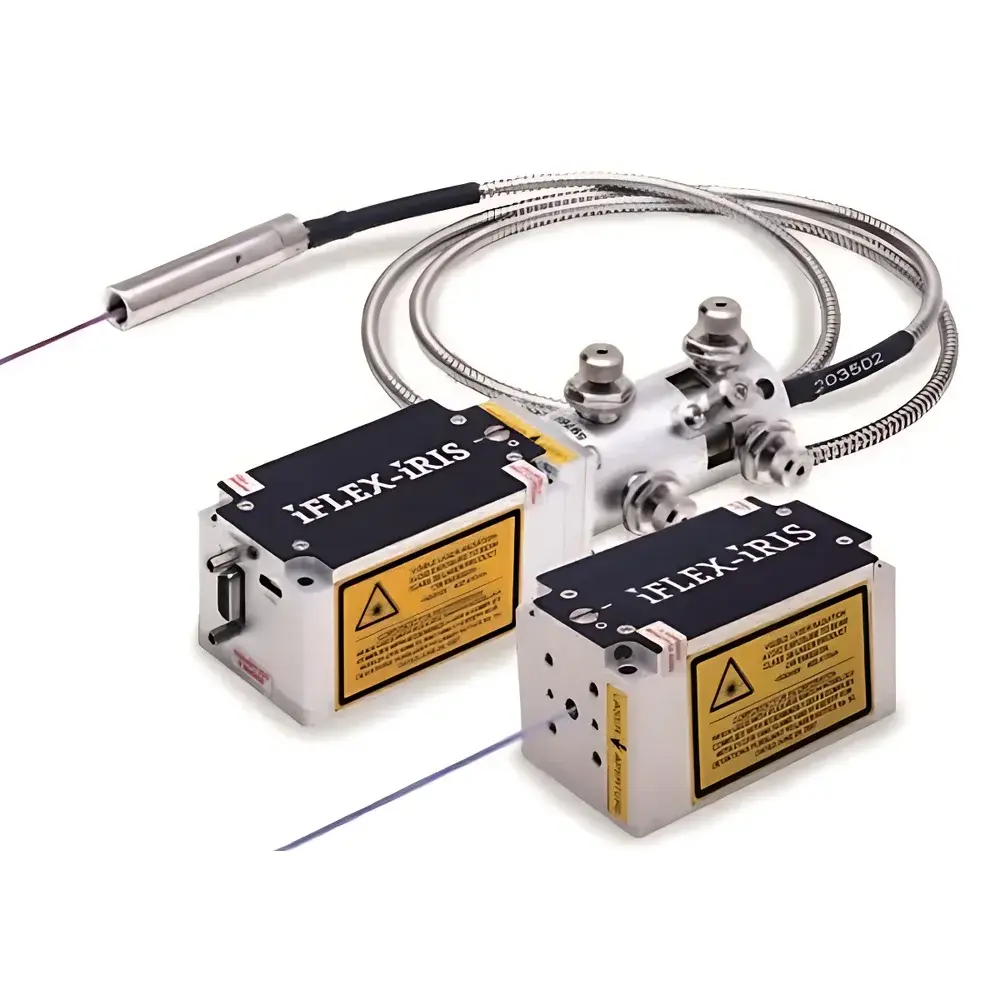
Qioptiq iFLEX-iRIS Series High-Stability Diode Laser Module
| Brand | Qioptiq |
|---|---|
| Origin | United Kingdom |
| Manufacturer Type | Authorized Distributor |
| Import Status | Imported |
| Model | iFLEX-iRIS |
| Core Technology | Single-Mode Polarization-Maintaining Fiber-Coupled Diode Laser |
| Beam Quality (M²) | <1.1 |
| Power Stability (8 h) | <0.5 % RMS |
| Beam Pointing Stability | <1 µrad/°C |
| Dimensions | 70 × 40 × 38 mm |
| Modulation Options | TTL, Analog, Dual-Mode |
| Output | Collimated Free-Space or SM PM Fiber-Coupled |
| Wavelength Options | Customizable Multi-Wavelength Integration Available |
| Compliance | CE, RoHS, IEC 60825-1:2014 Class 3B Laser Product |
Overview
The Qioptiq iFLEX-iRIS series is a high-performance, fiber-coupled diode laser module engineered for applications demanding exceptional temporal and spatial beam stability. Based on semiconductor gain media and integrated with active thermal stabilization and closed-loop power control, the iFLEX-iRIS operates on the principle of current- and temperature-regulated single-mode lasing in a hermetically sealed, compact package. Its output is delivered either as a collimated free-space beam or, more commonly, through a single-mode polarization-maintaining (PM) optical fiber—ensuring mode purity, minimal pointing drift, and long-term repeatability critical for interferometric, confocal, and scattering-based measurement systems. Designed specifically for OEM integration into analytical and biomedical instrumentation, the iFLEX-iRIS meets stringent requirements for low-noise operation (<0.03 % RMS intensity noise, 10 Hz–10 MHz), sub-microradian thermal beam steering control, and robust mechanical alignment retention under vibration and thermal cycling.
Key Features
- Ultra-low intensity noise: <0.03 % RMS (10 Hz–10 MHz bandwidth), enabling high-fidelity signal detection in photon-limited applications such as fluorescence correlation spectroscopy and single-molecule imaging.
- Exceptional power stability: <0.5 % RMS over 8 hours at constant ambient temperature—achieved via real-time photodiode feedback and precision current regulation.
- Superior beam pointing stability: <1 µrad/°C, realized through monolithic mechanical design, symmetric thermal management, and low-expansion housing materials.
- Diffraction-limited beam quality: M² < 1.1, supporting tight focusing and high numerical aperture coupling into microscope objectives or fiber arrays.
- Compact OEM form factor: 70 × 40 × 38 mm footprint with standardized mounting interfaces and low-profile electrical connectors—optimized for space-constrained instrument chassis.
- Dual-mode modulation capability: Simultaneous TTL digital and analog voltage control enables flexible triggering, intensity ramping, and synchronization with external acquisition hardware (e.g., cameras, scanners, lock-in amplifiers).
- Configurable output options: Standard collimated free-space output; optional single-mode PM fiber coupling with FC/APC or SMA905 termination; customizable beam shaping (circularization, line generation) and multi-wavelength integration (e.g., 488 nm + 561 nm + 640 nm in one housing).
Sample Compatibility & Compliance
The iFLEX-iRIS is compatible with a wide range of optical components and sample environments, including aqueous biological specimens, microfluidic chips, solid-state sensors, and vacuum-compatible stages (with optional vacuum-rated versions). Its fiber-coupled configuration eliminates alignment sensitivity during system integration and ensures consistent illumination across variable sample geometries. The module complies with IEC 60825-1:2014 for Class 3B laser safety, carries CE marking for EMC and LVD directives, and conforms to RoHS 2011/65/EU material restrictions. For regulated environments—including clinical diagnostics equipment and GMP-compliant manufacturing tools—the iFLEX-iRIS supports traceable calibration documentation and can be supplied with factory-certified power and spectral measurements per ISO/IEC 17025-accredited procedures.
Software & Data Management
While the iFLEX-iRIS operates as a stand-alone analog/digital device, it is fully compatible with industry-standard control ecosystems. Drivers and SDKs are provided for LabVIEW, MATLAB, Python (PyVISA), and C/C++ environments, enabling seamless integration into automated test platforms and data acquisition frameworks. All modulation inputs accept standard 0–5 V analog and 3.3/5 V TTL logic levels, and optional USB or RS-232 interfaces support remote parameter monitoring (output power, case temperature, driver status) with timestamped logging. Audit trails for laser-on duration, modulation history, and thermal setpoint adjustments can be exported for GLP/GMP compliance reporting. Firmware updates are performed via secure bootloader protocol, ensuring firmware integrity verification prior to execution.
Applications
- Confocal and super-resolution microscopy: Stable excitation source for multi-color fluorescence imaging with minimal photobleaching and high signal-to-noise ratio.
- Flow cytometry and cell sorting: Precise, jitter-free illumination for scatter and fluorescence signal discrimination at >10,000 events/sec throughput.
- DNA sequencing platforms (e.g., Illumina SBS, PacBio SMRT): Uniform, low-noise excitation across flow cells and zero-mode waveguides.
- Dynamic light scattering (DLS) and nanoparticle tracking analysis (NTA): Coherent, low-phase-noise illumination essential for accurate autocorrelation function computation.
- Holographic optical trapping and optical tweezers: High M² fidelity and pointing stability required for stable trap formation and force calibration.
- Spectroscopic sensing and environmental monitoring: Multi-wavelength variants enable ratiometric absorption or fluorescence detection in gas-phase or aqueous analyte analysis.
- Photostimulation in optogenetics: Rapid TTL-gated pulsing with nanosecond rise/fall times for precise neuronal activation timing.
FAQ
Is the iFLEX-iRIS suitable for use in FDA-regulated diagnostic instruments?
Yes—when integrated with appropriate system-level safety interlocks and documented within a formal risk management file (ISO 14971), the iFLEX-iRIS meets baseline requirements for Class II/III IVD devices. Optional IQ/OQ documentation packages are available.
Can output power be calibrated and re-certified after field installation?
Yes—Qioptiq offers accredited recalibration services traceable to NPL (UK) standards, including power, wavelength, and beam divergence verification.
What is the typical lifetime and warranty coverage?
Rated MTTF > 20,000 hours under continuous operation at 25 °C ambient; standard warranty is 24 months, extendable to 36 months with service agreement.
Does the module support synchronization with camera frame triggers?
Yes—TTL input accepts external sync signals with programmable delay (0–100 ms) and pulse width control, enabling pixel-accurate illumination gating.
Are custom wavelengths or fiber connector types available?
Yes—wavelengths from 405 nm to 1064 nm are supported; FC/APC, FC/PC, SMA905, and custom hybrid connectors are available upon request.





