
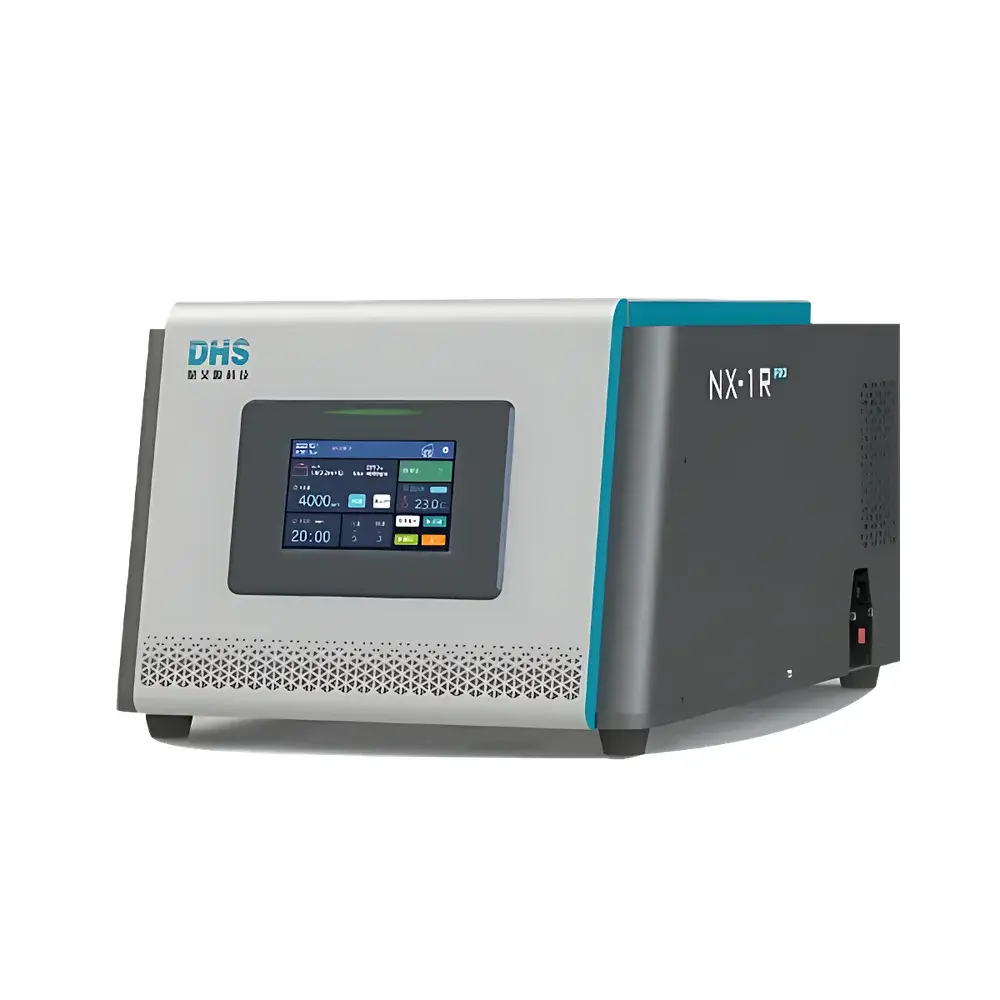
DHS NX-1R Pro High-Speed Refrigerated Microcentrifuge
| Brand | DHS |
|---|---|
| Origin | Tianjin, China |
| Model | NX-1R Pro |
| Instrument Type | Benchtop Centrifuge |
| Speed Range | 200–17,500 rpm |
| Max RCF | 23,300 × g |
| Max Capacity | 24 × 1.5/2.0 mL tubes |
| Temperature Range | –20 °C to +40 °C |
| Refrigeration System | Eco-friendly non-CFC compressor |
| Dimensions (W×D×H) | 355 × 270 × 545 mm |
| Display | 5-inch HD color touchscreen |
| Acceleration/Deceleration | 10-step programmable |
| Programs | 100 user-storable, up to 10-segment per program |
| Rotor Options | 5 interchangeable high-speed fixed-angle rotors |
| Tube Compatibility | 0.2–5.0 mL conical, round-bottom, PCR strip tubes, spin columns |
| Safety Features | Electronic lid lock, overspeed protection, overtemperature protection, condensation-resistant chamber |
| Construction | Full metal housing with epoxy powder coating |
| Data Logging | Real-time curve recording and historical run logs |
| Compliance | Designed for GLP-compliant workflows |
Overview
The DHS NX-1R Pro High-Speed Refrigerated Microcentrifuge is an engineered solution for precision separation of temperature-sensitive biomolecules in demanding laboratory environments. Built upon a robust fixed-angle rotor architecture and governed by Couette-flow centrifugal dynamics, the NX-1R Pro delivers reproducible sedimentation forces up to 23,300 × g at 17,500 rpm—optimized for rapid pelleting of nucleic acids, proteins, plasmids, viral particles, and subcellular organelles. Its integrated non-CFC refrigeration system maintains precise thermal control from –20 °C to +40 °C, minimizing thermal denaturation and enzymatic degradation during high-G processing. The unit’s compact footprint (355 × 270 × 545 mm) enables seamless integration into biosafety cabinets, cold rooms, or shared core facility benches without compromising mechanical stability or acoustic performance.
Key Features
- High-fidelity speed regulation via PWM-controlled brushless motor, ensuring ±50 rpm speed accuracy across full operational range (200–17,500 rpm)
- 10-stage acceleration and deceleration profiles to suppress resuspension of delicate pellets—critical for RNA integrity and membrane vesicle recovery
- 5-inch capacitive HD touchscreen with intuitive icon-driven interface, supporting multilingual OS localization (English, German, French, Spanish, Japanese)
- Full-metal chassis with electrostatically applied epoxy powder coating—resistant to ethanol, isopropanol, and 10% bleach; compliant with ISO 13485 surface cleanability standards
- Condensation-inhibiting chamber design with thermal barrier insulation and internal drain path—enables continuous operation below 0 °C without ice accumulation on motor housing or rotor interface
- Electronic lid interlock with dual-sensor verification and automatic rotor imbalance detection (±0.5 g mass asymmetry threshold)
- Embedded non-volatile memory storing ≥10,000 runtime events—including timestamped RCF, temperature, duration, rotor ID, and error codes—for traceability and CAP/CLIA audit readiness
Sample Compatibility & Compliance
The NX-1R Pro accommodates standard microvolume consumables including 0.2 mL PCR strips, 0.5–5.0 mL conical and round-bottom polypropylene tubes, and commercially available spin filtration columns (e.g., Amicon Ultra, Zymo-Spin). All five optional fixed-angle rotors are dynamically balanced to ISO 1940–1 G2.5 grade and certified for use with DNase/RNase-free certified tubes. The system meets IEC 61010-1:2010 safety requirements for laboratory equipment and incorporates hardware-level safeguards aligned with EN 61326–1 for electromagnetic compatibility. When operated within validated SOPs, it supports compliance with USP , ISO/IEC 17025:2017 (Section 5.9), and FDA 21 CFR Part 11 for electronic records—provided external software validation protocols are implemented per institutional QA policy.
Software & Data Management
Onboard firmware v3.2+ supports USB export of run logs in CSV and PDF formats, including graphical torque vs. time curves and thermal deviation overlays. Optional Ethernet/Wi-Fi module (NX-Link Adapter) enables remote monitoring, batch scheduling, and centralized fleet management via DHS CentriControl™ Web Suite—a browser-based platform compatible with Windows, macOS, and Linux clients. Audit trail functionality captures operator ID, parameter changes, and emergency stop events with SHA-256 hashing and write-once-read-many (WORM) storage logic. Data encryption at rest (AES-256) and TLS 1.3 in transit ensure alignment with HIPAA and GDPR data sovereignty requirements.
Applications
- Routine nucleic acid purification: plasmid minipreps, genomic DNA isolation, RNA cleanup post-TRIzol extraction
- Protein biochemistry: antibody clarification, His-tagged protein pellet concentration, lipoprotein fractionation
- Cellular microbiology: bacterial periplasmic extraction, yeast lysate clearing, exosome enrichment from conditioned media
- Diagnostics development: sample prep for qPCR, digital PCR, and next-generation sequencing library construction
- Quality control in biomanufacturing: residual host cell protein removal, aggregate screening in mAb formulations
FAQ
What is the minimum run time supported for low-speed pre-clearance steps?
The NX-1R Pro supports programmable durations from 10 seconds to 99 minutes and 59 seconds, enabling precise short-duration spins for debris removal prior to high-G pelleting.
Can the instrument be calibrated in-house using NIST-traceable tachometers?
Yes—rotor-specific calibration coefficients may be entered manually via service mode; full calibration reports (including RCF verification at three speed points) are generated automatically and exportable.
Is rotor lifetime tracked automatically?
Each rotor contains an RFID tag encoding manufacturing date, material lot, and maximum rated cycles; the system logs cumulative run hours and alerts users at 90% of defined service life.
Does the centrifuge support automatic rotor recognition?
All five factory-certified rotors feature embedded RFID tags that auto-configure max speed, RCF limits, and temperature compensation algorithms upon insertion.
How is temperature uniformity verified across the rotor chamber?
During factory acceptance testing, thermal mapping is performed per ASTM E2251–16 using 9-point thermocouple arrays; deviation remains ≤ ±1.2 °C at –20 °C steady state.



