
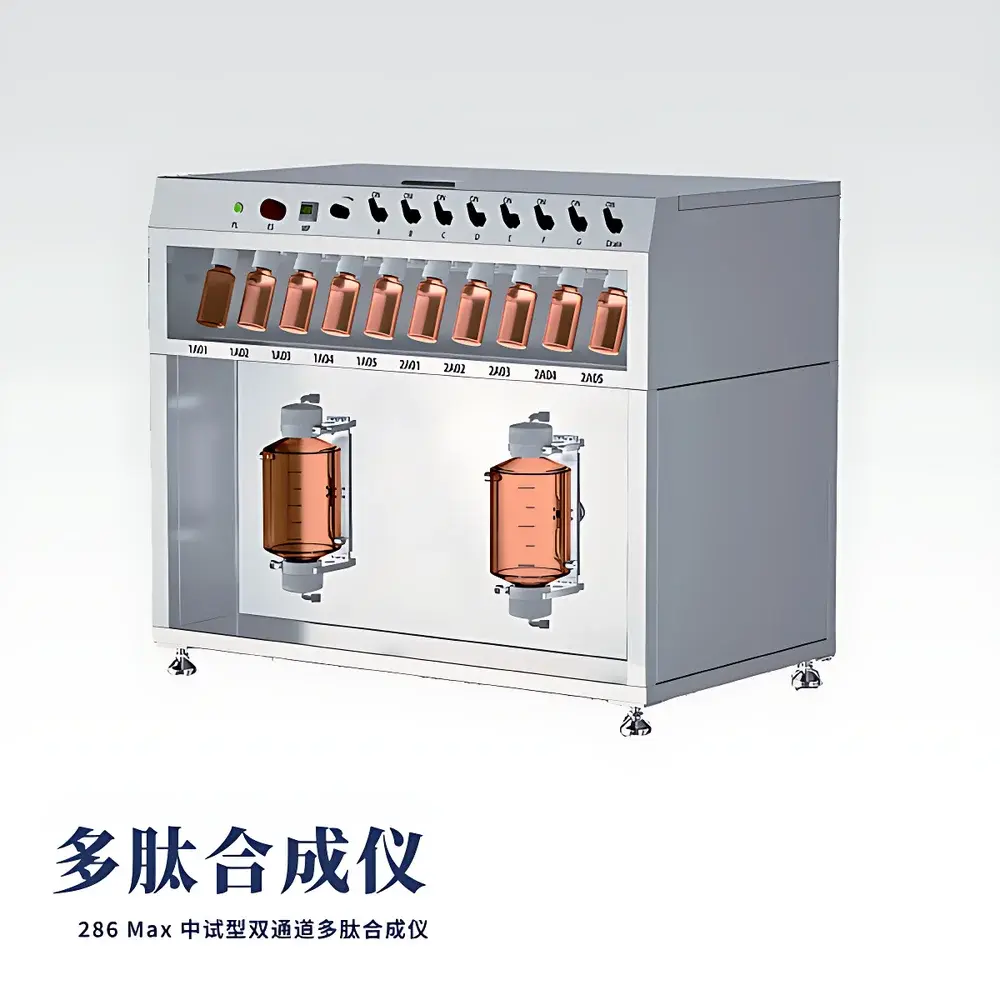
Dilun Bio 286Max Pilot-Scale Dual-Channel Peptide Synthesizer
| Brand | Dilun Bio |
|---|---|
| Origin | Beijing, China |
| Model | 286Max |
| Synthesis Scale | 2–25 mmol |
| Number of Reactors | 3 |
| Reactor Volume Options | 0.5 / 1 / 2 L |
| Amino Acid Positions | 10 (250 mL bottles) |
| Solvent Positions | 5 (20 L / 50 L tanks) |
| Dispensing Accuracy | ±1 mL |
| Activation Modes | Simultaneous & Pre-activation |
| Amino Acid Delivery | Automated quantitative weighing & dissolution-transfer |
| Reagent Delivery | Automated precise aspiration |
| Mixing Mechanism | 180° mechanical flip agitation |
| Power Supply | 110/220 V, 50/60 Hz |
| Dimensions (W×D×H) | 108 × 62 × 90.5 cm |
| Weight | 87 kg |
Overview
The Dilun Bio 286Max Pilot-Scale Dual-Channel Peptide Synthesizer is an engineered solution for robust, reproducible solid-phase peptide synthesis (SPPS) at the pilot scale. Built upon Fmoc- and Boc-compatible chemistry platforms, the system implements automated iterative coupling–deprotection cycles with high positional fidelity and minimal manual intervention. Its dual-channel architecture enables parallel synthesis of two distinct peptide sequences under independently programmable protocols—critical for comparative optimization studies, batch consistency validation, or multi-target lead generation. Each channel integrates gravimetric amino acid dispensing, solvent-controlled activation kinetics, and precisely timed reagent delivery to ensure stoichiometric accuracy across scales from 2 mmol to 25 mmol. The system’s mechanical 180° flip agitation ensures homogeneous resin suspension without shear-induced cleavage—preserving coupling efficiency in long-sequence syntheses (>50 residues) and sterically hindered motifs.
Key Features
- Dual independent synthesis channels with synchronized or asynchronous protocol execution
- Automated amino acid handling: quantitative weighing, full dissolution in DMF/NMP, and quantitative transfer to reaction vessels
- Precision reagent delivery: ±1 mL volumetric accuracy for activators (e.g., HBTU, DIC), bases (e.g., DIPEA), and deprotection agents (e.g., 20% piperidine)
- Modular reactor configuration: interchangeable 0.5 L, 1 L, and 2 L vessels supporting scalable resin loading (up to 25 mmol)
- 10-position amino acid station with 250 mL reservoirs; 5-position solvent station with dual-capacity tanks (20 L / 50 L)
- Non-contact mechanical agitation: 180° bidirectional flip motion ensuring uniform resin mixing without magnetic stir bars or gas sparging
- Integrated environmental monitoring: real-time temperature and pressure logging during coupling/deprotection steps
- Fail-safe fluid path design with check valves, pressure sensors, and automatic line purge cycles to prevent cross-contamination
Sample Compatibility & Compliance
The 286Max accommodates standard SPPS resins—including Wang, Rink amide, 2-CTC, and Sieber amide—and supports both Fmoc/tBu and Boc/Bzl protection strategies. It is compatible with common coupling reagents (HATU, PyBOP, DCC), activators, scavengers, and cleavage cocktails (TFA/H2O/TIS). The instrument meets CE marking requirements for laboratory equipment and conforms to IEC 61010-1:2010 safety standards. While not pre-certified for GMP environments, its architecture supports audit readiness: all synthesis logs—including timestamps, reagent volumes, agitation cycles, and error flags—are stored locally with optional encrypted export for GLP/GMP traceability. Optional 21 CFR Part 11-compliant software modules (with electronic signatures and audit trail) are available upon request for regulated QC laboratories.
Software & Data Management
The synthesizer operates via a dedicated Windows-based control interface with intuitive workflow scripting. Users define step-by-step protocols—including coupling time, temperature setpoints, wash cycles, and resin swelling parameters—with support for nested loops and conditional branching (e.g., extended coupling for difficult residues). All operational data—including dispense volumes, agitation duration, temperature profiles, and alarm events—are timestamped and archived in CSV and SQLite formats. Remote monitoring is supported via secure HTTPS API endpoints, enabling integration into enterprise LIMS or ELN systems. Data integrity safeguards include write-once file locking, SHA-256 log hashing, and configurable backup intervals to network-attached storage (NAS) or cloud repositories.
Applications
- Pilot-scale production of therapeutic peptides (e.g., GLP-1 analogs, antimicrobial peptides, epitope vaccines)
- Method development and optimization for challenging sequences (e.g., hydrophobic domains, β-sheet prone regions, cyclic constraints)
- Batch-to-batch reproducibility assessment prior to technology transfer to cGMP manufacturing
- Academic and industrial research requiring parallel synthesis of peptide libraries or SAR series
- Supporting downstream processes including cleavage, purification (HPLC), and analytical characterization (MS, HPLC, CD)
FAQ
What synthesis chemistries does the 286Max support?
The system is fully compatible with both Fmoc- and Boc-based solid-phase peptide synthesis, including orthogonal side-chain protection schemes.
Can the instrument be integrated into an existing lab automation infrastructure?
Yes—via RESTful API and OPC UA protocol support, the 286Max can synchronize with robotic liquid handlers, autosamplers, or central process control systems.
Is remote diagnostics and firmware update capability available?
Standard remote access is enabled through SSH and VNC; over-the-air firmware updates require authenticated TLS handshake and digital signature verification.
What maintenance intervals are recommended for sustained performance?
Daily line flushes, monthly calibration of dispensing pumps, and biannual inspection of O-rings, valves, and agitation drive components are advised per the operator manual.
Does the system support custom resin types or non-standard solvents?
Yes—user-defined solvent compatibility tables and resin swelling profiles can be imported to adapt protocols for specialty resins (e.g., ChemMatrix®) or alternative solvents (e.g., DCM/EtOAc mixtures).
Related Products




