
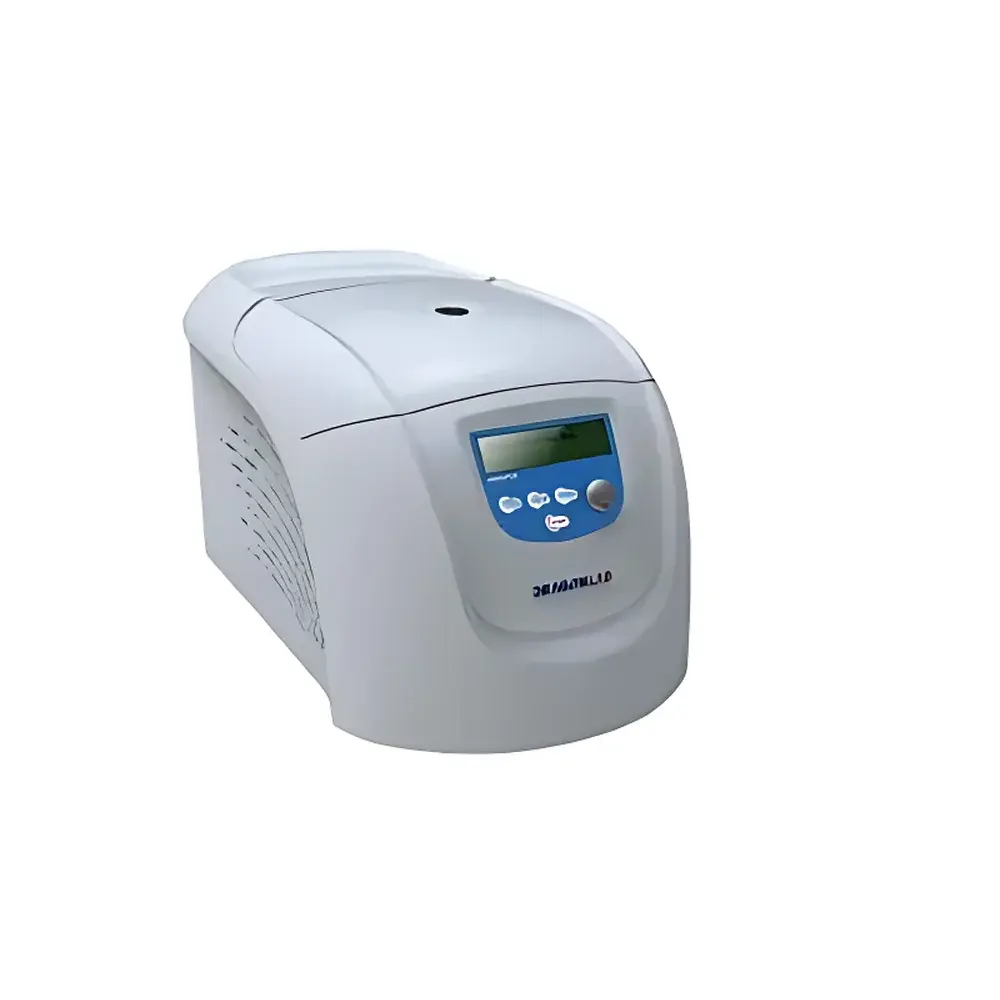
DLAB D3024R High-Speed Refrigerated Microcentrifuge
| Brand | DLAB |
|---|---|
| Origin | Beijing, China |
| Model | D3024R |
| Instrument Type | Benchtop Centrifuge |
| Speed Range | 200–15,000 rpm (adjustable in 10 rpm increments) |
| Max RCF | 21,380 ×g (adjustable in 10 ×g increments) |
| Temperature Range | −20 °C to +40 °C |
| Max Capacity | 2 mL × 24 |
| Refrigerant | Eco-friendly non-CFC |
| Drive Motor | Brushless DC motor |
| Dimensions (L×D×H) | 338 × 580 × 324 mm |
| Weight | 30 kg |
| Safety | Dual interlocked lid, overspeed protection, overtemperature cutoff, real-time diagnostics |
| Power Input | AC 220–240 V, 50/60 Hz, 10 A or AC 100–120 V, 50/60 Hz, 10 A |
| Timer | 30 s to 99 min or HOLD mode |
| Additional Functions | rpm/×g conversion, quick-spin (short-time run), progress bar display, audible end-of-run signal |
Overview
The DLAB D3024R High-Speed Refrigerated Microcentrifuge is an engineered benchtop solution for precise, reproducible separation of microliter-volume biological samples under controlled thermal conditions. Designed for routine and high-throughput molecular biology workflows—including nucleic acid purification, protein precipitation, cell organelle isolation, and PCR product cleanup—the instrument operates on the principle of centrifugal sedimentation, generating up to 21,380 ×g at 15,000 rpm to resolve subcellular particles, macromolecular complexes, and viscous supernatants. Its refrigerated architecture maintains sample integrity during extended runs, with temperature stabilization within ±1 °C across the full operating range (−20 °C to +40 °C), even at maximum rotor speed—a critical capability for heat-sensitive enzymes, RNA, and transient intermediates.
Key Features
- Brushless DC motor delivering rapid acceleration (0–15,000 rpm in <15 s) and deceleration with programmable soft-braking profiles to minimize pellet disturbance during low-speed transitions.
- Biological-grade aluminum rotor with autoclavable construction—validated for ≥500 cycles at 121 °C, 2 bar steam sterilization—ensuring long-term sterility compliance in GLP and clinical research environments.
- Dual mechanical + electronic lid interlock system meeting IEC 61010-2-020 safety requirements; automatically halts rotation if lid is opened mid-run or if imbalance exceeds 5 g threshold.
- Eco-conscious refrigeration using non-ozone-depleting R134a refrigerant and pulse-width modulated (PWM) compressor control—reducing energy consumption by ~32% compared to continuous-cycle systems while maintaining ≤4 °C chamber temperature at top speed.
- Intuitive 4.3-inch LCD interface with real-time graphical display of rpm, ×g, time remaining, temperature, and error codes—supporting multilingual UI (English, Spanish, German, Chinese) via firmware update.
- Integrated acoustic dampening enclosure achieving ≤55 dB(A) at 1 m distance—meeting ISO 7779 noise emission standards for shared laboratory spaces.
Sample Compatibility & Compliance
The D3024R accommodates standard microcentrifuge formats without adapter dependency: 2 mL conical tubes (24-position), 0.5 mL snap-cap tubes (36-position), and 8-strip PCR plates (4-position rotor). All rotors are certified to ISO 15197:2013 for dimensional repeatability and dynamic balance tolerance (G ≤ 2.5 mm/s). The system complies with electromagnetic compatibility per EN 61326-1, electrical safety per EN 61010-1, and carries CE, RoHS, and FDA-listed establishment registration (U.S. Agent: DLAB Americas, Inc.). It supports audit-ready operation under 21 CFR Part 11 when paired with optional DLAB CentriLog™ software (v3.2+), providing electronic signatures, user access tiers, and immutable run logs with timestamped metadata.
Software & Data Management
While standalone operation requires no PC connection, the optional CentriLog™ software enables method library management, remote monitoring via Ethernet/Wi-Fi, and export of CSV-formatted run reports compliant with LIMS integration protocols (ASTM E1578, ISO/IEC 17025 Annex A.2). Each protocol stores rotor ID, calibration date, maintenance history, and deviation alerts—facilitating internal QA reviews and external accreditation audits (e.g., CAP, CLIA, ISO 15189). Firmware updates are delivered via USB or network push, preserving validated configurations through version-controlled rollback capability.
Applications
- Nucleic acid extraction workflows requiring cold-phase phase separation (e.g., phenol-chloroform, silica-membrane spin columns).
- Preparative isolation of exosomes and extracellular vesicles from serum/plasma using differential ultracentrifugation protocols (≥10,000 ×g, 4 °C, 30 min).
- High-yield recovery of bacterial inclusion bodies post-lysis without thermal denaturation.
- Routine clarification of lysates prior to HPLC, mass spectrometry, or ELISA analysis.
- Storage-compatible pelleting of cryopreserved cell suspensions at −80 °C prior to resuspension in cryoprotectant media.
FAQ
What rotor types are compatible with the D3024R?
The D3024R accepts only factory-certified DLAB angular rotors (e.g., A12-2, A18-5, PCR-4); third-party rotors void warranty and compromise safety certification.
Can the centrifuge maintain −20 °C at 15,000 rpm?
No—minimum operational temperature at maximum speed is +4 °C due to adiabatic heating; for sub-zero operation, reduce speed to ≤12,000 rpm per the integrated thermal derating curve.
Is rotor calibration traceable to NIST standards?
Yes—each rotor ships with a calibration certificate referencing NIST-traceable tachometer and thermistor verification, valid for 2 years or 500 runs, whichever occurs first.
Does the system support password-protected user profiles?
Yes—CentriLog™ software enables role-based access (Operator, Supervisor, Administrator) with encrypted local storage of credentials and session timeout after 5 minutes of inactivity.
What maintenance intervals are recommended?
Brushless motor requires no scheduled servicing; annual inspection of refrigerant pressure, door seal integrity, and rotor corrosion resistance is advised per ISO 13485 preventive maintenance guidelines.



