
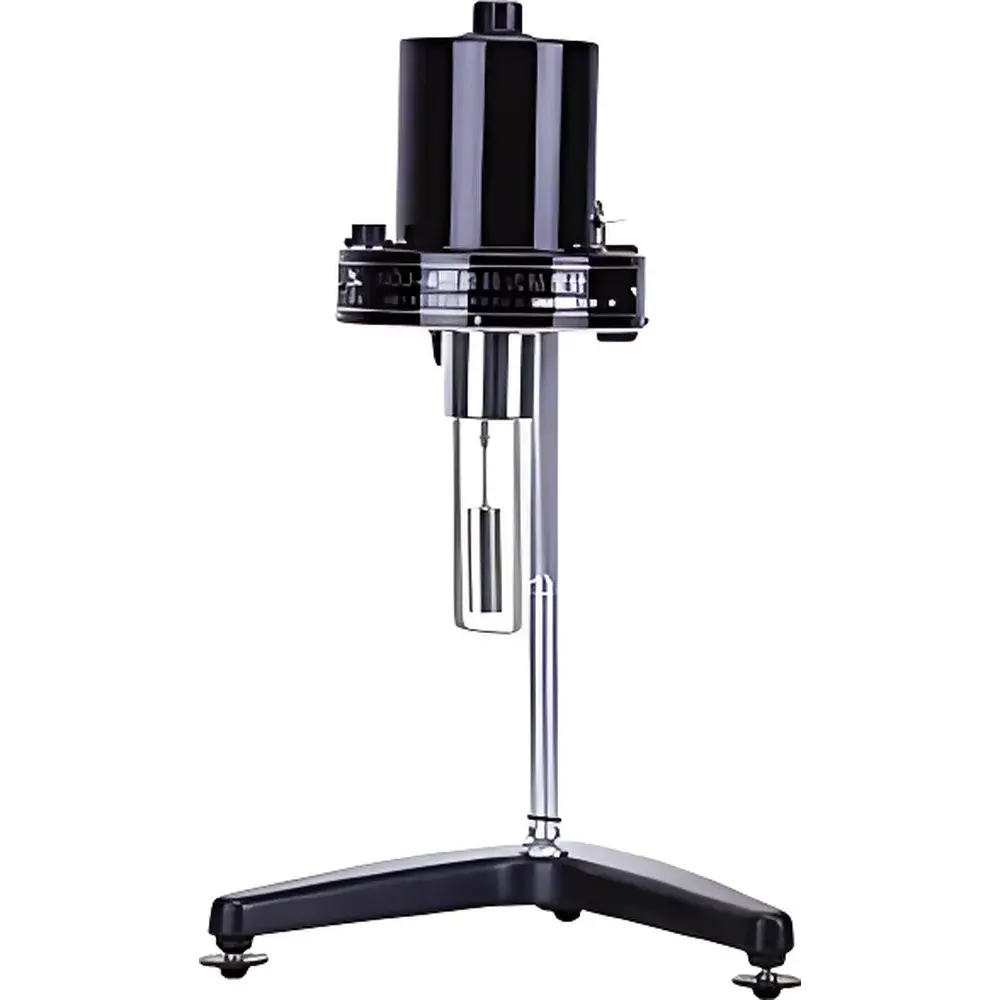
SOPTOP NDJ-1 Analog Rotational Viscometer
| Brand | SOPTOP |
|---|---|
| Origin | Shanghai, China |
| Model | NDJ-1 |
| Instrument Type | Analog Rotational Viscometer |
| Viscosity Range | 1–100,000 mPa·s |
| Rotational Speeds | 6 / 12 / 30 / 60 rpm |
| Spindle Set | LV Spindles #1–#4 |
| Accuracy (Newtonian Fluids) | ±5% |
| Dimensions (W×D×H) | 275 × 265 × 445 mm |
| Display | Analog Pointer Gauge |
| Speed Control | Manual Gear Shift |
Overview
The SOPTOP NDJ-1 Analog Rotational Viscometer is a mechanically driven, coaxial cylinder-type viscometer engineered for routine viscosity assessment of Newtonian and mildly non-Newtonian fluids in quality control, production, and educational laboratories. It operates on the principle of rotational drag torque measurement: as the spindle rotates at a fixed speed within the sample, viscous resistance generates torque proportional to dynamic viscosity. This torque is transmitted via a calibrated spring mechanism to an analog pointer gauge, delivering direct mPa·s readouts without digital electronics or software dependency. Designed for robustness and long-term mechanical stability, the NDJ-1 meets fundamental requirements for ASTM D2196, ISO 2555, and GB/T 265—standards governing rotational viscosity testing of paints, adhesives, food emulsions, pharmaceutical suspensions, and lubricating oils. Its analog architecture ensures immunity to electromagnetic interference and eliminates calibration drift associated with sensor aging—a critical advantage in environments lacking stable power or IT infrastructure.
Key Features
- Mechanically synchronized gear-driven speed selection offering four discrete rotational speeds: 6, 12, 30, and 60 rpm—optimized for balancing shear rate coverage and torque resolution across low- to medium-viscosity ranges.
- Four interchangeable LV spindles (#1–#4) enabling systematic range extension; each spindle is precision-machined from stainless steel and individually calibrated per factory traceable procedures.
- Analog pointer display with linear scale and parallax-reduced glass lens—providing immediate visual feedback without warm-up delay, battery dependency, or firmware updates.
- Fixed-axis vertical alignment system with adjustable leveling feet and sample cup retention collar, ensuring consistent immersion depth (±0.5 mm) and minimizing eccentricity-induced measurement artifacts.
- Compact benchtop footprint (275 × 265 × 445 mm) and tool-free spindle coupling—facilitating rapid setup, cleaning, and relocation between QC stations or teaching labs.
- No internal microprocessor or data storage; fully compliant with legacy GLP workflows requiring manual recordkeeping and handwritten audit trails.
Sample Compatibility & Compliance
The NDJ-1 is validated for homogeneous, particle-free liquids exhibiting near-Newtonian behavior under tested shear rates—including vegetable oils, syrups, solvent-based coatings, aqueous polymer solutions, and topical ointments. It is not suitable for highly thixotropic gels, fiber-reinforced suspensions, or samples requiring temperature-controlled rheology (e.g., Peltier-regulated cells). All spindle geometries conform to ISO 3219 Annex A specifications for standard LV geometry. The instrument satisfies basic metrological traceability per JJG 1002–2005 (Chinese National Verification Regulation for Rotational Viscometers) and supports documentation required for ISO/IEC 17025 internal audits when paired with certified reference oils (e.g., Cannon–NIST traceable standards). Routine verification uses silicone oil standards with certified viscosity values at 25 °C.
Software & Data Management
The NDJ-1 operates entirely without embedded software, firmware, or connectivity interfaces. Data acquisition follows manual transcription protocols: users record spindle number, selected speed, pointer deflection, and ambient temperature in laboratory notebooks or LIMS-compatible spreadsheets. This architecture inherently complies with FDA 21 CFR Part 11 requirements for systems where electronic records are not generated—eliminating validation burdens related to user access controls, electronic signatures, or audit trail configuration. For laboratories integrating analog instruments into digital workflows, SOPTOP provides optional calibration certificates with uncertainty budgets (k = 2) and traceability to NIM (National Institute of Metrology, China).
Applications
- QC release testing of edible oils and margarines per GB 5009.228–2016 methodology.
- Batch consistency verification of architectural paints and industrial primers during manufacturing.
- Viscosity grading of topical hydrogels and ointment bases in pharmaceutical development labs.
- Educational demonstration of Newton’s law of viscosity and shear-dependent flow behavior in undergraduate physics and chemical engineering curricula.
- In-process monitoring of starch-thickened sauces and dairy-based dressings in food pilot plants.
- Stability screening of solvent-borne adhesives before and after accelerated aging cycles.
FAQ
Is the NDJ-1 suitable for non-Newtonian fluid characterization?
It provides single-point viscosity values at fixed shear rates; it does not generate flow curves or yield stress estimates. For full rheological profiling, a programmable rotational rheometer with controlled shear rate ramps is required.
Can I use ASTM D1200 Zahn cups or Ford viscosity funnels with this instrument?
No—the NDJ-1 requires its dedicated LV spindles and matching sample cup geometry. Cup-and-orifice methods measure efflux time, not dynamic viscosity, and are not interchangeable.
What maintenance is required to ensure long-term accuracy?
Annual recalibration using certified reference oils is recommended. Spindles must be cleaned with appropriate solvents after each use and inspected for nicks or bending; the pointer zero must be verified before every session.
Does the instrument meet ISO/IEC 17025 accreditation requirements?
Yes—when operated with documented procedures, traceable standards, and technician competency records, the NDJ-1 supports accredited testing for viscosity parameters listed in its scope of accreditation.
Is temperature control integrated?
No—external water baths or thermostatic jackets must be used for temperature-sensitive measurements. SOPTOP offers compatible immersion sleeves (sold separately) for 25 °C and 40 °C stabilization.



