
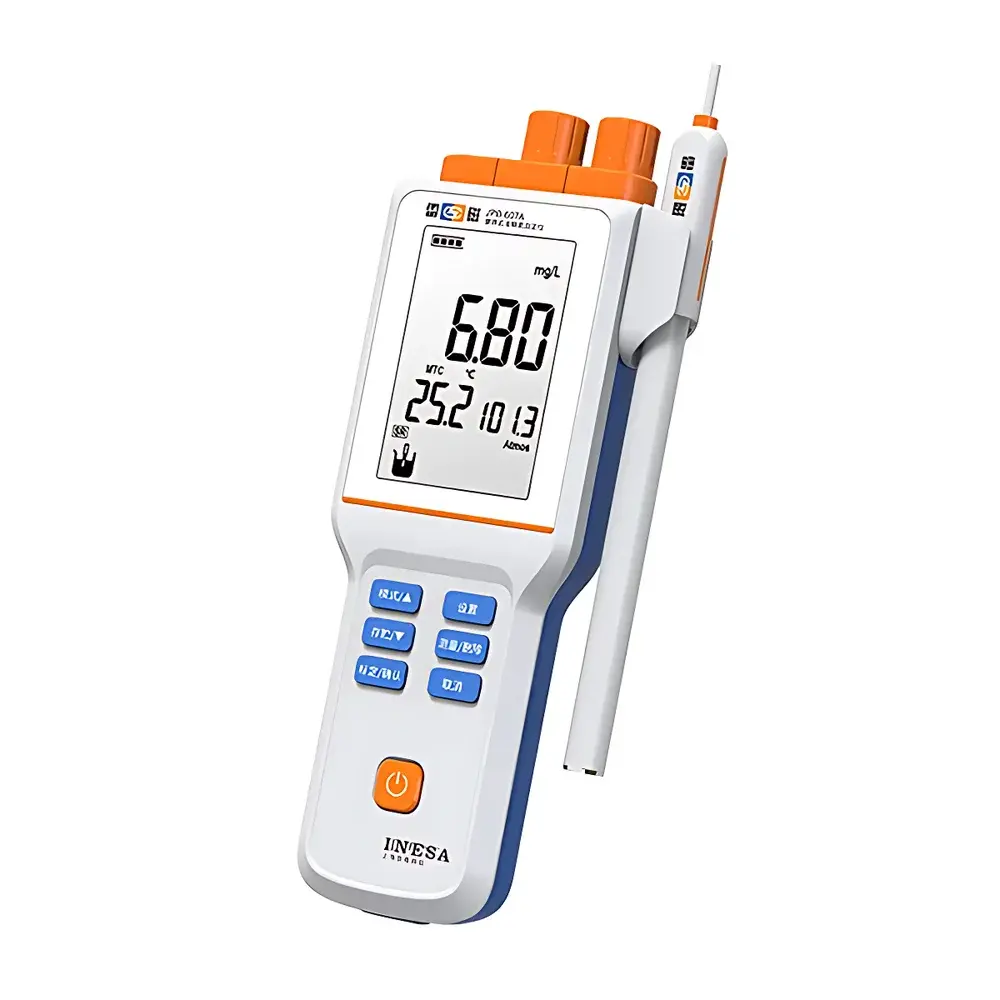
Leici JPB-607A Portable Dissolved Oxygen Meter
| Brand | Leici |
|---|---|
| Origin | Shanghai, China |
| Model | JPB-607A |
| Instrument Type | Portable |
| Measurement Principle | Electrochemical (Clark-type Polarographic Probe) |
| Measurement Range | Dissolved Oxygen: (0.0–20.0) mg/L |
| Temperature | (0.0–40.0) °C |
| Accuracy | ±0.30 mg/L (DO), ±0.5 °C (Temperature) |
| Repeatability | ±0.1 mg/L |
| Stability | ±0.10 mg/L over 3 h |
| Response Time | ≤45 s to 90% of final value at 20 °C |
| Zero Oxygen Error | ≤0.10 mg/L |
| Power Supply | Two AA alkaline batteries |
| Display | 3.5-digit LCD with optional blue backlight |
| Calibration | Zero-oxygen and saturated-air (full-scale) calibration supported |
| Temperature Compensation | Automatic, integrated thermistor |
Overview
The Leici JPB-607A Portable Dissolved Oxygen Meter is a field-deployable electrochemical analyzer engineered for reliable, on-site measurement of dissolved oxygen (DO) concentration in natural waters, wastewater, aquaculture systems, and process streams. It operates on the Clark-type polarographic principle—utilizing a membrane-covered cathode where oxygen diffuses through a selective gas-permeable membrane and undergoes reduction at a fixed applied potential (typically −0.6 V vs. Ag/AgCl). The resulting diffusion-limited current is linearly proportional to the partial pressure of dissolved oxygen, enabling direct quantification in mg/L (ppm) under standardized temperature and salinity conditions. Designed for environmental monitoring professionals, water quality technicians, and field researchers, the JPB-607A integrates automatic temperature compensation via an embedded thermistor, eliminating manual correction and ensuring traceable measurements across the 0.0–40.0 °C operational range. Its compact form factor, low power consumption, and robust probe interface make it suitable for extended battery-powered operation in remote or resource-constrained settings.
Key Features
- Portable, handheld design optimized for field use—lightweight chassis with ergonomic grip and IP65-rated enclosure for dust and water resistance during outdoor deployment.
- Electrochemical sensing architecture based on a replaceable DO-957 polarographic probe featuring a Teflon-coated gas-permeable membrane, silver-silver chloride reference system, and gold cathode for stable signal output and minimized polarization drift.
- 3.5-digit LCD display with optional blue backlight for enhanced readability under low-light or twilight field conditions.
- Automatic temperature compensation (ATC) algorithm compliant with Winkler-derived DO solubility models per ISO 5814:2012 and ASTM D888–22, ensuring accuracy without user intervention.
- Dual-point calibration capability: zero-oxygen calibration using sodium sulfite solution and full-scale calibration in air-saturated water or certified zero-air standard—both procedures guided by on-screen prompts.
- Stability performance verified at ±0.10 mg/L over 3 hours, meeting routine QA/QC requirements for field instrumentation under GLP-aligned workflows.
Sample Compatibility & Compliance
The JPB-607A is validated for aqueous samples with conductivity >100 µS/cm and salinity <35 g/kg (typical of freshwater, estuarine, and coastal marine environments). It is not intended for use in highly viscous, suspended-solids-rich, or strongly reducing matrices without pre-filtration or flow-cell adaptation. The instrument conforms to IEC 61000-4 electromagnetic compatibility standards and meets CE marking requirements for portable environmental measurement devices. While not certified to FDA 21 CFR Part 11, its calibration log and measurement records support audit-ready documentation when paired with external lab notebooks or LIMS-integrated data capture protocols. It aligns with ISO 17025:2017 general requirements for competence of testing and calibration laboratories when operated within defined uncertainty budgets and traceable calibration intervals.
Software & Data Management
The JPB-607A operates as a standalone instrument with no embedded memory or USB connectivity. All measurements are displayed in real time and must be manually recorded or transferred via external logging—consistent with ISO 5667-3:2018 field sampling guidelines requiring contemporaneous entry of environmental parameters. For laboratory integration, users commonly pair the meter with spreadsheet-based QA templates or LIMS platforms that accept CSV-formatted import from auxiliary Bluetooth-enabled data loggers (e.g., third-party RS232-to-Bluetooth adapters). Firmware updates are not supported; calibration verification and sensor maintenance follow manufacturer-recommended intervals per Leici Technical Bulletin TB-DO-2023.
Applications
- Routine monitoring of surface water bodies (rivers, lakes, reservoirs) for compliance with national ambient water quality criteria (e.g., China’s GB 3838–2002, US EPA 305.1).
- Wastewater treatment plant effluent and aeration basin profiling to optimize biological oxygen demand (BOD) control and energy efficiency.
- Aquaculture pond management—tracking diurnal DO fluctuations to prevent hypoxia-induced fish mortality.
- Environmental impact assessments (EIA) and baseline studies requiring rapid, repeatable DO screening across multiple sampling points.
- Educational field labs and undergraduate environmental science courses emphasizing hands-on sensor principles and water chemistry fundamentals.
FAQ
What type of electrode is compatible with the JPB-607A?
The instrument is designed exclusively for use with the Leici DO-957 polarographic dissolved oxygen electrode—a membrane-covered, three-electrode (working, reference, counter) sensor requiring periodic electrolyte replenishment and membrane replacement every 3–6 months depending on usage frequency and sample matrix.
Does the JPB-607A compensate for salinity effects?
No. Salinity compensation is not implemented in firmware. Users must apply post-measurement correction factors derived from standard oxygen solubility tables (e.g., Benson & Krause, 1984) when measuring in brackish or seawater environments.
Can the device store calibration or measurement history?
No. The JPB-607A lacks internal memory or data logging functionality. All calibration events and readings must be documented externally to satisfy regulatory record retention requirements.
Is the blue backlight standard or optional?
The blue-backlit LCD is an optional configuration selected at time of order; units shipped without this option feature a standard monochrome display with passive reflectivity.
What is the recommended recalibration interval?
Leici recommends zero and span calibration before each day’s field session or after every 8 hours of continuous operation—whichever occurs first—to maintain measurement integrity within stated accuracy specifications.
Related Products







