
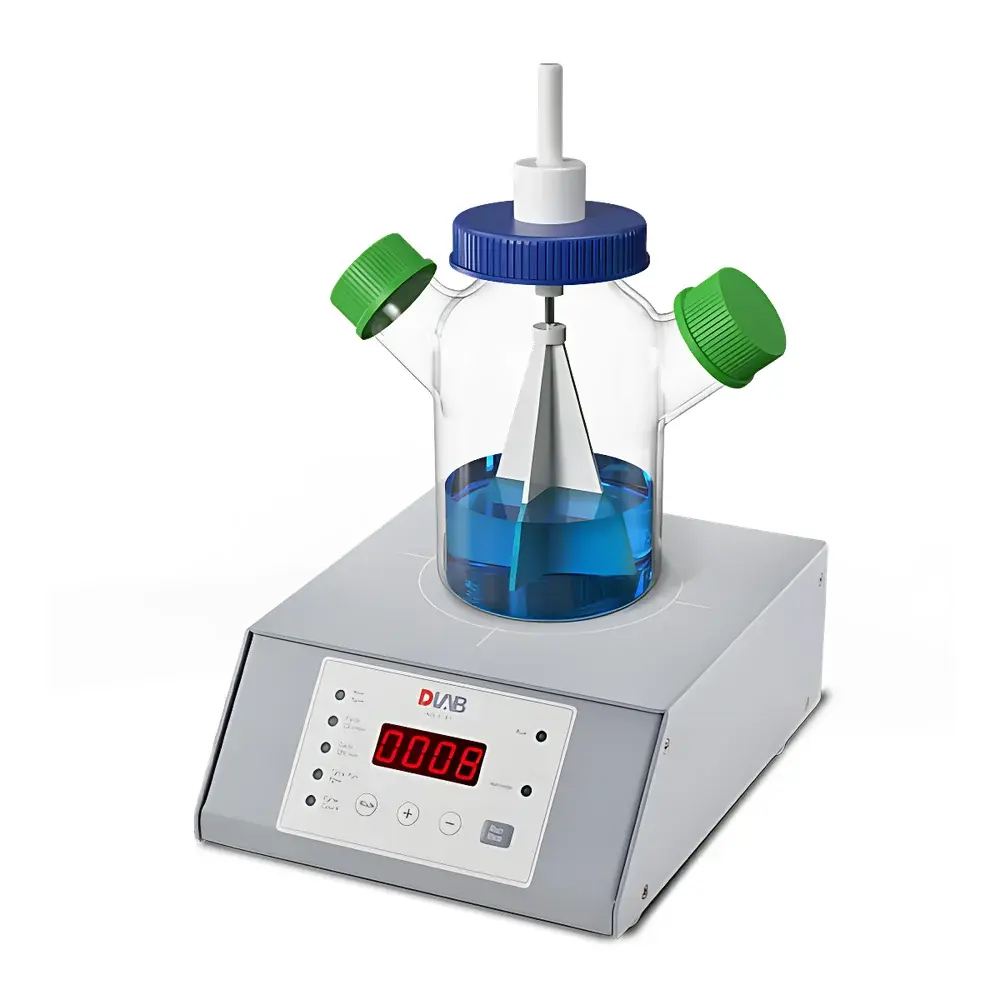
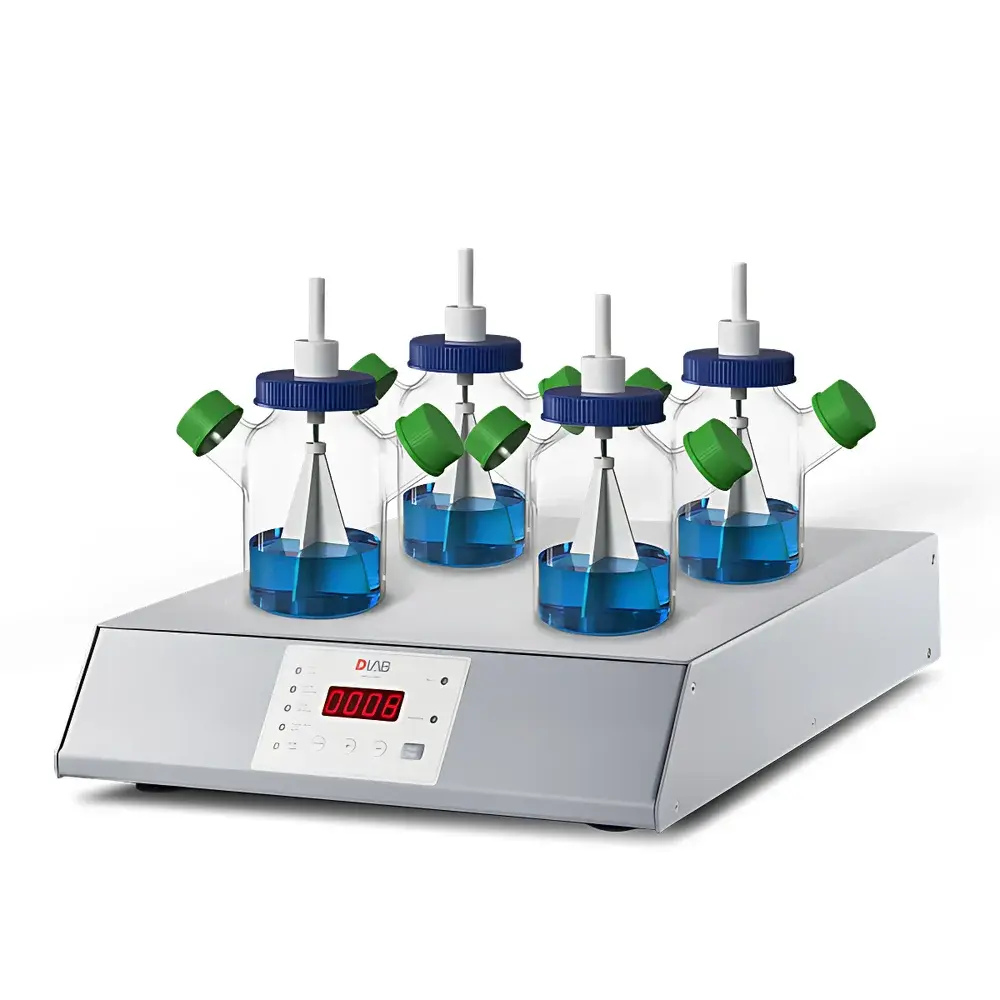
DLAB MS-C-S1/S4 Cell Culture Magnetic Stirrer
| Brand | DLAB |
|---|---|
| Origin | Beijing, China |
| Manufacturer Type | Direct Manufacturer |
| Product Category | Domestic |
| Model | MS-C-S1 / MS-C-S4 |
| Instrument Type | Magnetic Stirrer |
| Max Stirring Volume | 3 L (S1) / 3 L × 4 (S4) |
| Speed Range | 5–200 rpm (Resolution: ±1 rpm) |
| Display | LED Digital Speed Readout |
| Motor Type | Stepper Motor |
| Plate Material | Cast Aluminum |
| Plate Diameter | Ø105 mm |
| Max Stir Bar Length | 80 mm |
| IP Rating | IP21 |
| Output Power | 15 W |
| Power Supply | 100–120 V / 200–240 V, 50/60 Hz |
| Dimensions (L×W×H) | 250×205×90 mm (S1) / 450×395×90 mm (S4) |
| Weight | 2.5 kg (S1) / 5.5 kg (S4) |
| Operating Temperature | 5–40 °C |
| Relative Humidity | ≤80% RH |
| Communication Interface | RS232 |
Overview
The DLAB MS-C-S1 and MS-C-S4 Magnetic Stirrers are purpose-engineered for sensitive cell culture applications requiring precise, low-shear agitation under controlled environmental conditions. Unlike conventional magnetic stirrers optimized for general lab mixing, the MS-C series integrates a high-torque stepper motor with ultra-fine speed resolution (±1 rpm) and programmable multi-mode operation to maintain cellular integrity during long-term suspension culture, media equilibration, or reagent homogenization inside CO₂ incubators. The device operates on the principle of magnetic coupling—rotating a permanent magnet beneath a non-magnetic plate to drive a stir bar immersed in the sample—ensuring zero mechanical contact, minimal heat generation, and no risk of contamination through shaft penetration. Its compact footprint, sealed cast-aluminum heating plate, and IP21-rated enclosure enable reliable placement directly inside standard 37 °C incubators without compromising sterility or thermal uniformity.
Key Features
- Programmable multi-mode operation: selectable constant-speed, intermittent start-stop, and dual-speed cycling—ideal for mimicking physiological shear profiles or staged media conditioning.
- Low-speed precision control (5–200 rpm) with ±1 rpm resolution ensures reproducible, gentle agitation critical for adherent and suspension cell lines including CHO, HEK293, and primary neurons.
- High-torque stepper motor delivers consistent rotational force at low speeds without stalling—even with viscous culture media or large-volume flasks—eliminating vortex-induced shear stress.
- Incubator-compatible design: compact height (90 mm), corrosion-resistant anodized cast-aluminum plate, and drip-resistant surface geometry prevent condensation accumulation and support ISO 5 cleanroom-adjacent use.
- Smooth vertical motion profile during start/stop sequences minimizes transient turbulence—reducing mechanical stress on fragile cells and preventing pellet resuspension artifacts.
- LED digital display provides real-time feedback of actual rotational speed; RS232 interface enables integration into automated lab environments for GLP-compliant data logging and remote parameter adjustment.
Sample Compatibility & Compliance
The MS-C-S1 supports single-vessel stirring up to 3 L (e.g., spinner flasks, vented cap bottles), while the MS-C-S4 accommodates four independent 3 L vessels spaced at 190 mm intervals—enabling parallel culture condition screening or multi-line bioprocessing validation. Compatible with standard PTFE- or glass-coated stir bars up to 80 mm in length. Designed for use with aqueous-based cell culture media (e.g., DMEM, RPMI-1640), buffered saline solutions, and low-viscosity hydrogels (<10 mPa·s). Complies with IEC 61010-1:2010 for laboratory electrical equipment safety; meets EN 61326-1:2013 for electromagnetic compatibility in research settings. No integrated heating element—intended strictly for isothermal agitation within temperature-controlled enclosures per ISO 13485-aligned cell manufacturing workflows.
Software & Data Management
The RS232 serial interface supports ASCII-based command protocols for bidirectional communication with host systems running custom Python, LabVIEW, or MATLAB scripts. Enables time-stamped speed logging, mode change tracking, and audit-ready session records—fully compatible with FDA 21 CFR Part 11 requirements when deployed with validated electronic record systems. Optional DLAB StirControl™ software (v2.1+) provides graphical scheduling, alarm thresholds for speed deviation (>±3 rpm over 30 s), and export to CSV for downstream statistical analysis (e.g., ANOVA of growth rate vs. agitation profile). All firmware updates retain backward compatibility with existing hardware revisions.
Applications
- Suspension cell expansion in serum-free or chemically defined media under hypoxic or normoxic incubation.
- Uniform pH and dissolved oxygen distribution in static bioreactor seed trains prior to transfer to stirred-tank systems.
- Pre-incubation mixing of transfection reagents (e.g., lipofectamine–DNA complexes) to ensure stoichiometric homogeneity without foaming.
- Long-duration drug exposure assays where continuous low-shear rotation prevents sedimentation of adherent-derived spheroids or organoid fragments.
- QC testing of media lot consistency via standardized viscosity and buffering capacity assessment across multiple batches.
- GLP-regulated toxicology studies requiring traceable, repeatable agitation parameters per OECD Test Guideline 455 (Reprotox).
FAQ
Can the MS-C-S4 operate all four positions at different speeds simultaneously?
No—the MS-C-S4 drives all four stir points at the same set speed; independent speed control per channel is not supported.
Is the cast-aluminum plate autoclavable?
No—autoclaving is not recommended due to thermal expansion mismatch and potential coating degradation; surface disinfection with 70% ethanol or hydrogen peroxide vapor is validated.
Does the device meet ISO 14644-1 Class 5 cleanroom requirements?
While not certified for unidirectional airflow environments, its sealed construction and lack of moving external parts permit use in ISO 14644-1 Class 7–8 supporting labs when installed within pass-through chambers.
What stir bar size is optimal for 3 L spinner flasks?
A 60–75 mm elliptical PTFE-coated stir bar with internal magnet alignment yields optimal torque transfer and laminar flow at 30–60 rpm in standard 3 L vessels.
Can RS232 logs be timestamped using NTP synchronization?
Yes—when connected to a host PC with NTP-enabled OS (e.g., Windows Server or Linux with systemd-timesyncd), timestamps align to UTC with <100 ms drift over 24 h.



