
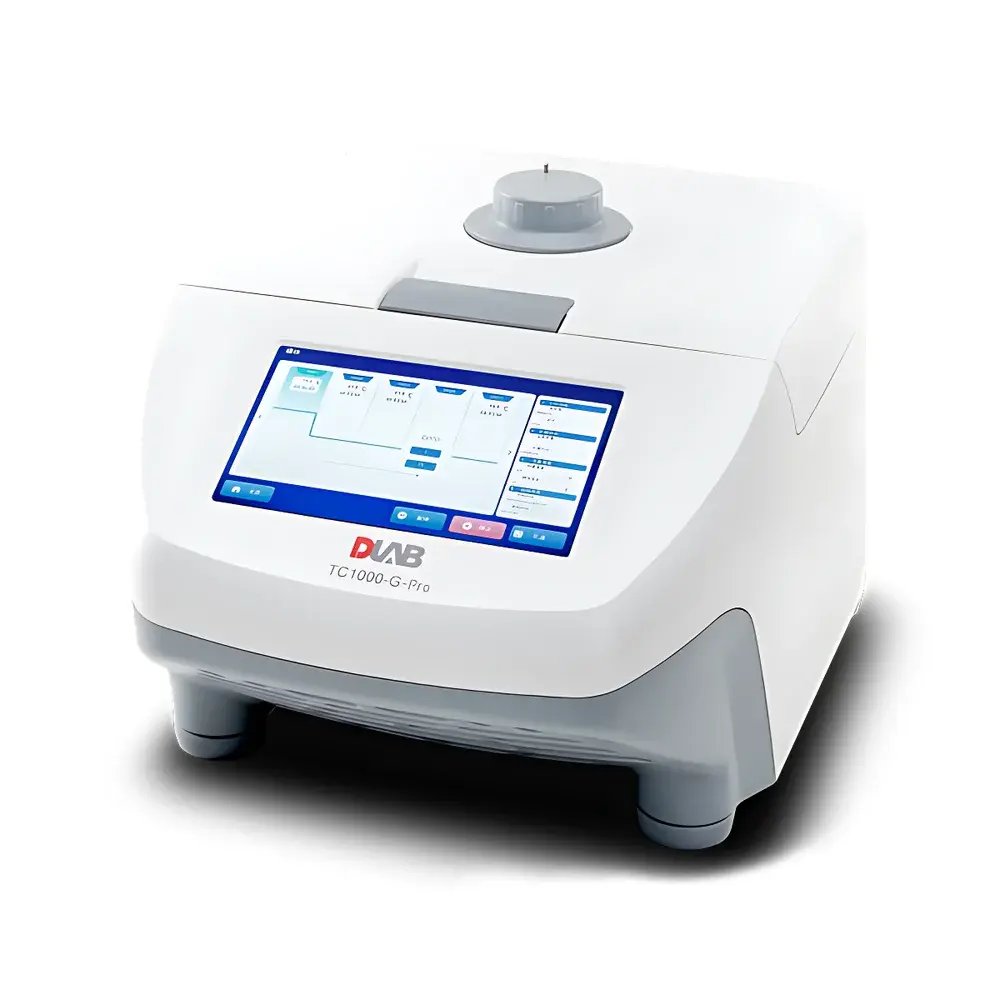
DLAB TC1000-G-Pro Gradient Thermal Cycler
| Brand | DLAB |
|---|---|
| Model | TC1000-G-Pro |
| Instrument Type | Gradient PCR Thermal Cycler |
| Sample Capacity | 96 × 0.2 mL tubes / 12 × 0.2 mL strips / 0.2 mL 96-well plates |
| Block Temperature Range | 0–105 °C |
| Heat Lid Temperature Range | 30–115 °C |
| Temperature Display Accuracy | ±0.1 °C |
| Temperature Control Accuracy (at 55 °C) | ±0.1 °C |
| Temperature Uniformity (at 55 °C) | ±0.2 °C |
| Max Ramp Rate | 5 °C/sec |
| Gradient Range | 30–105 °C |
| Gradient Span | 1–42 °C |
| Temperature Control Mode | Block- or Tube-based |
| Block Material | Anodized Aluminum |
| Display | 7″ LCD (1024 × 600) |
| Input Method | Touchscreen + PC-based host software |
| Communication Interfaces | USB 2.0, Wi-Fi (IEEE 802.11 b/g/n) |
| Power Supply | 100–120 V / 200–240 V, 50/60 Hz |
| Dimensions (L×W×H) | 280 × 370 × 250 mm |
| Weight | 9.5 kg |
| Data Retention (Power Loss Recovery) | >20,000 cycles (USB flash memory) |
Overview
The DLAB TC1000-G-Pro Gradient Thermal Cycler is an engineered solution for precise, reproducible nucleic acid amplification under variable thermal conditions. Based on Peltier-driven solid-state thermoelectric control and optimized aluminum block architecture, it delivers high-fidelity thermal ramping and uniform temperature distribution across the entire 96-well footprint. Its gradient capability enables simultaneous evaluation of up to 12 distinct annealing temperatures within a single run—critical for primer optimization, assay development, and robustness testing in molecular diagnostics, academic research, and quality-controlled production environments. Designed for compliance with ISO/IEC 17025 laboratory management principles, the instrument supports traceable thermal performance validation and integrates seamlessly into GLP-compliant workflows.
Key Features
- True gradient functionality with programmable span (1–42 °C) and range (30–105 °C), enabling rapid empirical determination of optimal annealing conditions without sequential runs.
- Dual-mode temperature control: selectable Block-based or Tube-based calibration ensures accuracy whether using standard 0.2 mL tubes, 8-tube strips, or full-skirted/unskirted 96-well plates.
- High-resolution 7-inch capacitive touchscreen (1024 × 600) with intuitive icon-driven interface; real-time visualization of current cycle, step progress, and estimated time-to-completion.
- Integrated Wi-Fi module compliant with IEEE 802.11 b/g/n standards allows secure local-area network deployment—enabling centralized monitoring and synchronized multi-unit control via DLAB’s PC-based host software.
- USB 2.0 port supports direct data export/import, firmware updates, and user-defined protocol storage; internal flash memory retains >20,000 power-loss recovery events with timestamped audit trail.
- Active heat lid with adjustable pressure and temperature range (30–115 °C) prevents condensation and ensures consistent evaporation control across all well formats.
Sample Compatibility & Compliance
The TC1000-G-Pro accommodates industry-standard consumables including thin-walled 0.2 mL PCR tubes, 8-tube strips (with or without caps), and 96-well plates—regardless of skirt configuration (non-, semi-, or full-skirted). All thermal specifications are validated per ASTM E2234-22 (Standard Practice for Calibration of Thermal Cyclers) and align with ISO 13485 requirements for medical device-related nucleic acid testing. The system supports electronic record retention in accordance with FDA 21 CFR Part 11 when used with validated host software and controlled access accounts—facilitating audit readiness for clinical or regulated manufacturing settings.
Software & Data Management
DLAB’s proprietary thermal cycler host software provides cross-platform (Windows/macOS) protocol design, remote scheduling, and batch execution. Each user account can be assigned role-based permissions (e.g., operator, supervisor, administrator), enforcing password-protected access to critical functions such as method editing, calibration reset, and firmware update. All program executions generate immutable log files containing timestamps, thermal profiles, error codes, and user IDs—exportable in CSV or PDF for QA documentation. Software updates may be deployed locally via USB or over secure Wi-Fi, with version rollback capability and SHA-256 integrity verification.
Applications
- Primer and probe optimization through parallel gradient screening across multiple annealing temperatures.
- Validation of qPCR assay robustness under varying thermal conditions per CLSI EP23-A guidelines.
- Amplification of GC-rich or secondary-structure-prone templates requiring precise ramp rate control (up to 5 °C/sec).
- Preparation of amplicons for downstream NGS library construction where template integrity and yield consistency are critical.
- Teaching laboratories requiring reliable, low-maintenance thermal cycling with intuitive operation and remote classroom management.
FAQ
Does the TC1000-G-Pro support remote firmware updates via Wi-Fi?
Yes—firmware updates can be initiated remotely over a secured local network using the host software, with cryptographic signature verification to ensure authenticity.
Can I export raw thermal profile data for third-party analysis?
Yes—each run generates a timestamped .csv file containing cycle-by-cycle block temperature, lid temperature, ramp rates, and dwell times, compatible with MATLAB, Python (NumPy/Pandas), or Excel.
Is the heat lid pressure adjustable for different plate types?
The heat lid applies consistent downward force via spring-loaded mechanism; no manual adjustment is required—the system automatically maintains optimal contact across all supported plate geometries.
What safety certifications does this instrument carry?
It complies with IEC 61010-1:2010 for laboratory equipment safety and meets EMC requirements per IEC 61326-1:2013 Class A, with CE marking and RoHS 3 compliance documented in the technical dossier.
How is temperature uniformity verified during factory calibration?
Each unit undergoes 9-point thermal mapping using NIST-traceable PT100 sensors at 55 °C and 95 °C; results are recorded in the Certificate of Conformance shipped with the instrument.



