
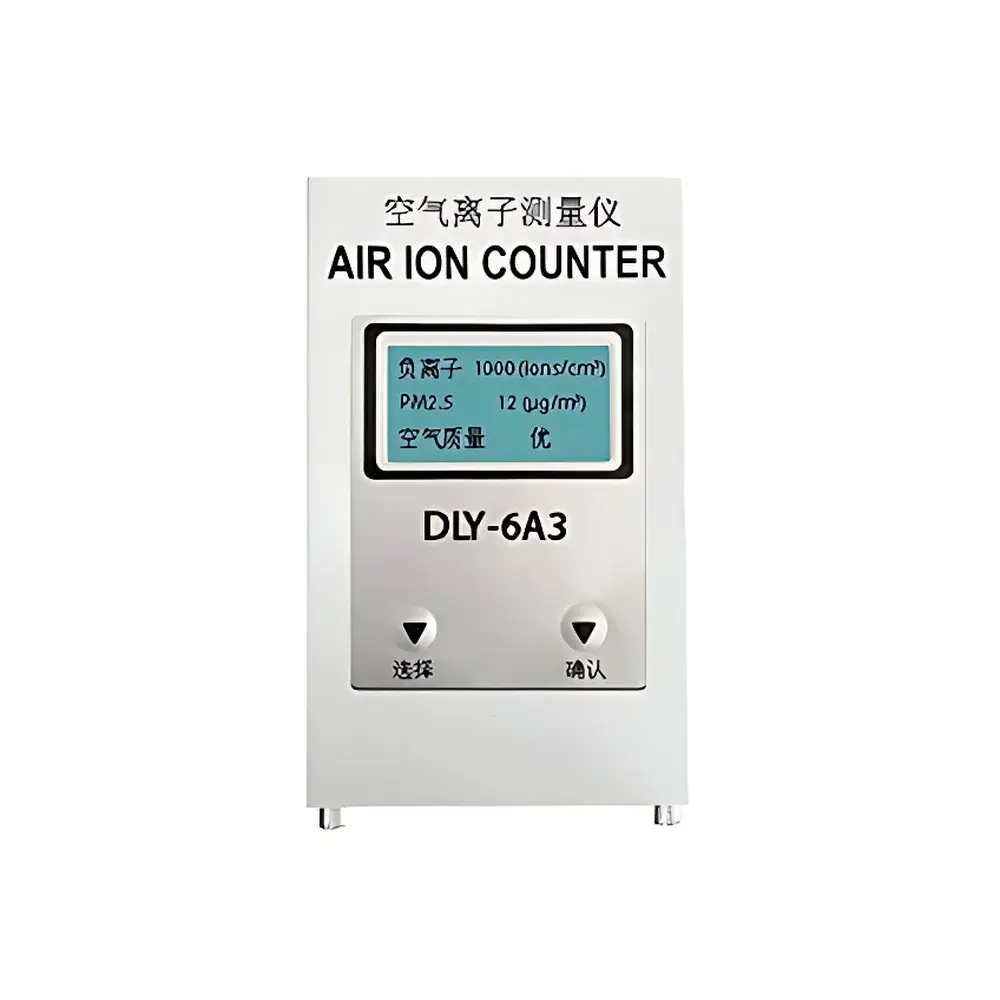
DLY-6A3 Air Negative Ion and PM2.5 Monitor
| Origin | Beijing, China |
|---|---|
| Manufacturer Type | Distributor |
| Origin Category | Domestic (China) |
| Model | DLY-6A3 |
| Price Range | USD 1,400 – 2,800 |
| Ion Measurement Range | 1–1.5×10⁶ ions/cm³ |
| Polarity | Positive or Negative |
| Resolution | 2 ions/cm³ |
| Measurement Cycle | 60 seconds |
| Mobility | 0.4 cm²/(V·s) |
| PM2.5 Detection | Integrated optical scattering sensor |
| Data Interface | USB-to-Serial (CP210x chipset) |
| PC Compatibility | Windows XP/7/8/10 |
| Software | KT.exe with real-time plotting, parameter configuration, and dual-mode data logging (instant/average) |
Overview
The DLY-6A3 Air Negative Ion and PM2.5 Monitor is an integrated environmental sensing instrument engineered for simultaneous quantitative assessment of airborne negative/positive ion concentration and particulate matter (PM2.5) mass concentration. It operates on the principle of air ion mobility spectrometry—drawing ambient air through a cylindrical collector electrode under a controlled electric field, where ions of defined polarity are selectively attracted and counted via electrometer-based current measurement. The ion mobility value of 0.4 cm²/(V·s) corresponds to the standard classification for small air ions (diameter < 1.6 nm), ensuring compatibility with widely accepted atmospheric ion physics models. Concurrently, PM2.5 is measured using a calibrated optical scattering (nephelometric) module, with compensation algorithms for humidity and temperature drift. The device computes a composite air quality index (AQI) based on dual-parameter correlation—aligning with empirical thresholds used in Chinese environmental standards (HJ 618–2011, GB/T 18883–2022) for indoor and outdoor micro-environmental evaluation.
Key Features
- Simultaneous dual-parameter acquisition: real-time negative ion, positive ion, net bipolar ion concentration, and PM2.5 mass concentration (μg/m³)
- Auto-ranging ion detection from 1 to 1.5 × 10⁶ ions/cm³ with 2 ions/cm³ resolution—optimized for forest, urban, and indoor settings
- Selectable measurement modes: negative-ion-only, positive-ion-only, or bipolar differential mode
- Integrated temperature and relative humidity compensation for both ion and PM2.5 channels
- 60-second standardized measurement cycle—compliant with routine monitoring intervals recommended by ISO 29463-1:2011 for aerosol instrumentation stability verification
- Ruggedized handheld enclosure with electrostatic-shielded sensor chamber and laminar-flow inlet design to minimize turbulence-induced ion recombination
Sample Compatibility & Compliance
The DLY-6A3 is validated for continuous operation in ambient air environments ranging from −10 °C to +45 °C and 20–95% RH (non-condensing). It meets electromagnetic compatibility requirements per GB/T 18268.1–2010 (equivalent to IEC 61326-1:2012) for laboratory and field-use instrumentation. While not certified to ISO/IEC 17025 for accredited calibration, its ion channel demonstrates repeatability ≤ ±3% RSD over 24-hour continuous operation when operated within specified environmental limits. The PM2.5 module adheres to the light-scattering principle outlined in EPA EQPM-0609-193 and supports traceability via factory calibration against NIST-traceable polystyrene latex (PSL) spheres. Device firmware and software architecture support audit-ready data integrity practices—including timestamped records, user-defined session IDs, and immutable storage of raw sensor outputs.
Software & Data Management
The KT.exe desktop application (Windows only) provides full bidirectional communication via virtual COM port (CP210x driver required). It enables remote configuration of sampling interval, averaging window, polarity selection, and alarm thresholds. All measurements are logged with UTC timestamps and stored in CSV-compatible binary format, supporting two retention modes: instantaneous point values (1 Hz equivalent) and user-configurable moving averages (1–60 minute windows). The software implements basic GLP-aligned features: operator login (text-based), session metadata tagging, and exportable audit logs showing parameter changes and connection events. Raw datasets include synchronized ion polarity flags, PM2.5 confidence indicators, and internal sensor diagnostics (e.g., flow rate deviation, voltage stability). No cloud upload or third-party API integration is supported; all data remains locally resident unless manually exported.
Applications
- Indoor air quality (IAQ) assessment in offices, schools, hospitals, and wellness centers—correlating ion depletion with HVAC efficiency and VOC presence
- Ecological monitoring in forests, waterfalls, mountain resorts, and coastal zones—quantifying natural ion generation gradients
- Validation of ionizer and air purifier performance per GB/T 18801–2015 test protocols
- Research-grade correlation studies between atmospheric ion concentration, PM2.5 loadings, and meteorological variables (e.g., barometric pressure, solar radiation)
- Educational laboratories demonstrating gas-phase charge transport, aerosol dynamics, and environmental sensor fusion principles
FAQ
Does the DLY-6A3 require annual recalibration?
No formal recalibration certificate is issued. Users are advised to perform functional verification every 6 months using a known ion source (e.g., alpha-emitting check source) and reference PM2.5 aerosol generator.
Can the device operate autonomously without a PC connection?
Yes—the instrument performs standalone measurements and displays real-time ion and PM2.5 values on its built-in LCD. PC connectivity is optional and used solely for extended logging, configuration, and visualization.
Is the KT.exe software compatible with macOS or Linux?
No. KT.exe is a native Windows executable and does not support Wine, virtualization, or cross-platform emulation environments.
What is the expected service life of the ion collector electrode?
Under normal use (≤8 hours/day, low-dust environments), the stainless-steel collector maintains stable sensitivity for ≥3 years. Cleaning with isopropyl alcohol and lint-free swabs is recommended quarterly.
Does the device meet FDA 21 CFR Part 11 requirements?
No. KT.exe lacks electronic signature capability, audit trail encryption, and role-based access control—thus it is unsuitable for regulated GxP environments requiring Part 11 compliance.







