
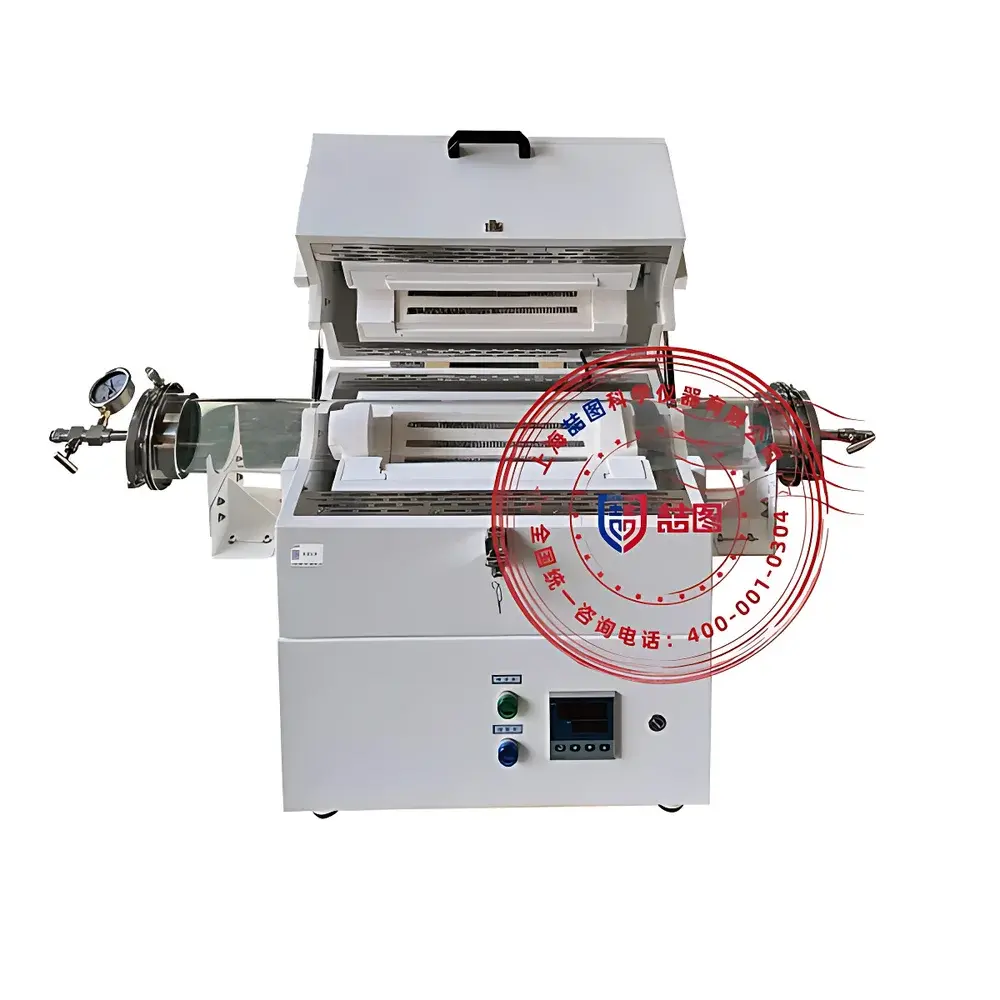
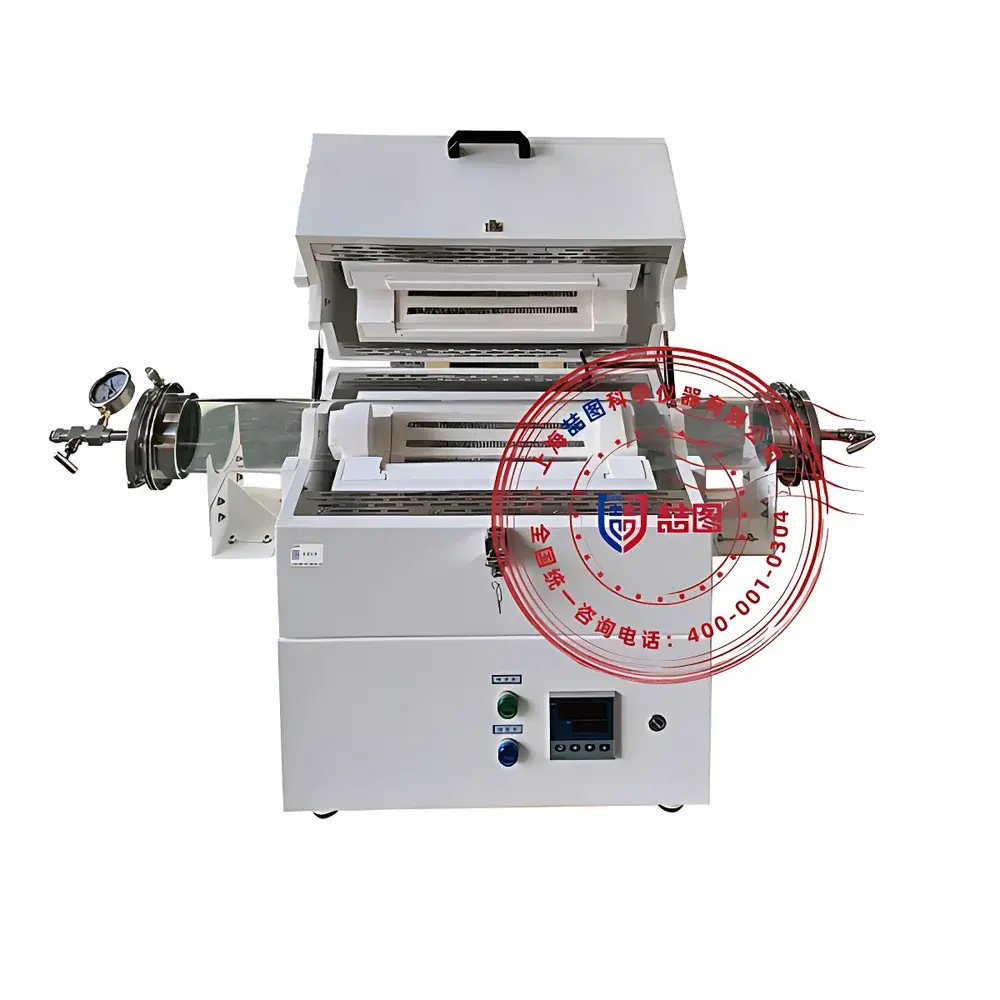
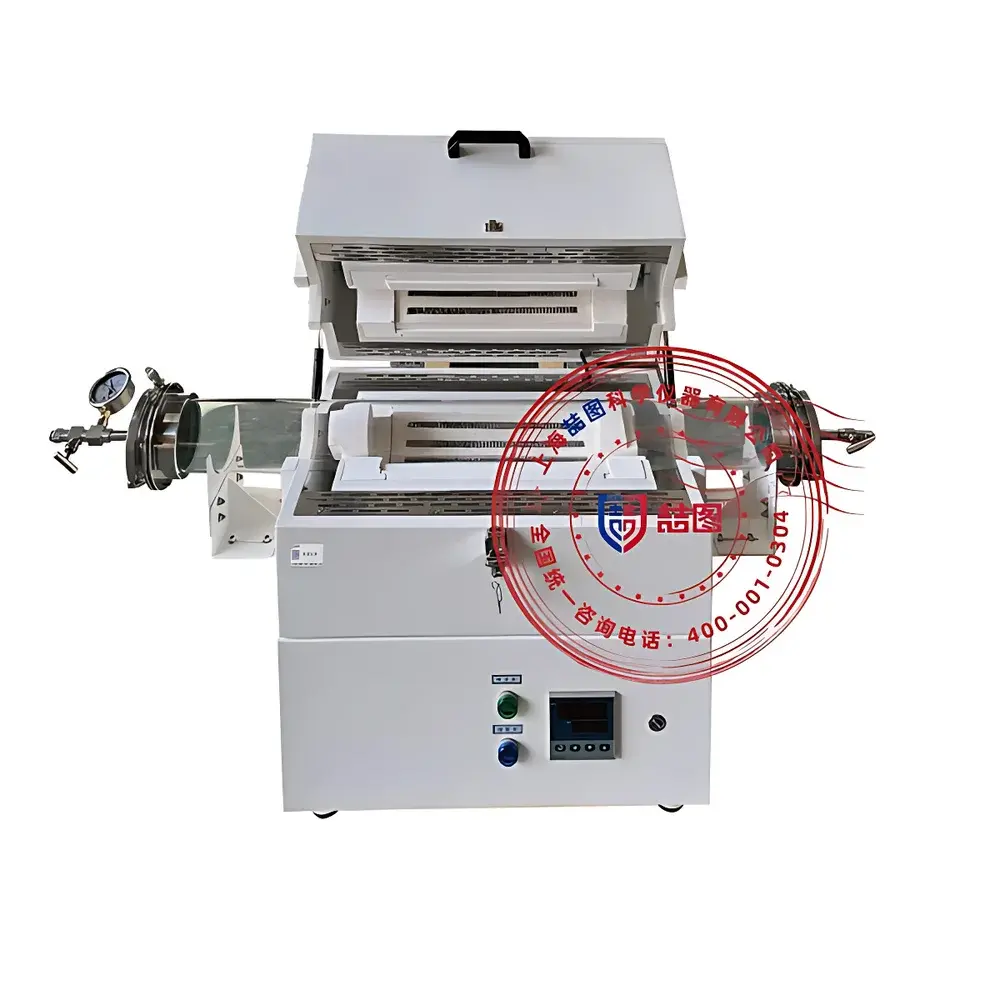
DRETOP GB17-1010B High-Temperature Vacuum Tube Furnace
| Brand | DRETOP |
|---|---|
| Origin | Shanghai, China |
| Model | GB17-1010B |
| Instrument Type | Horizontal Tube Furnace |
| Max Temperature | 1700 °C |
| Temperature Control Accuracy | ±1 °C |
| Max Power | 9 kW |
| Heating Time to Max Temp | ≤60 min |
| Heating Element | Silicon Molybdenum (MoSi₂) Rods |
| Tube Diameter | 100 mm |
| Control Method | Programmable PID Controller |
| Vacuum Capability | Yes (with optional vacuum pump) |
| Atmosphere Compatibility | N₂, Ar, H₂, forming gas, and other inert/reducing gases |
| Sealing | Dual O-ring KF stainless steel flanges |
| Tube Material | High-purity alumina (Al₂O₃) or optional quartz (for ≤1200 °C) |
| Safety Features | Over-temperature protection, thermocouple break alarm, door-interlocked heating cutoff, leakage current protection |
Overview
The DRETOP GB17-1010B is a horizontally oriented, high-temperature vacuum tube furnace engineered for precise thermal processing under controlled atmospheric and vacuum conditions. It operates on the principle of resistive heating via silicon molybdenum (MoSi₂) rods, enabling stable and uniform temperature distribution across its 100 mm internal diameter alumina tube—rated for continuous operation up to 1700 °C (recommended service limit: 1600 °C). Unlike conventional muffle furnaces, this system integrates dual functionality: high-vacuum capability (typically down to 10⁻³ mbar with compatible pumps) and programmable multi-gas atmosphere control. This architecture supports applications requiring strict exclusion of oxygen and moisture—such as oxide-sensitive sintering, CVD precursor decomposition, or reduction annealing—while maintaining traceability and repeatability essential for materials R&D, quality assurance, and process validation in regulated environments.
Key Features
- High-temperature capability: Rated for 1700 °C with MoSi₂ heating elements and high-purity alumina tube construction—chemically inert, low thermal expansion, and resistant to thermal shock.
- Vacuum-integrated design: Equipped with KF-25/40 stainless steel flanges featuring dual elastomeric O-ring seals; compatible with standard rotary vane or turbomolecular vacuum pumps.
- Programmable thermal profiling: 30-segment PID controller enables complex ramp-hold-cool sequences with adjustable rates (0.1–30 °C/min), supporting ISO/ASTM-compliant heat treatment protocols.
- Thermal efficiency & uniformity: Multi-layered insulation using polycrystalline mullite fiber yields radial temperature uniformity of ±5 °C over a 350 mm hot zone (B-series configuration).
- Safety-engineered interlocks: Automatic power cutoff upon furnace door opening; independent over-temperature cutout (settable above operating range); grounded chassis with residual-current device (RCD) protection.
- Modular gas handling: Side-mounted gas inlet/outlet ports with VCR or Swagelok-compatible fittings; optional mass flow controllers (MFCs) and pressure regulators support dynamic atmosphere switching during thermal cycles.
Sample Compatibility & Compliance
The GB17-1010B accommodates cylindrical or rod-shaped samples up to 100 mm in diameter and 350 mm in length (standard B-zone configuration). Its alumina tube is suitable for air-sensitive ceramics, battery cathode precursors (e.g., LiCoO₂, NMC), metal injection molded (MIM) compacts, semiconductor substrates, and carbon-based nanomaterials. The system meets mechanical and electrical safety requirements per IEC 61010-1 and conforms to electromagnetic compatibility (EMC) standards EN 61326-1. When configured with audit-trail-capable software and calibrated Class 1 thermocouples (Type S or B), it supports GLP/GMP-aligned workflows—including FDA 21 CFR Part 11 compliance when paired with validated data acquisition systems.
Software & Data Management
The integrated controller supports RS485/Modbus RTU communication for external SCADA or LIMS integration. Optional PC-based software provides real-time temperature logging, profile upload/download, and event-triggered data export (CSV/TXT). All thermal cycles are timestamped and include operator ID, setpoint history, actual temperature deviation, and alarm logs—enabling full traceability for internal audits or regulatory submissions. Calibration records for thermocouples and temperature uniformity mapping (per ASTM E220 or ISO/IEC 17025 guidelines) can be archived alongside run data.
Applications
This furnace serves critical roles in advanced materials development and production support: sintering of ultra-high-temperature ceramics (UHTCs) and refractory metals; annealing of graphene and transition metal dichalcogenides under H₂/Ar; thermal decomposition of metal-organic frameworks (MOFs); solid-state synthesis of phosphors and scintillators; binder burnout and debinding in MIM/CIM processes; low-pressure chemical vapor deposition (LPCVD) of SiC or TiN coatings; and thermal stability testing of battery electrode materials per UL 1642 or IEC 62133 protocols. Its vacuum-atmosphere flexibility also supports research in hydrogen storage alloys, superconducting oxides, and catalyst regeneration.
FAQ
What maximum vacuum level can the GB17-1010B achieve?
With a compatible two-stage rotary vane pump, typical base pressure is 1×10⁻³ mbar; with a turbomolecular pump, pressures below 1×10⁻⁵ mbar are attainable.
Is the furnace compatible with hydrogen atmospheres?
Yes—when equipped with leak-tested KF flanges, H₂-rated seals, and appropriate ventilation/safety interlocks per NFPA 55 and local hydrogen handling codes.
Can the heating zone length be customized?
Standard configurations offer 205 mm (A), 350 mm (B), or 400 mm (C) hot zones; custom lengths are available upon request with recalibrated thermal uniformity validation.
Does the system include vacuum pump and gas delivery components?
No—these are optional accessories selected based on application requirements (e.g., dry scroll pump for clean vacuum, MFCs for precise gas blending).
How is temperature uniformity verified and documented?
Uniformity mapping is performed per ASTM E220 using at least nine calibrated thermocouples; a certificate of uniformity (±5 °C over specified zone) is provided with each unit.



