
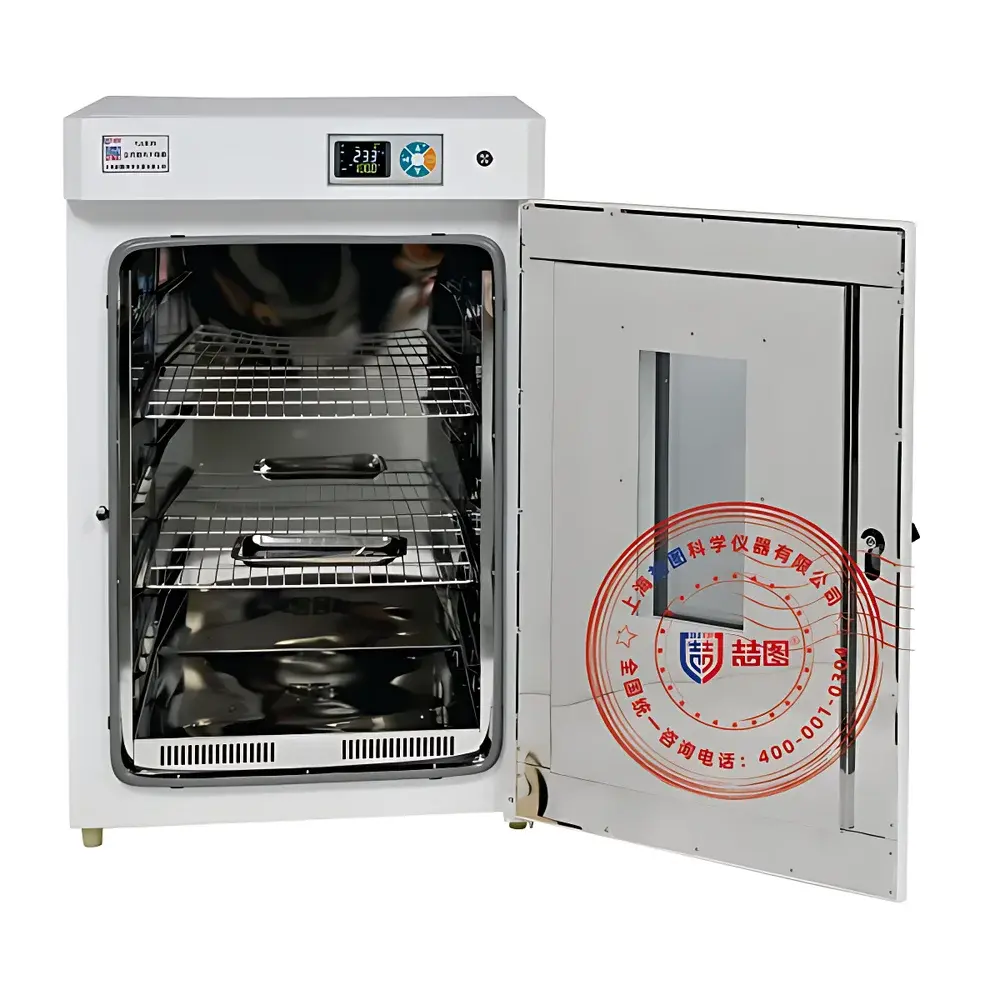
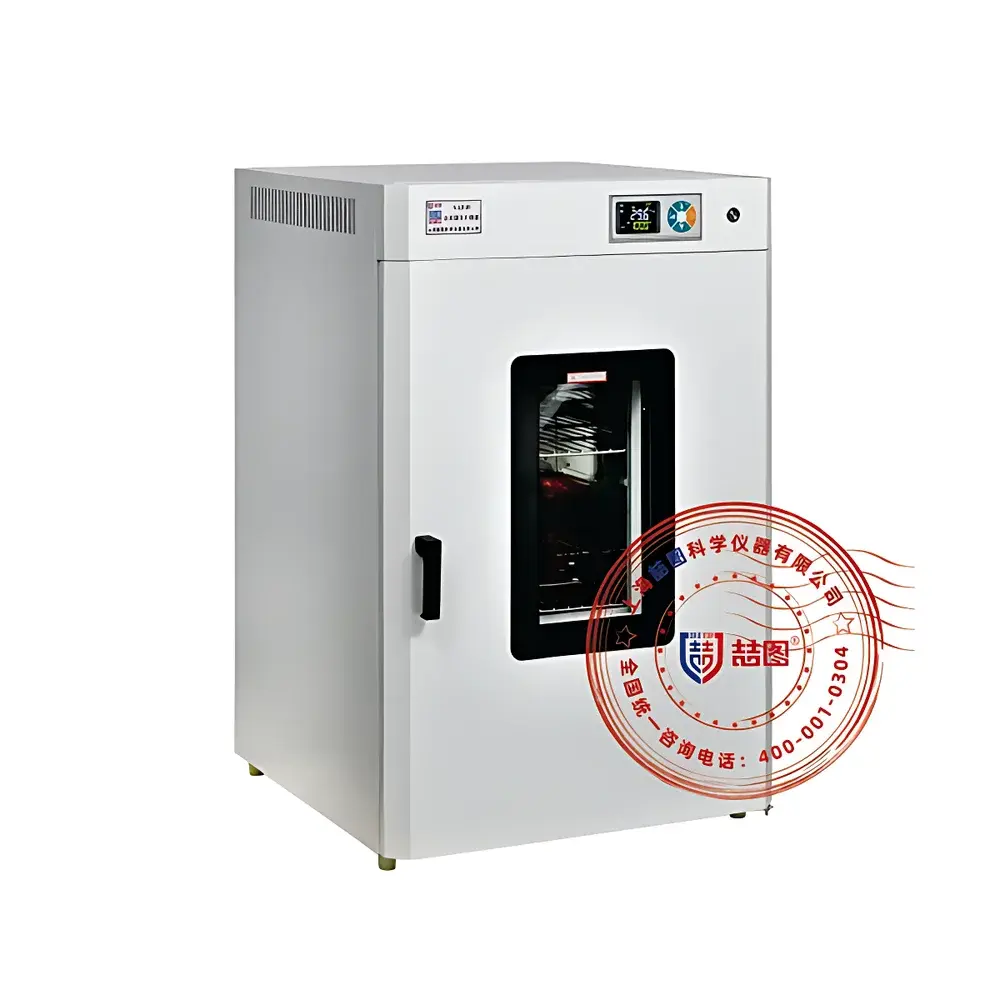
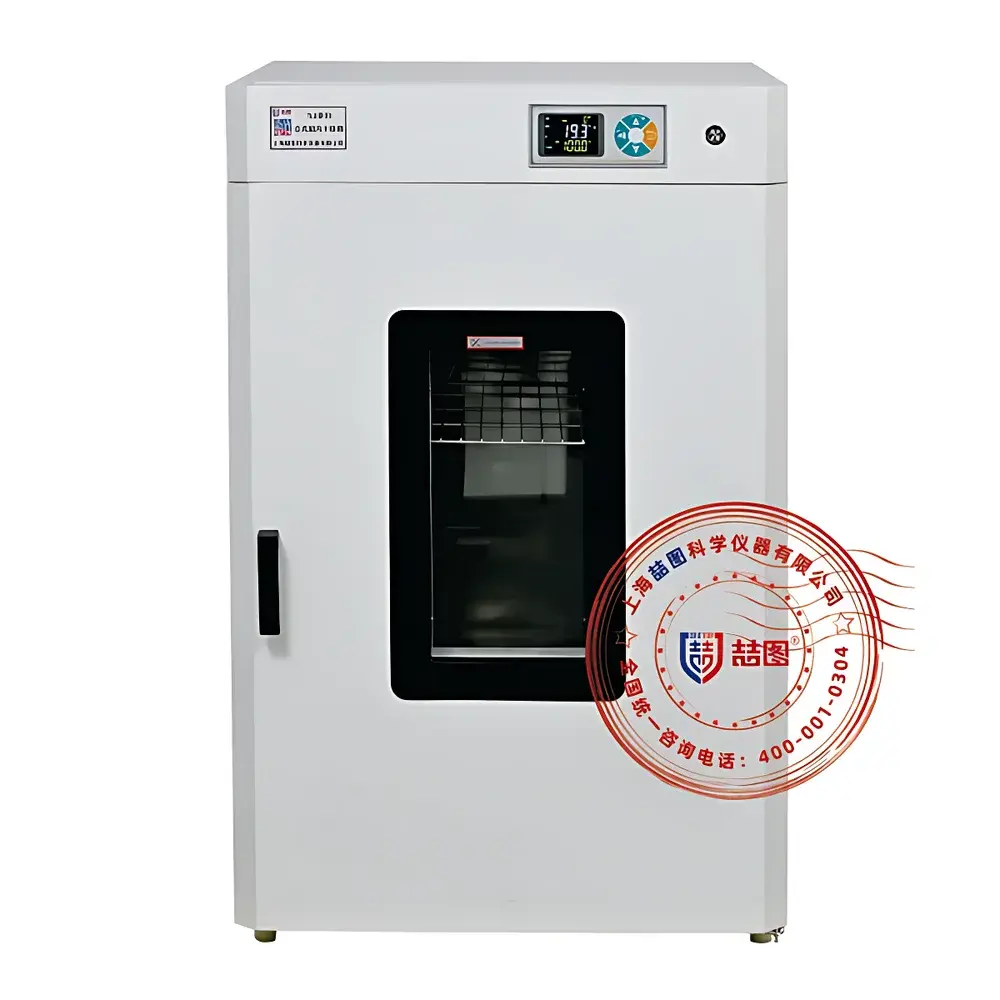
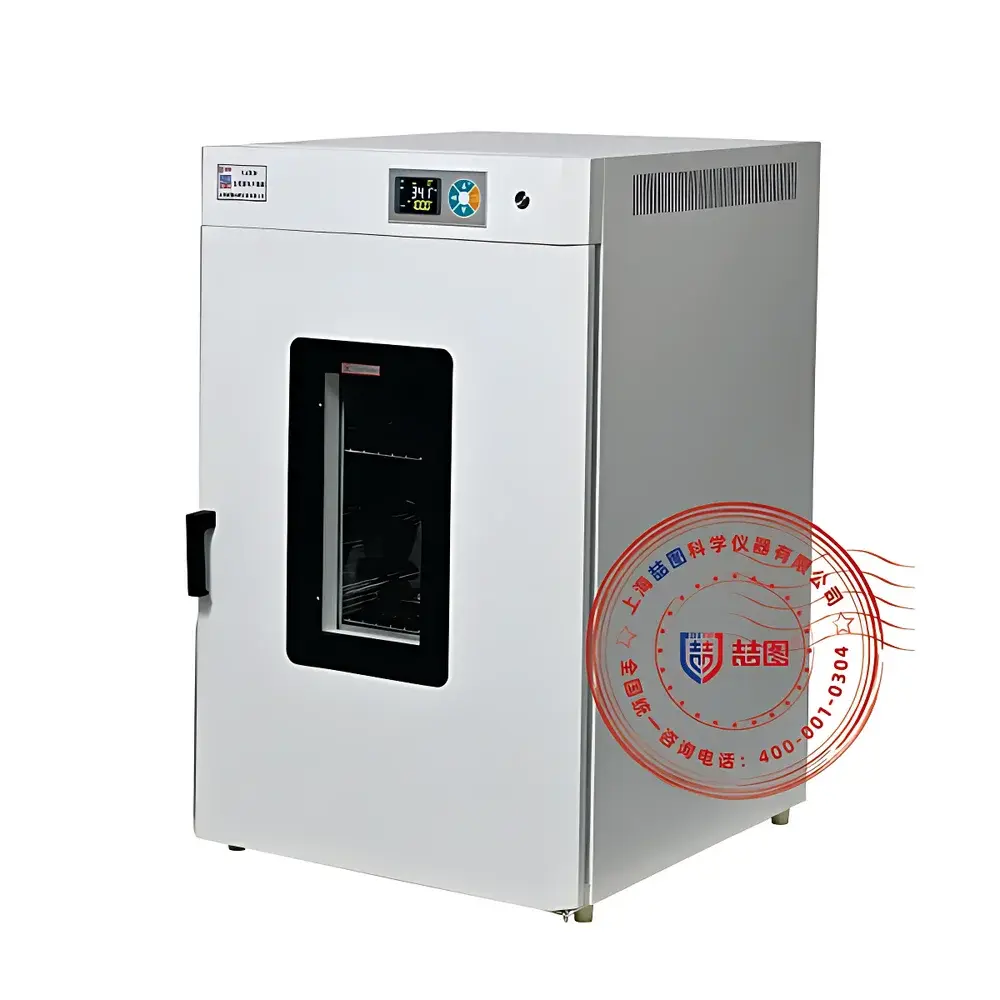
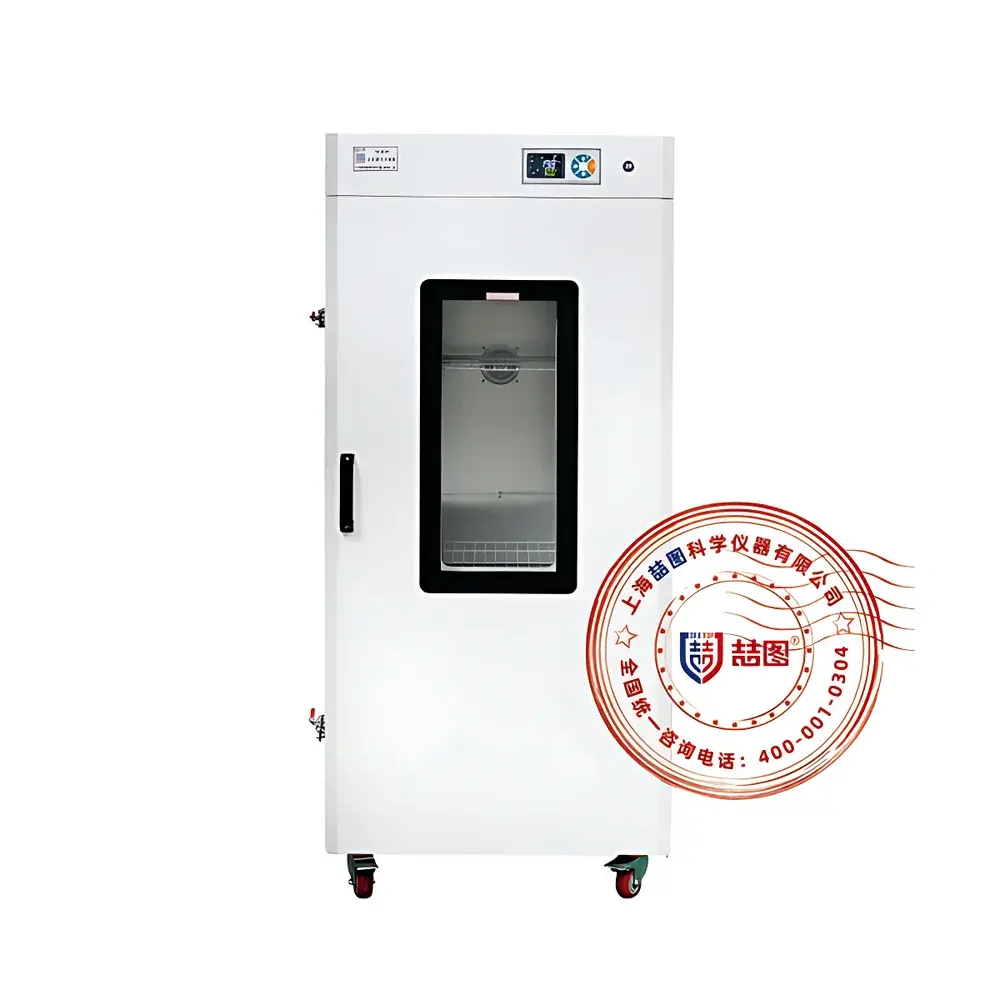
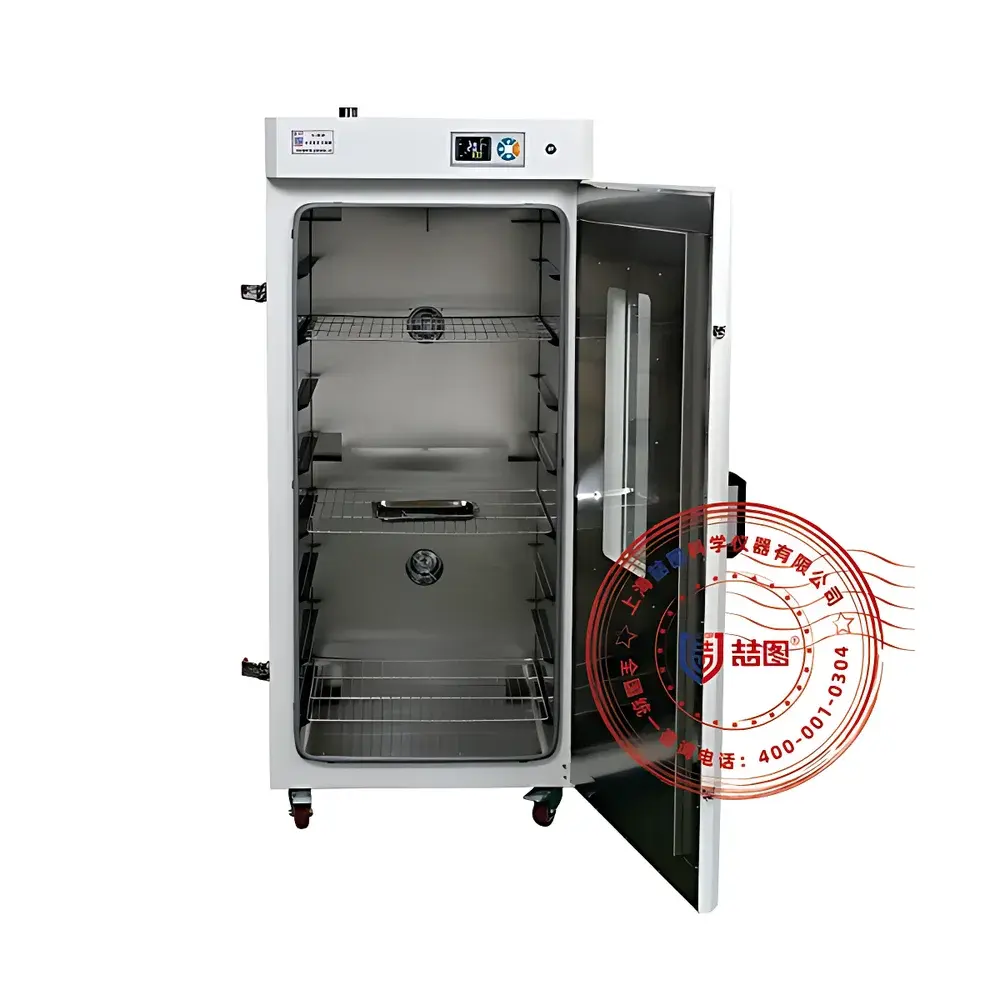
DRETOP TLG-9420A Vertical Forced-Air Drying Oven
| Brand | DRETOP |
|---|---|
| Origin | Shanghai, China |
| Model | TLG-9420A |
| Instrument Type | General-Purpose Forced-Convection Oven |
| Temperature Range | RT+10°C to 250°C (operational up to 300°C) |
| Temperature Uniformity | ±2.5°C (empty chamber, at 100°C) |
| Temperature Fluctuation | ±0.5°C |
| Temperature Resolution | 0.1°C |
| Working Environment | +5°C to +45°C |
| Internal Dimensions (W×D×H) | 600 × 550 × 1300 mm |
| External Dimensions (W×D×H) | 770 × 705 × 1750 mm |
| Chamber Material | Stainless Steel (SUS304) |
| Heating Method | Horizontal Rear-Mounted Forced-Air Circulation |
| Airflow Design | Optimized dual-channel convection duct system with rear exhaust port for optional external venting |
| Power Supply | AC 220 V, 50 Hz |
| Rated Power | 3000 W |
| Standard Shelving | 2 adjustable stainless steel trays (removable, height-adjustable) |
| Timer Range | 1–9999 minutes |
| Safety Features | Dual-limit temperature protection, fault-code diagnostics, auto-restart after power recovery, audible/visual over-temperature alarm |
Overview
The DRETOP TLG-9420A Vertical Forced-Air Drying Oven is an engineered solution for precise, repeatable thermal processing in research laboratories, quality control environments, and industrial R&D facilities. Designed around the principle of forced-convection heat transfer, it employs a horizontally oriented, rear-mounted high-temperature fan coupled with a symmetrical dual-channel airflow duct system to ensure uniform thermal distribution across its 420 L working chamber. Unlike natural-convection ovens, this model maintains consistent air velocity and directional flow—critical for applications requiring minimal thermal gradient (±2.5°C uniformity at 100°C, empty chamber) and tight process control (±0.5°C fluctuation). Its vertical footprint minimizes benchtop space usage while enabling scalable sample loading via three-tier stainless steel shelving—optimized for batch drying, pre-conditioning, moisture removal, sterilization validation support, and accelerated aging studies in compliance with ISO 554, ASTM E145, and ICH Q1A(R2) environmental stress protocols.
Key Features
- Microprocessor-based P.I.D. temperature controller with 0.1°C resolution, programmable timer (1–9999 min), and real-time deviation monitoring.
- Dual-stage mechanical door lock with high-compression silicone gasket (heat-resistant to 350°C), ensuring long-term sealing integrity and energy efficiency.
- Double-layer tempered glass observation window with low-emissivity coating—provides clear visual access without compromising thermal insulation or operator safety.
- Rear-mounted horizontal exhaust port compatible with standard 50 mm ducting—enables safe evacuation of volatile organics, residual solvents, or process-generated fumes per OSHA 1910.1200 and local ventilation codes.
- Self-diagnostic firmware that displays alphanumeric error codes (e.g., E01 = sensor open circuit, E03 = over-temperature fault) directly on the 3-color LCD interface for rapid troubleshooting.
- Auto-recovery function retains setpoints and elapsed time during unexpected power interruption—essential for GLP-compliant long-duration stability testing.
Sample Compatibility & Compliance
The TLG-9420A accommodates heterogeneous loads—including stacked PCB assemblies, polymer film reels, ceramic substrates, pharmaceutical blister packs, and coated metal components—without compromising thermal homogeneity. Its stainless steel (SUS304) interior resists corrosion from saline mists, weak acids, and organic vapors, supporting ASTM B117 salt-spray preconditioning and IPC-TM-650 2.6.25 thermal shock cycling. The oven meets CE marking requirements under Directive 2014/35/EU (Low Voltage) and 2014/30/EU (EMC), and its construction aligns with ISO 14644-1 Class 8 cleanroom-compatible practices when used with HEPA-filtered inlet air kits (optional). For regulated industries, the device supports audit-ready operation when paired with optional RS485 Modbus RTU interface and 21 CFR Part 11–compliant data logging software (sold separately).
Software & Data Management
While the base unit operates via embedded firmware, optional digital enhancements extend traceability and automation capability. A USB data export module enables direct transfer of time-stamped temperature logs to FAT32-formatted USB drives—generating CSV files compatible with Excel, MATLAB, or LIMS platforms. The RS485 interface permits integration into centralized building management systems (BMS) or SCADA networks for remote monitoring and alarm relay. Optional color touchscreen controllers support multi-segment programmable ramp-soak profiles (up to 32 steps), ideal for ASTM D2857 moisture content determination or ISO 11357-3 polymer melting point verification. All logged data include timestamp, setpoint, actual chamber temperature, and event flags—meeting ALCOA+ principles for attributable, legible, contemporaneous, original, accurate, complete, consistent, enduring, and available records.
Applications
- Pre-drying of gravimetric samples prior to ash content analysis (AOAC 923.03, USP <641>).
- Accelerated stability testing of medical device packaging per ISO 11607-1.
- Curing of epoxy-coated electrical insulators and printed circuit board conformal coatings.
- Moisture equilibration of hygroscopic reference standards (e.g., NIST SRM 2890) under controlled RH-free conditions.
- Thermal conditioning of lithium-ion battery separators before electrochemical characterization.
- Residual solvent removal from API intermediates in non-GMP pilot-scale synthesis.
FAQ
What is the maximum continuous operating temperature of the TLG-9420A?
The chamber is rated for continuous operation up to 250°C; short-term exposure to 300°C is permissible for calibration or cleaning cycles, provided dwell time remains under 30 minutes.
Can the oven be validated for IQ/OQ/PQ protocols?
Yes—its stable thermal profile, documented sensor linearity (PT100 class B), and optional data logging enable full qualification per ASTM E2297 and EU Annex 15 guidelines.
Is the internal fan speed adjustable?
No—the fan operates at fixed optimal RPM for uniform airflow; however, an optional front-panel air velocity selector switch (accessory) allows manual reduction for delicate samples.
Does the unit comply with energy efficiency standards?
It meets China’s GB 30253–2013 Level 2 energy efficiency rating and exceeds EU Ecodesign Directive 2019/2021 minimum requirements for laboratory ovens.
What maintenance intervals are recommended?
Inspect door gasket compression and clean air intake filters every 90 days; recalibrate temperature sensors annually using NIST-traceable dry-block calibrators.



