
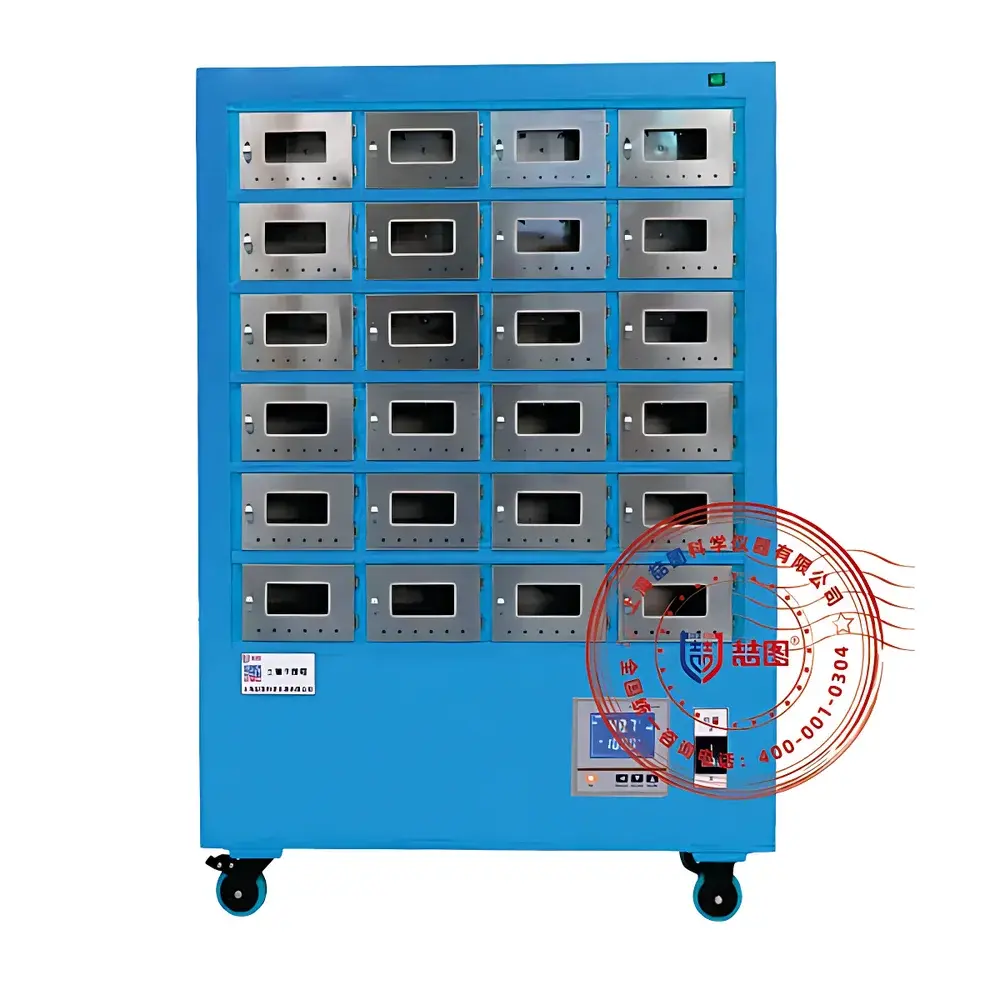
DRETOP TRD-7.2-24K Soil Drying Cabinet
| Brand | DRETOP |
|---|---|
| Origin | Shanghai, China |
| Model | TRD-7.2-24K |
| Temperature Range | RT+5 to 60°C |
| Temperature Uniformity | ±1°C |
| Temperature Resolution | ±0.1°C |
| Internal Chamber Dimensions (W×D×H) | 200 × 300 × 120 mm |
| Number of Independent Sample Compartments | 24 |
| Heating Method | Forced-Air Circulation |
| Inner Liner Material | 304 Stainless Steel |
| Operating Ambient Temperature | RT+5 to 40°C |
| Power Supply | AC 220 V, 50 Hz |
| Input Power | 300 W |
| Control Mode | Independent PID Temperature Control per Compartment |
| Communication Interface | Optional RS-485 for MES/LIMS Integration |
| Vacuum Capability | None |
Overview
The DRETOP TRD-7.2-24K Soil Drying Cabinet is a precision-engineered, forced-air circulation drying system designed specifically for the standardized pre-treatment of soil samples in environmental, agricultural, geological, and regulatory testing laboratories. Unlike general-purpose ovens, this cabinet implements a compartmentalized, airflow-isolated architecture—featuring 24 independent sample chambers—each equipped with dedicated air inlet, filtered intake, and thermally stabilized heating. It operates exclusively within a low-temperature range (RT+5°C to 60°C), eliminating thermal degradation of volatile organic compounds (VOCs), microbial activity, or labile nutrients while ensuring consistent moisture removal. The system adheres to core principles of gravimetric soil moisture determination as defined in ISO 11465:2022 and ASTM D2216–22, supporting compliance-driven workflows in GLP and ISO/IEC 17025-accredited laboratories.
Key Features
- 24 independently controlled sample compartments, each with isolated airflow path and individual PID temperature regulation—eliminating cross-contamination and enabling parallel processing of heterogeneous soil matrices.
- 304 stainless steel interior construction ensures chemical resistance against acidic, alkaline, or organically rich soil extracts; facilitates rapid decontamination and long-term corrosion resistance.
- Forced vertical air circulation with optimized duct geometry achieves uniform thermal distribution across all compartments, minimizing localized condensation or moisture reabsorption during extended drying cycles.
- High-efficiency particulate air (HEPA)-filtered intake system prevents airborne particulate ingress, preserving sample integrity—critical for trace metal analysis (e.g., EPA Method 6010D) and microplastic quantification workflows.
- Liquid-crystal PID controller with ±0.1°C resolution and ±1°C stability supports method-defined drying protocols; programmable ramp-hold profiles available via optional RS-485 interface for integration into centralized laboratory information management systems (LIMS/MES).
- Transparent tempered glass observation windows on both gas treatment and sample zones enable real-time visual monitoring without chamber opening—reducing thermal disturbance and operator exposure.
Sample Compatibility & Compliance
The TRD-7.2-24K accommodates diverse soil types—including clay-rich, high-organic-matter, saline, and hydrocarbon-contaminated matrices—without compromising structural integrity or analytical fidelity. Its non-vacuum, low-temperature operation preserves analyte stability required for USP , EPA SW-846 Methods 8260/8270, and ISO 10390-compliant pH and EC measurements. Each compartment’s sealed airflow design meets ISO 50001 energy management prerequisites and aligns with Good Laboratory Practice (GLP) Annex 13 requirements for documented environmental control. No internal vacuum or inert gas purge is provided; therefore, it is not suitable for oxygen-sensitive or pyrophoric samples.
Software & Data Management
While the base unit features a standalone LCD PID controller, the optional RS-485 serial interface enables bidirectional communication with external SCADA, LIMS, or MES platforms. This allows remote parameter setting, real-time temperature logging per compartment, audit-trail generation, and automated report export compliant with FDA 21 CFR Part 11 electronic record requirements—when deployed with validated software middleware. All temperature setpoints, dwell times, and deviation alerts are timestamped and stored locally for minimum 30-day retention, supporting internal quality audits and accreditation assessments.
Applications
- Agricultural Science: Standardized air-drying for moisture content (gravimetric basis), particle size distribution (ASTM D422), and cation exchange capacity (CEC) assays—ensuring reproducible baseline conditions prior to nutrient extraction.
- Environmental Monitoring: Preparation of field-collected soils for heavy metal speciation (EPA 6020B), pesticide residue screening (AOAC 2007.01), and persistent organic pollutant (POP) analysis—where uncontrolled drying induces analyte loss or redistribution.
- Geotechnical Engineering: Controlled desiccation for determining soil bulk density, porosity, and Atterberg limits (ASTM D4318), directly informing foundation design and slope stability modeling.
- Research Laboratories: Enabling kinetic studies of soil water retention curves (van Genuchten model fitting), microbial community shifts under progressive desiccation stress, and contaminant aging behavior in aged vs. freshly spiked soils.
- Third-Party Testing: High-throughput batch processing with full traceability per sample position—supporting CNAS, UKAS, and NATA accreditation requirements for multi-client soil testing programs.
FAQ
Is the TRD-7.2-24K suitable for drying samples requiring inert atmosphere or vacuum conditions?
No. This model provides only ambient-pressure, forced-air drying. It lacks vacuum sealing, gas purging ports, or inert gas compatibility.
Can temperature be set differently across compartments?
Yes. Each of the 24 chambers features independent PID control, allowing simultaneous operation at distinct setpoints within the RT+5°C to 60°C range.
What maintenance is required for long-term reliability?
Monthly inspection of HEPA filter integrity, quarterly calibration verification using NIST-traceable probe, and annual fan bearing lubrication per manufacturer service schedule.
Does the unit comply with electromagnetic compatibility (EMC) standards for laboratory use?
Yes. Certified to IEC 61326-1:2023 for EMC immunity and emissions in laboratory environments.
Is validation documentation (IQ/OQ/PQ) available?
DRETOP provides standard factory test reports. Full qualification packages—including protocol templates and execution support—are available upon request for regulated users.
Related Products



