
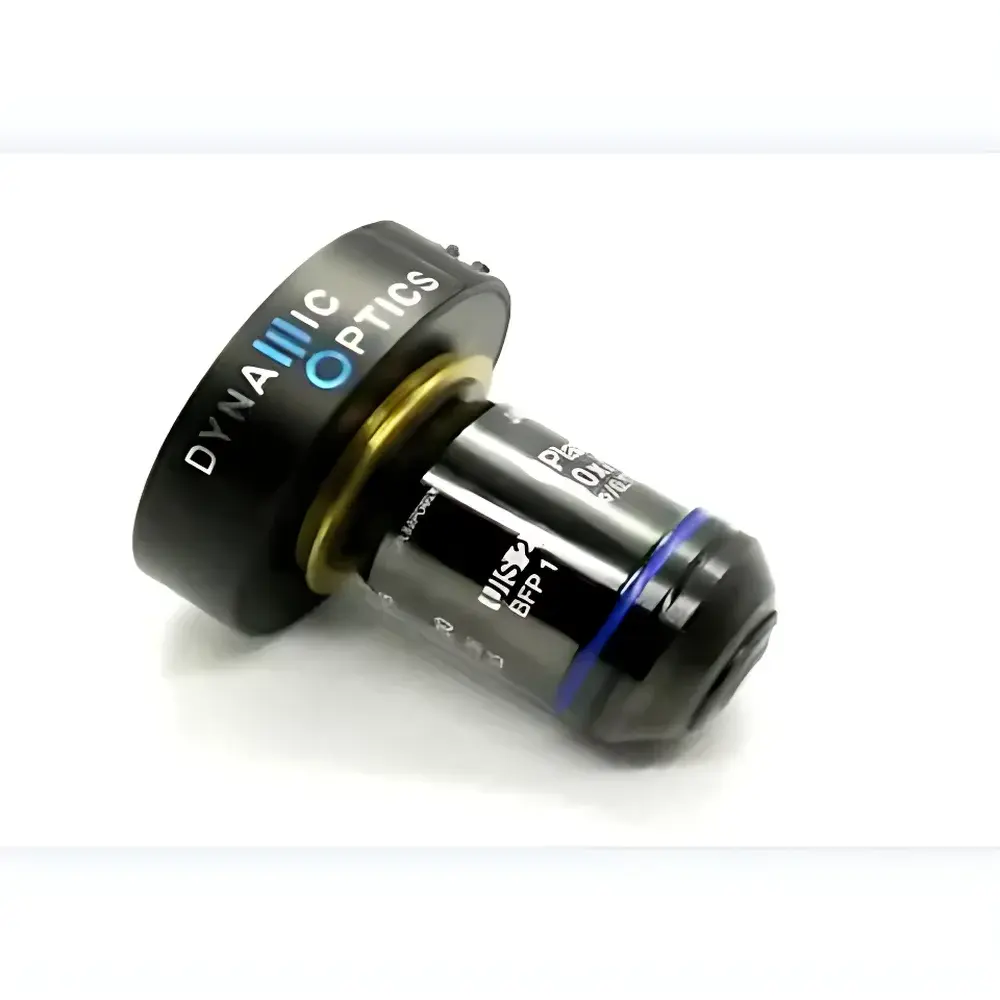
Dynamic Optics Deformable Mirror (DM) – Piezoelectric Stack Actuator-Based Adaptive Optics Component
| Brand | Dynamic Optics |
|---|---|
| Origin | Italy |
| Model | DM Series (18/32/128-Actuator Configurations) |
| Clear Aperture | 10–200 mm (Standard: 25 mm, 75 mm, 92 mm) |
| Coating Options | Metallic (Al, Ag, Au) or Dielectric (HR up to 99.99% @ specified wavelength(s)) |
| Reflectivity | Up to 99.99% |
| Transmission (for transmissive deformable lenses) | 92% (uncoated), 97% (AR MgF₂-coated) |
| Wavefront Correction Capability | Up to 4th-order Zernike modes |
| Response Time | < 5 ms |
| Max. Avg. Power Handling | 1 kW (transmissive lens), 4 kW (reflective DM, uncooled) |
| GDD | Low |
| Damage Threshold | High |
| Incident Angle | Arbitrary (0°–45° typical) |
| Actuator Drive Voltage | ±125 V (PZT Mini), or custom stack drive |
| Controller Interface | USB 3.0, TCP/IP programmable |
| Compatible With | Alpao, OKO, Adaptica, BMC, Thorlabs DMs |
| Software | PhotonLoop (supports closed-loop & open-loop control, Shack-Hartmann wavefront sensor integration) |
| SH Sensor Specs | Microlens Pitch: 150 µm, Focal Length: 5.2 mm (customizable), Sensor Area: 9 × 7.13 mm, Frame Rate: 500 fps (up to 1000 Hz), Interface: USB 3.0, Drive Voltage: 5 V |
Overview
Dynamic Optics Deformable Mirrors (DMs) are high-performance, piezoelectric stack–actuated adaptive optics components engineered for precise, real-time wavefront correction in demanding optical systems. Based on a thermally passive, monolithic design, these mirrors eliminate the need for active cooling—even at average optical powers up to 4 kW—making them uniquely suited for high-power laser applications including industrial material processing, scientific ultrafast laser systems, and space-qualified beam control. Unlike traditional voice-coil or magnetic DMs, Dynamic Optics’ stack-driven architecture delivers sub-millisecond mechanical response (< 5 ms), nanometer-level surface displacement repeatability, and exceptional long-term stability under thermal and mechanical stress. The core principle relies on localized, voltage-controlled axial expansion of co-fired PZT stacks bonded beneath a continuous, optically polished mirror substrate—enabling controlled deformation of the reflective surface to compensate for low- to mid-order aberrations (up to 4th-order Zernike polynomials). This physics-based actuation mechanism ensures deterministic, linear, and hysteresis-minimized behavior—critical for closed-loop adaptive optics (AO) implementations in ophthalmic imaging, confocal microscopy, free-space optical communications, and atmospheric turbulence compensation.
Key Features
- Thermally passive, uncooled operation: Sustains up to 4 kW average power without thermal lensing or drift—validated per ISO 10110-7 and IEC 60825-1 safety standards.
- Scalable actuator count: Configurable with 18, 32, or up to 128 independent PZT stack actuators—enabling spatial resolution matched to application-specific aberration spectra.
- Optical interface flexibility: Standard clear apertures from 25 mm to 200 mm; custom diameters available. Compatible with metallic (Al, Ag, Au) and broadband dielectric HR coatings (R ≥ 99.99% at user-specified λ).
- Low group delay dispersion (GDD): Critical for ultrashort pulse applications (e.g., Ti:sapphire, Yb-fiber lasers); verified via spectral interferometry per ISO 15360.
- High laser-induced damage threshold (LIDT): > 10 J/cm² (1064 nm, 10 ns, 10 Hz) for dielectric coatings; compliant with ISO 21254-1 testing protocols.
- Integrated or external electronics: Compact 92 mm-diameter DM with embedded controller; 75 mm variant supports external driver rack—both compatible with industry-standard TTL synchronization and analog voltage inputs.
Sample Compatibility & Compliance
Dynamic Optics DMs are designed for seamless integration into regulated and research-grade optical platforms. They meet mechanical and environmental requirements outlined in MIL-STD-810G (vibration/shock) and EN 61326-1 (EMC for laboratory equipment). For medical device integration—including OCT systems, retinal imaging platforms, and scanning laser ophthalmoscopes—the mirrors comply with biocompatible mounting interfaces and outgassing specifications per ISO 10993-12. All coatings undergo adhesion testing per ASTM D3359 and humidity resistance per IEC 60068-2-30. Reflective variants support arbitrary incidence angles (0°–45°), enabling use in folded-beam architectures common in multiphoton microscopes and EUV lithography testbeds. Transmissive deformable lenses (10/15/25 mm aperture) are qualified for ISO 13694-compliant laser safety classification when integrated into Class 4 laser systems.
Software & Data Management
PhotonLoop software provides vendor-agnostic, standards-compliant AO control architecture. It supports both open-loop pre-compensation and closed-loop wavefront correction using real-time feedback from Shack-Hartmann sensors (including Dynamic Optics’ own SH units). The software implements IEEE 1857.1–compliant data logging, timestamped frame capture (microsecond precision), and audit-trail generation required for GLP/GMP environments. Integration with third-party hardware is enabled via TCP/IP API (RESTful endpoints), LabVIEW VIs, Python SDK (PyDynamicOptics), and MATLAB Instrument Control Toolbox drivers. All calibration matrices—including influence functions, actuator crosstalk maps, and Zernike mode decomposition coefficients—are stored in HDF5 format with embedded metadata (CF-1.8 compliant). Firmware updates follow secure OTA protocols aligned with IEC 62443-3-3.
Applications
- Ophthalmic Imaging: Real-time correction of ocular aberrations in adaptive optics scanning laser ophthalmoscopy (AOSLO) and high-resolution OCT—enabling cellular-level visualization of photoreceptors and retinal pigment epithelium.
- Microscopy: Aberration correction in multiphoton, light-sheet, and STED systems—improving signal-to-noise ratio, axial resolution, and volumetric imaging depth in thick biological specimens.
- High-Power Laser Systems: Thermal distortion compensation in kW-class fiber and slab lasers; beam shaping for laser welding, cutting, and directed energy applications.
- Astronomy & Atmospheric Optics: Ground-based telescope wavefront correction (e.g., in solar observatories or laser guide star AO systems), compensating for turbulence-induced phase errors.
- Free-Space Optical Communications: Mitigation of scintillation and beam wander in terrestrial and satellite downlinks—enhancing link availability and bit-error-rate performance.
FAQ
What is the maximum wavefront stroke achievable with the 32-actuator DM?
Stroke is configuration-dependent and optimized per application; typical peak-to-valley (PV) deflection exceeds ±5 µm for low-order modes (e.g., focus, astigmatism) and scales nonlinearly with mode order. Full stroke maps are provided in calibration reports per ISO 20473 Annex B.
Can the DM be used in vacuum environments?
Yes—standard versions operate in 10⁻⁶ mbar vacuum; optional bake-out compatible versions (per ISO 14644-1 Class 5 cleanroom assembly) support 10⁻⁹ mbar operation with zero outgassing coatings.
Is PhotonLoop software FDA 21 CFR Part 11 compliant?
Yes—audit trail, electronic signatures, and role-based access control modules are validated for use in regulated clinical imaging workflows per FDA guidance (2022 Digital Health Center of Excellence).



