
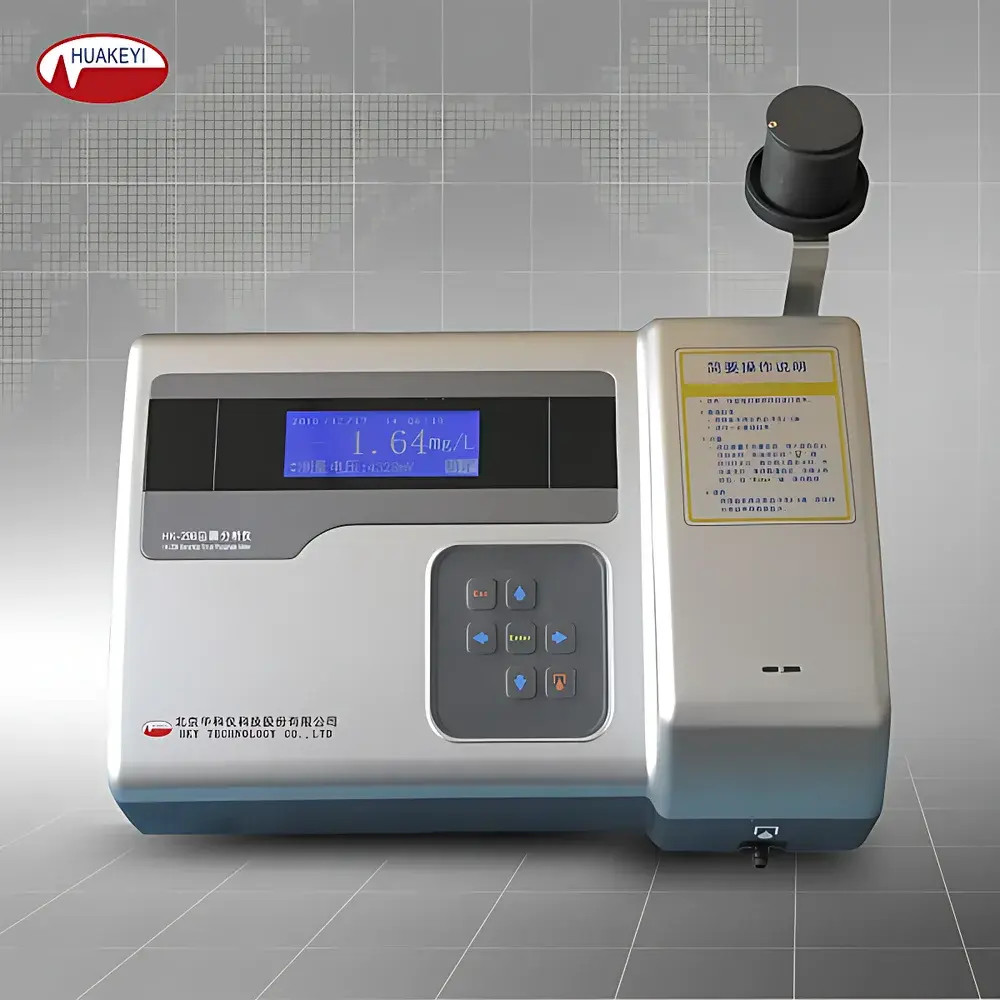
Huake Instrument HK-298 Total Phosphorus Analyzer
| Brand | Huake Instrument |
|---|---|
| Origin | Beijing, China |
| Manufacturer Type | Authorized Distributor |
| Country of Origin | China |
| Model | HK-298 |
| Price Range | USD 1,400 – 7,000 |
| Instrument Type | Benchtop Laboratory Analyzer |
Overview
The Huake Instrument HK-298 Total Phosphorus Analyzer is a benchtop spectrophotometric analyzer engineered for precise, reliable quantification of total phosphorus (as PO₄³⁻) in water and wastewater samples. It operates on the molybdenum blue colorimetric method—per ASTM D515-18 and ISO 6878:2004—following high-temperature persulfate digestion to convert all phosphorus species (orthophosphate, condensed phosphates, organophosphorus compounds) into orthophosphate. The system employs a stable, imported monochromatic cold light source centered at 700 nm, coupled with a high-precision silicon photodiode detector, enabling accurate absorbance measurement under controlled thermal conditions. Designed for routine compliance monitoring and process control, the HK-298 meets the analytical requirements of power generation (cooling water, boiler feedwater), petrochemical effluent management, pulp & paper mill discharge testing, and municipal wastewater treatment facilities.
Key Features
- 32-bit embedded microcontroller architecture with surface-mount technology (SMT) and fully integrated mechanical-electrical design for long-term operational stability
- IP65-rated waterproof enclosure with full silicone membrane overlay keypad—resistant to moisture, dust, and chemical splashes in industrial lab environments
- Imported photodetector with low dark-current drift and high quantum efficiency ensures <1% absorbance repeatability over 8-hour continuous operation
- Patented fuzzy PID-based thermostatic control for digestion and color development modules—maintains ±0.3°C setpoint accuracy across ambient temperatures from 5–45°C
- Zero-reagent calibration protocol: uses deionized water only for blank adjustment—eliminates reagent lot variability and reduces consumable dependency
- Multi-point calibration curve selection (up to 5 points): supports user-defined non-linear fitting (linear, quadratic, cubic) to optimize accuracy across the full 0.05–3.5 mg/L range (extendable to 50 mg/L via sample dilution)
- Role-based access control with configurable password protection (administrator/operator levels) compliant with GLP documentation integrity requirements
- Internal data logger with timestamped storage for ≥10,000 measurement records—including sample ID, calibration status, operator ID, and environmental conditions
Sample Compatibility & Compliance
The HK-298 accepts aqueous samples with suspended solids ≤50 mg/L (pre-filtration recommended per ISO 5667-3). It complies with core regulatory frameworks for environmental and industrial water testing, including EPA Method 365.4 (phosphorus by ascorbic acid reduction), ASTM D515-18 (total phosphorus in water), and ISO 6878:2004 (water quality—determination of phosphorus—ammonium molybdate spectrophotometric method). Its hardware architecture and firmware support audit-trail functionality required for ISO/IEC 17025-accredited laboratories. All digestion and reaction protocols are validated for matrix recovery in high-chloride (≤2,000 mg/L Cl⁻), high-turbidity (≤100 NTU), and low-pH (≥3.5) samples typical of cooling tower blowdown and refinery wastewater.
Software & Data Management
Data export is supported via USB 2.0 interface (no proprietary drivers required)—output formats include CSV and PDF reports with embedded calibration history and QC flagging. The onboard software enables manual or automatic QC checks against stored reference standards (e.g., NIST-traceable phosphate solutions), with pass/fail alerts based on user-defined tolerance bands (±2% FS per IEC 61000-4-3 immunity criteria). Audit logs record all configuration changes, calibration events, and data deletions—fully traceable to operator ID and timestamp. While not natively 21 CFR Part 11 compliant, the system supports external LIMS integration through ASCII serial output (RS-232) and can be deployed within validated workflows meeting FDA and EU Annex 11 expectations when paired with documented procedural controls.
Applications
- Boiler feedwater and condensate monitoring in thermal power plants (ASTM D1066, D4582)
- Phosphorus dosing control and corrosion inhibitor verification in HVAC cooling systems
- Effluent compliance testing for NPDES permits (EPA 40 CFR Part 136)
- In-process quality control of phosphate-based cleaners and metal finishing baths
- Research-grade phosphorus speciation studies when combined with offline fractionation (e.g., sequential extraction)
- Field-deployable lab verification for portable phosphorus sensors (cross-validation mode)
FAQ
What digestion method does the HK-298 use for total phosphorus determination?
It applies high-temperature (120°C, 30 min) alkaline persulfate oxidation in sealed quartz digestion vials—conforming to ISO 6878 and EPA 365.4 protocols.
Can the instrument measure orthophosphate without digestion?
No—the HK-298 is configured exclusively for total phosphorus; orthophosphate analysis requires a separate, non-digestion assay module not included in this model.
Is the calibration curve linear across the entire 0.05–50 mg/L extended range?
Linearity is maintained up to 3.5 mg/L (R² ≥ 0.999); beyond that, dilution is required and multi-point non-linear calibration is recommended for optimal accuracy.
Does the device support remote diagnostics or network connectivity?
No Ethernet or Wi-Fi interface is provided; connectivity is limited to USB mass storage and RS-232 serial output for local data transfer and basic command control.
What maintenance intervals are recommended for long-term reliability?
Optical path cleaning every 3 months; digestion heater verification annually; photodetector baseline validation semiannually per ISO/IEC 17025 preventive maintenance guidelines.
Related Products







