
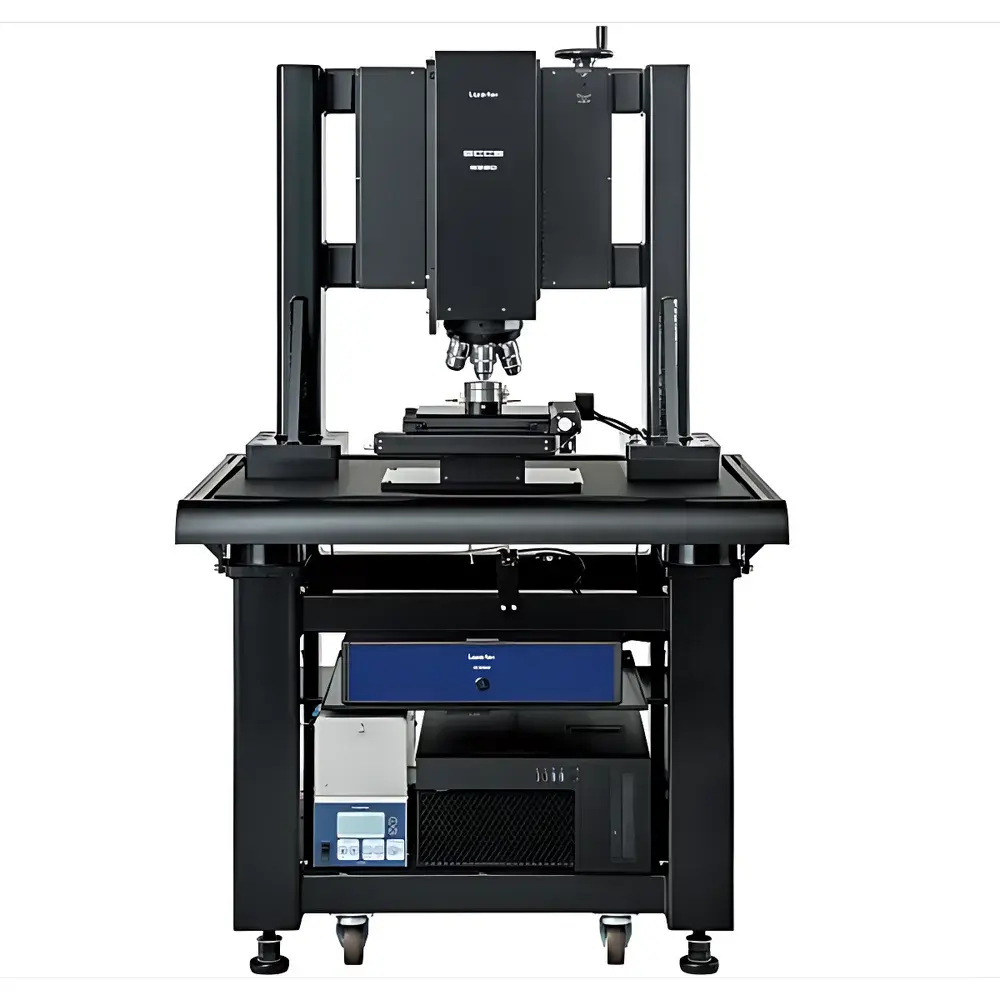
ECCS B320 Electrochemical Reaction Visualization Confocal Microscopy System
| Brand | TOYO Corporation (Japan) |
|---|---|
| Origin | Japan |
| Model | ECCS B320 |
| Instrument Type | Point-Scanning Confocal Microscope |
| Distribution Channel | Authorized Import Distributor |
| Country of Manufacture | Japan |
| Compliance | CE, ISO 9001-certified supply chain |
Overview
The ECCS B320 Electrochemical Reaction Visualization Confocal Microscopy System is a purpose-engineered point-scanning confocal platform designed for in situ and operando observation of electrochemical interfaces within working battery cells. Leveraging high-resolution laser scanning confocal optics coupled with synchronized electrochemical stimulus control, the system enables real-time, micron-scale visualization of dynamic structural evolution—such as electrode volume change, lithium dendrite nucleation, interfacial reaction heterogeneity, and solid-electrolyte interphase (SEI) growth—during galvanostatic or potentiostatic cycling. Unlike conventional ex situ microscopy, the ECCS B320 integrates a thermally regulated electrochemical cell stage (±0.5 °C stability) with optical access ports compatible with pouch, coin, and custom-designed transparent-window cells. Its core measurement principle relies on optical sectioning via pinhole-confined detection, delivering axial resolution down to ~0.7 µm (at 488 nm excitation) and lateral resolution <250 nm, enabling quantitative 3D reconstruction of evolving electrode microstructures under controlled current/voltage profiles.
Key Features
- Point-scanning confocal architecture optimized for low-phototoxicity, high-contrast imaging of optically sensitive electrochemical interfaces
- Integrated temperature-controlled stage (range: −20 °C to +80 °C; programmable ramping and hold)
- Synchronized data acquisition: Simultaneous recording of high-frame-rate color video (up to 30 fps at 1024×1024), potentiostat/galvanostat output (voltage, current, dQ/dV), and EIS spectra (frequency range: 10 mHz–1 MHz)
- Dedicated mechanical fixtures: Modular pouch-cell compression jig with pressure-sensing feedback and standardized CR2032 coin-cell holder with optical-grade quartz windows
- Multi-channel fluorescence & reflectance imaging capability supporting label-free and dye-assisted contrast enhancement (e.g., Li-ion sensitive probes, SEI-selective fluorophores)
- Robust optical design with motorized Z-stage (10 nm step resolution), autofocus stabilization, and vibration-damped optical table integration
Sample Compatibility & Compliance
The ECCS B320 supports a broad range of electrochemical configurations, including sealed coin cells (CR2032, CR2025), flexible pouch cells (up to 50 mm × 50 mm active area), and custom-built transmission-mode flow cells with sapphire or fused silica optical windows (thickness tolerance: ±10 µm). All sample holders comply with ASTM D1505 (density gradient column) and ISO 12106 (fatigue testing of thin films) dimensional reference standards to ensure repeatable optical alignment. The system meets IEC 62133-2:2017 safety requirements for battery testing equipment and adheres to ISO/IEC 17025 calibration traceability protocols for optical path verification. Data integrity conforms to FDA 21 CFR Part 11 requirements through audit-trail-enabled software logging, electronic signatures, and immutable raw-data archiving.
Software & Data Management
Acquisition and analysis are performed using ECCS Control Suite v4.2—a modular, Windows-based application compliant with GLP/GMP documentation workflows. The software provides synchronized timeline overlay of electrochemical curves (voltage vs. time, dV/dQ, Nyquist/Bode plots) directly onto corresponding video frames. Quantitative image analytics include time-resolved thickness mapping (pixel-to-micron calibration), dendrite length/branching density extraction, local strain field calculation via digital image correlation (DIC), and grayscale intensity profiling across electrode cross-sections. Export formats include TIFF (lossless), HDF5 (metadata-rich), and CSV (for third-party modeling tools such as COMSOL Multiphysics® or MATLAB®). All processing pipelines are scriptable via Python API for batch analysis and integration into automated QC reporting systems.
Applications
- In situ monitoring of graphite anode lithiation/delithiation-induced expansion/contraction kinetics at varying SOC states (0–100%)
- Visualizing spatial distribution and growth dynamics of metallic lithium dendrites under asymmetric current densities
- Correlating localized SEI formation with interfacial impedance rise measured by simultaneous EIS
- Evaluating electrolyte wetting uniformity and pore-filling behavior in silicon-based composite anodes
- Assessing thermal runaway initiation points via spatiotemporal temperature–morphology coupling under abuse conditions
- Validating multiscale battery models by providing ground-truth 3D microstructural boundary conditions
FAQ
Can the ECCS B320 be used with commercial 18650 or 21700 cylindrical cells?
Yes—custom optical adapters with precision-machined aluminum mounts and anti-reflective coated borosilicate windows are available upon request for standard cylindrical formats.
Is real-time EIS acquisition fully synchronized with video capture?
Yes—the system uses a shared timing master clock; EIS spectra acquired at user-defined intervals (e.g., every 5% SOC increment) are automatically tagged with corresponding video frame timestamps and spatial coordinates.
Does the software support automated dendrite detection and classification?
Built-in machine learning modules (trained on >12,000 annotated dendrite images) enable binary segmentation and morphological classification (mossy, filamentous, whisker-type) with >92% precision per ASTM E2925 guidelines.
What optical resolution can be achieved through a 100-µm-thick polymer separator?
Axial resolution degrades by ≤15% relative to air immersion; lateral resolution remains sub-300 nm when using oil-immersion objectives (NA 1.4) and adaptive spherical aberration correction.
Is remote operation supported for facility-shared instruments?
Yes—secure TLS-encrypted web interface enables full instrument control, live streaming, and dataset retrieval from external networks, compliant with institutional IT security policies.




