
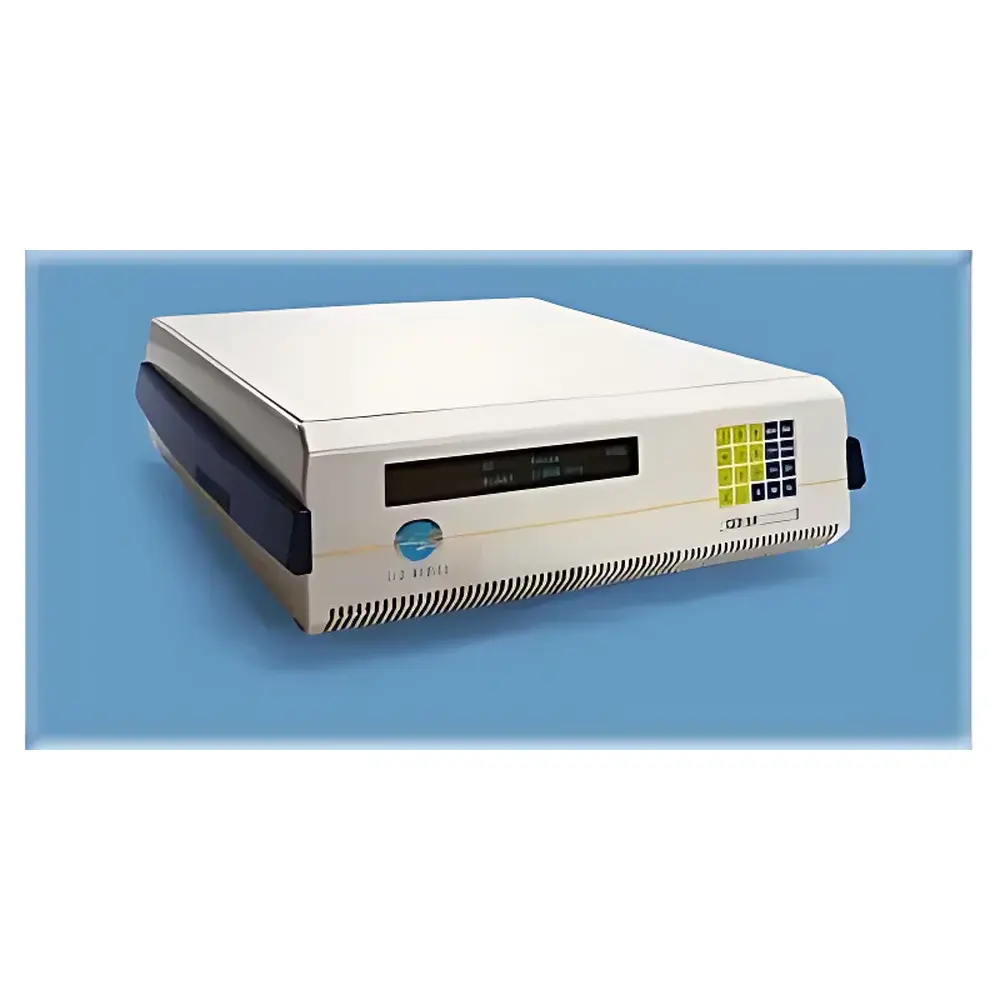
Eco Physics CLD 80/800 Series Chemiluminescence Nitrogen Oxide Analyzer
| Origin | Switzerland |
|---|---|
| Manufacturer Type | Authorized Distributor |
| Origin Category | Imported |
| Model | CLD 80/800 Series |
| Price Range | USD 13,500 – 40,500 |
Overview
The Eco Physics CLD 80/800 Series is a modular family of high-precision chemiluminescence detection (CLD) analyzers engineered for quantitative measurement of nitrogen oxides (NO, NO₂, NOₓ), ammonia (NH₃), and related reactive nitrogen species—including nitrite (NO₂⁻), nitrate (NO₃⁻), and S-nitrosothiols (RSNO)—in gaseous and liquid matrices. Based on the well-established gas-phase reaction between nitric oxide (NO) and ozone (O₃) to produce excited NO₂*, which emits characteristic near-infrared photons upon relaxation, the CLD 80/800 platform delivers exceptional specificity, sub-second response kinetics, and trace-level sensitivity across an unprecedented dynamic range—from parts-per-quadrillion (ppq) in liquid-phase biological samples to percent-level concentrations in industrial flue gas. All models comply with fundamental principles outlined in ISO 7935, ASTM D5157, and EN 14625 for NOₓ monitoring, and support GLP/GMP-aligned data integrity through hardware-based audit trails and configurable calibration logging.
Key Features
- Modular architecture enabling field-configurable sensor modules, reaction chambers (single or dual), and conversion systems (thermal, photolytic, or catalytic) tailored to application-specific requirements.
- Sub-100 ms T₉₀ response time across all configurations—achievable via optimized gas flow dynamics (110 mL/min to 1.2 L/min), high-speed 100 kHz sampling, and 24-bit analog-to-digital resolution.
- Integrated high-voltage ozone generator producing stable, contamination-free O₃ at programmable output—eliminating reliance on external ozone sources or consumable precursors.
- High-temperature ozone destruct unit operating above 300 °C, replacing carbon-based scrubbers to prevent secondary emissions, adsorption saturation, and maintenance downtime.
- Heated sample lines (up to 190 °C) and pressure-compensated flow control (600–1200 mbar) ensure stability under variable stack or ambient conditions—critical for compliance-grade flue gas and atmospheric monitoring.
- One-touch automated zero/span calibration with real-time correction factor logging; no manual valve actuation or external standards required during routine operation.
Sample Compatibility & Compliance
The CLD 80/800 Series accommodates diverse sampling protocols without hardware modification. Gaseous applications include continuous emission monitoring (CEM) of combustion sources (ISO 12039, EN 15267), ambient air quality networks (EU Directive 2008/50/EC), stratospheric profiling (NOy speciation), and semiconductor cleanroom verification. Liquid analysis—enabled by optional vaporization modules—is validated for plasma, urine, aqueous standards, and environmental water matrices per US EPA Method 300.5 and ISO 11923. All instruments meet electromagnetic compatibility (EMC) per IEC 61326-1 and safety standards IEC 61010-1. Optional FDA 21 CFR Part 11-compliant software modules provide electronic signatures, role-based access, and immutable audit trails for regulated laboratories.
Software & Data Management
Eco Physics PowerChrom™ software provides full instrument control, real-time spectral visualization, multi-parameter trending, and automated report generation. It supports synchronized acquisition from up to four independent CLD channels (e.g., NO, NO₂, NH₃, RSNO), applies ozone yield correction coefficients derived from in-situ photolysis efficiency validation (e.g., PLC 860/PLC 762), and exports timestamped, metadata-embedded CSV/NetCDF files compatible with LIMS and EPA’s CEMS Data Acquisition Systems (DAS). Remote diagnostics, firmware updates over secure TLS, and configurable alarm thresholds (with email/SNMP notification) are standard. Raw signal logs retain full 24-bit resolution for post-acquisition reprocessing—essential for research-grade uncertainty quantification.
Applications
- Regulatory Emission Monitoring: Dual-chamber CLD 824MM dr deployed in parallel stack ducts for cross-validation and redundancy per EU BREF guidelines.
- Atmospheric Chemistry Research: CLD 88p + PLC 762 photolytic converter used in mobile labs to quantify tropospheric NO₂ with <0.05 ppb LOD and PAN/HNO₃ interference rejection.
- Clinical & Biomedical Analysis: CLD 88 configured with liquid autosampler measures picomolar NO metabolites in human serum—supporting NIH-funded studies on endothelial dysfunction.
- Industrial Process Control: CLD 844CM hr monitors NH₃ slip and NOₓ formation in SCR systems with simultaneous dual-converter operation and heated sampling up to 190 °C.
- Calibration Laboratory Traceability: CLD 80/800 series serves as primary transfer standard in national metrology institutes due to documented linearity (<1% FS), long-term drift <0.5% per month, and NIST-traceable calibration protocols.
FAQ
What detection principle does the CLD 80/800 Series use?
It employs gas-phase chemiluminescence: NO reacts stoichiometrically with ozone to emit photons at 600–3000 nm, detected by a cooled photomultiplier tube with spectral filtering.
Can the same instrument measure both NO and NO₂ without hardware changes?
Yes—via integrated thermal or photolytic NO₂ converters (e.g., Mo-catalyst or UV lamp), with automatic switching and efficiency compensation in firmware.
Is the system compliant with EPA Performance Specification 2 (PS-2)?
All CLD 80/800 variants meet PS-2 requirements for NOₓ CEMS when installed with certified zero/span gases, flow monitors, and data recording per 40 CFR Part 60 Appendix B.
How is zero drift managed in high-humidity environments?
Chemical zero correction using a pre-reaction chamber removes residual NO prior to detection; combined with heated sample lines and condensate traps, it maintains <±0.1 ppb zero stability at 95% RH.
Does the analyzer require external calibration gases during routine operation?
No—onboard zero air generation (filtered, dried ambient air) and automated span verification using internal permeation tubes or electrolytic O₃ synthesis eliminate dependency on cylinder gases.







