
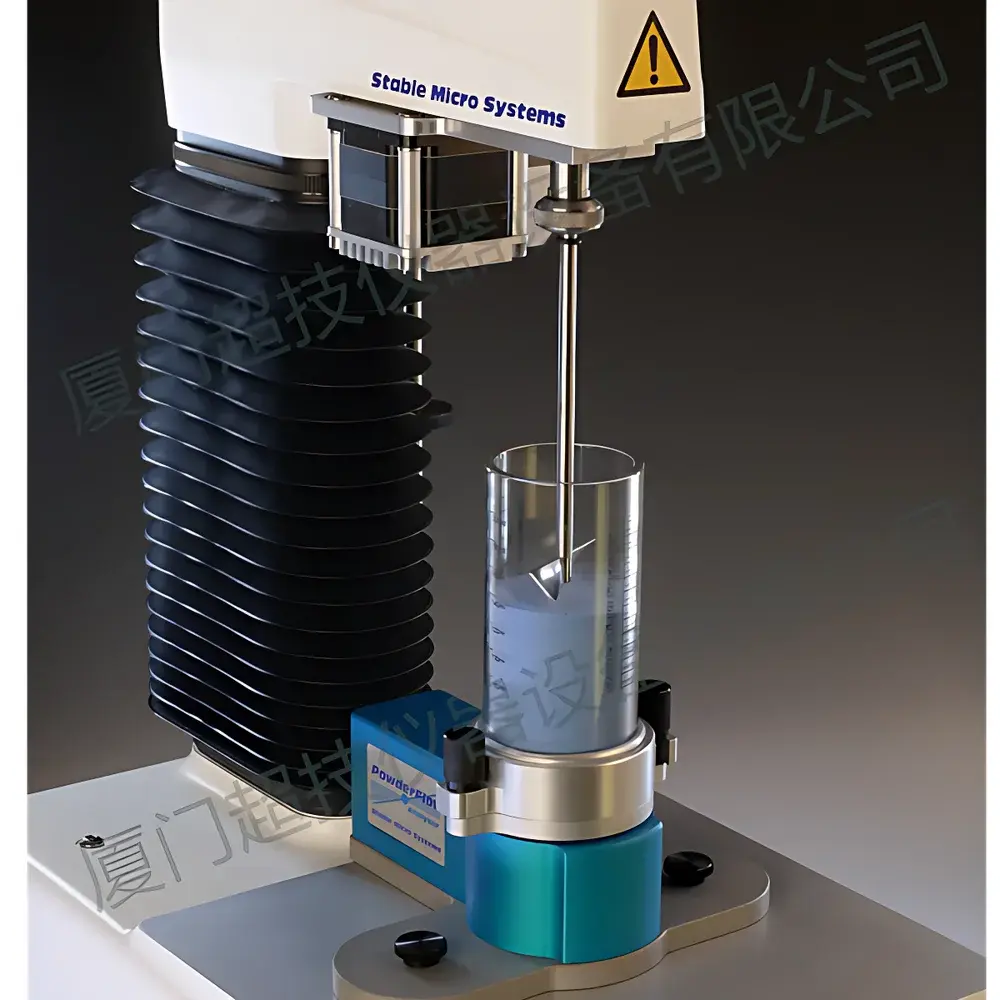
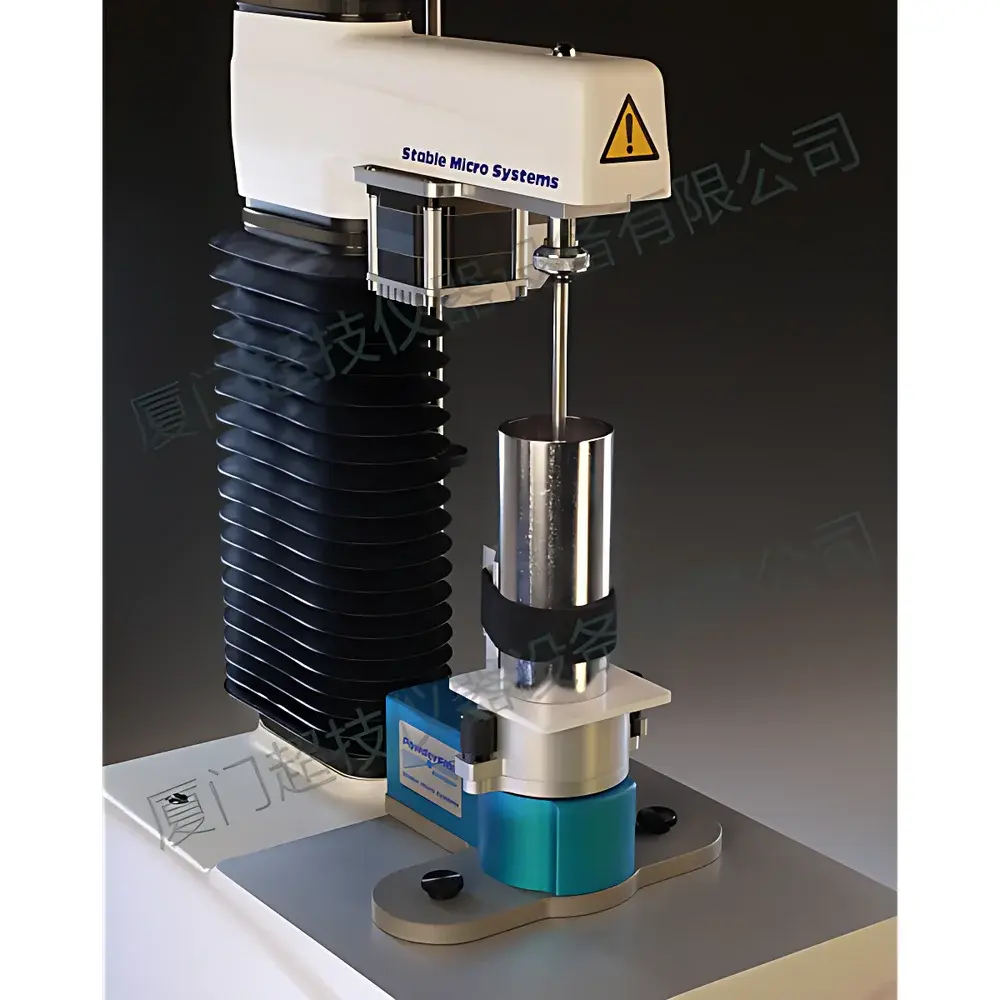
SMS Powder Flow Analyser PFA Series – Advanced Dynamic Powder Rheometer
| Brand | SMS |
|---|---|
| Origin | United Kingdom |
| Model | Powder Flow Analyser (PFA) |
| Instrument Type | Dynamic Powder Rheometer |
| Measurable Powder Properties | Particle size & shape distribution, moisture content, surface sorption characteristics, electrostatic charge, mixing kinetics, stop–flow transition behavior, inter-particle and particle–surface frictional forces |
| Maximum Sample Vessel Capacity | 200 mL |
| Minimum Sample Volume | 135 mL |
| Compliance | Designed for GLP/GMP-aligned R&D and QC environments |
| Software | PFA Control & Analysis Suite (v5.2+) with audit trail, user access levels, and FDA 21 CFR Part 11–ready data handling |
Overview
The SMS Powder Flow Analyser (PFA) is a dynamic, rotational rheometer engineered specifically for the quantitative mechanical characterization of bulk powders and granular solids under controlled stress, strain, and environmental conditions. Unlike traditional shear cell or angle-of-repose methods, the PFA employs a patented helical blade geometry that subjects powder samples to programmable axial compression, rotational shearing, fluidization, and controlled aeration — simulating real-world processing stresses encountered in hoppers, feeders, mixers, pneumatic conveyors, and tablet presses. The instrument operates on the principle of controlled-force, time-resolved torque and axial force measurement during probe motion, enabling derivation of fundamental flow energy profiles, cohesion indices, compressibility, permeability, and aeration thresholds. Data acquisition is fully automated and synchronized with high-resolution position and load transducers, delivering reproducible, digitized rheological signatures traceable to SI units.
Key Features
- Helical impeller design enables multi-mode testing: shear, consolidation, fluidization, blending, and wall friction assessment within a single vessel
- Integrated vertical lift and rotational drive system with ±0.01 N·m torque resolution and ±0.05 N axial force resolution
- Modular sample vessel platform accommodating 135–200 mL volumes; vessels fabricated from inert stainless steel or optional glass/PEEK for chemical compatibility
- Full compatibility with all SMS universal probe accessories (e.g., wall friction plates, compaction pistons, humidity-controlled enclosures)
- Real-time monitoring of powder state transitions — including arching onset, ratholing initiation, and fluidization threshold — via continuous energy profiling
- Temperature- and humidity-stabilized test environment options (optional integrated RH control module, ±2% RH accuracy)
Sample Compatibility & Compliance
The PFA supports dry, damp, cohesive, free-flowing, fibrous, and agglomerated powders across pharmaceutical, food, chemical, ceramic, metallurgical, and energy sectors. It accommodates materials ranging from sub-10 µm nanoparticles (e.g., silica fume, catalysts) to >1 mm granules (e.g., fertilizer prills, sugar crystals). All hardware and software modules conform to ISO 4778 (powder testing terminology), ASTM D6393 (Shear Cell Standard Practice), and USP (Powder Flow Assessment). The PFA Control & Analysis Suite includes electronic signature support, full audit trail logging, and configurable user roles — satisfying requirements for FDA 21 CFR Part 11 compliance and internal GLP/GMP validation protocols.
Software & Data Management
The PFA Control & Analysis Suite provides intuitive method-building tools for defining custom test sequences — such as cyclic shear at varying normal stresses, stepwise aeration ramping, or time-dependent consolidation hold periods. Raw force/torque/time datasets are automatically converted into industry-standard metrics: Basic Flow Energy (BFE), Specific Energy (SE), Compressibility Index (CI), Aeration Ratio (AR), and Flow Function (FFc). Export formats include CSV, PDF reports, and native .pfa binary files. Data integrity is maintained through encrypted local storage, optional networked database integration (SQL Server), and version-controlled method templates. All analytical routines are documented per IQ/OQ/PQ validation guidelines.
Applications
- Pharmaceutical: Quantifying blend uniformity, predicting die-fill variability, assessing capsule fill consistency, and validating excipient compatibility
- Food & Nutraceuticals: Optimizing spray-dried milk powder reconstitution, evaluating cocoa powder dispersion behavior, and modeling sugar crystallinity impact on flow
- Catalysis & Ceramics: Characterizing attrition resistance of zeolite pellets, measuring green-body extrusion stress profiles, and correlating binder burnout kinetics with structural integrity
- Battery Materials: Assessing cathode/anode powder cohesion under low-humidity handling, quantifying conductive additive dispersion homogeneity
- Agrochemicals: Validating granule friability in rotary drum tests, modeling pesticide dust generation potential during pneumatic transfer
- Coatings & Pigments: Determining TiO₂ dispersion stability in dry-blended colorants and predicting roller spalling in powder coating lines
FAQ
What sample volume is required for a statistically robust PFA measurement?
A minimum of 135 mL is recommended to ensure representative sampling of heterogeneous powders; larger volumes (up to 200 mL) improve repeatability for low-density or highly aeratable materials.
Can the PFA quantify electrostatic charge accumulation during flow?
Yes — when used with the optional integrated Faraday cup sensor module, the PFA records real-time charge decay profiles during shear and fluidization cycles.
Is calibration traceable to national standards?
All torque and axial load sensors are factory-calibrated against NIST-traceable reference standards, with annual recalibration supported via SMS-certified service centers.
How does the PFA differ from a conventional shear cell?
Unlike static shear cells that measure yield loci at fixed consolidation stresses, the PFA delivers dynamic, process-relevant energy maps capturing transient flow instabilities, time-dependent consolidation, and aeration-mediated de-aeration lag.
Does the software support automated pass/fail criteria for QC release?
Yes — users can define specification limits per parameter (e.g., BFE < 12.5 mJ/g), trigger visual alerts, and auto-generate release certificates compliant with internal SOPs.



