
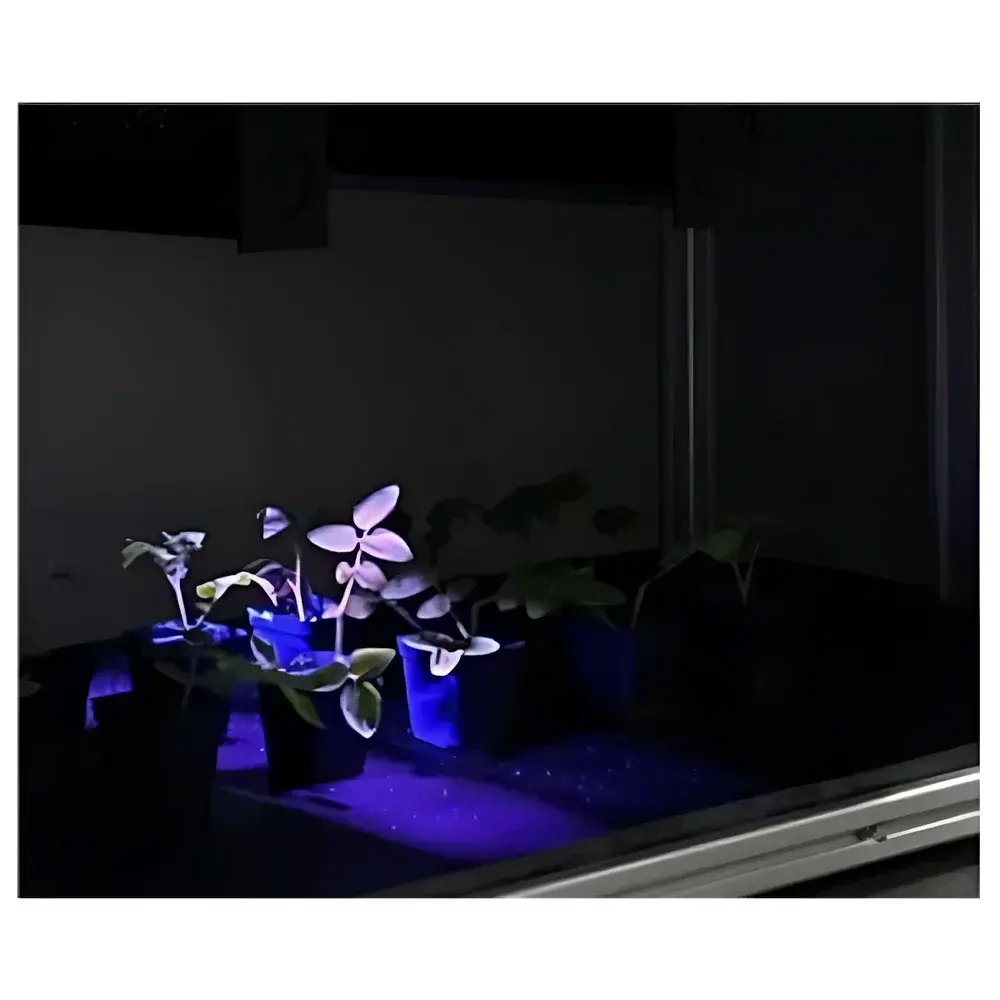
EcoTech FluorTron Plant Chlorophyll Fluorescence Spectral Imaging System
| Brand | EcoTech |
|---|---|
| Origin | Beijing, China |
| Model | FluorTron |
| Imaging Sensor | AMS CMV2000 CMOS (2048 × 1088 px) |
| Pixel Size | 5.5 µm |
| Spectral Range (Fluorescence) | F668–F772 (12+ chlorophyll fluorescence bands) |
| Spectral Range (RedEdge-NIR) | 665–960 nm (24 bands, FWHM 10–15 nm) |
| Excitation Source | Tunable blue LED (multi-excitation optional) |
| Data Acquisition Speed | ≥100 spectral cubes/sec |
| Optical Interface | C-mount |
| Power Consumption | 15 W |
| Morphometric Parameters | Projected area, length, width, aspect ratio, convex hull area, ROI area, roundness |
| Software Suite | FluorVision, SpectrAPP (ROI analysis, spectral fusion, derivative processing, >100 vegetation & physiological indices) |
| Modular Expansion | Optional hyperspectral (400–1000 nm, 448 channels), thermo-RGB, UV-MCF imaging |
Overview
The EcoTech FluorTron Plant Chlorophyll Fluorescence Spectral Imaging System is a research-grade, non-invasive phenotyping platform engineered for quantitative, spatially resolved analysis of photosynthetic physiology in intact plants. It integrates time-resolved and spectral-resolved chlorophyll fluorescence imaging with RedEdge–Near-Infrared (RE-NIR) reflectance spectroscopy to deliver concurrent functional and structural phenotypic data. Based on the principles of pulse-amplitude modulated (PAM) fluorometry and calibrated multispectral radiometry, the system captures dynamic fluorescence transients (e.g., Fo, Fm, Fv/Fm, ∆F/Fm′, NPQ, Y(NO), Y(NPQ)) across multiple emission wavelengths—enabling spectral fingerprinting of photosystem II (PSII) photochemical efficiency, energy dissipation pathways, and electron transport status. Simultaneously, its 24-band RE-NIR reflectance module supports robust calculation of biophysical and biochemical indices—including NDVI, OSAVI, ZTM (red-edge inflection point), NIRv, and MSR—thereby linking physiological function to canopy structure, pigment composition, and stress-responsive spectral signatures.
Key Features
- High-sensitivity spectral fluorescence imaging across 12+ emission bands (F668, F686, F704, F720, F727, F739, F740, F760, F772, etc.), enabling wavelength-specific quantification of PSII fluorescence yield and quenching kinetics.
- Time-resolved fluorescence acquisition at ≥100 spectral cubes per second, supporting high-temporal-resolution kinetic profiling under actinic illumination or saturating pulses.
- Dual-mode optical architecture: synchronized chlorophyll fluorescence detection (blue excitation, 450 ± 10 nm) and RE-NIR reflectance imaging (665–960 nm, 24 narrowband channels, FWHM 10–15 nm).
- AMS CMV2000 CMOS sensor with 2048 × 1088 resolution and 5.5 µm pixel pitch, optimized for low-noise, high-dynamic-range spectral capture under controlled illumination conditions.
- Modular, expandable design compliant with ISO/IEC 17025-aligned laboratory integration standards; supports field-deployable or growth-chamber-based configurations.
- C-mount optical interface enables interchangeability with macro, telecentric, or zoom lenses for scalable imaging fields—from single-leaf to multi-plant rosette assays.
- Integrated morphometric engine computes standardized geometric parameters (projected area, convex hull, length/width ratio, roundness) aligned with FAO and Crop Ontology definitions for biomass proxy estimation.
Sample Compatibility & Compliance
The FluorTron system is validated for use with angiosperms, gymnosperms, bryophytes, and algae under controlled-environment conditions (growth chambers, greenhouses, phenotyping platforms). It complies with ASTM E2599-21 (Standard Practice for Quantitative Hyperspectral Imaging of Plant Canopies) and supports GLP/GMP-aligned experimental workflows through audit-trail-enabled software logging. All fluorescence and reflectance calibrations are traceable to NIST-traceable reference standards (e.g., Spectralon® diffuse reflectance tiles, calibrated photodiode detectors). The system meets IEC 61000-6-3 (EMC emissions) and IEC 61000-6-2 (immunity) requirements for laboratory instrumentation. No sample preparation, labeling, or destructive sampling is required—ensuring longitudinal monitoring of individual plants across developmental stages or stress treatments.
Software & Data Management
FluorTron operates via two tightly integrated software environments: FluorVision (dedicated fluorescence spectral analysis) and SpectrAPP (multispectral/hyperspectral processing). Both support FDA 21 CFR Part 11-compliant user authentication, electronic signatures, and immutable audit trails for regulated research. Key capabilities include: automated ROI definition using machine-vision segmentation; batch processing of spectral cubes with configurable normalization (dark current, flat-field, reference standard); spectral derivative computation (1st/2nd order); peak detection and ratio indexing (e.g., F685/F740 for drought stress, F735/F700 for chlorophyll content); and export of metadata-rich HDF5 or NetCDF4 files compatible with Python (scikit-learn, h5py), R (hyperspec), and MATLAB workflows. All indices—including PRI, TCARI/OSAVI, CCI, DCNI, and UV-excited BGF ratios—are preconfigured per peer-reviewed literature protocols (e.g., Gitelson et al., 2003; Barnes et al., 2000; Merzlyak et al., 2008).
Applications
The FluorTron system serves as a core instrument in plant science laboratories focused on abiotic and biotic stress physiology, breeding program screening, functional genomics validation, and climate-resilience phenotyping. Typical use cases include: quantifying PSII photoinhibition kinetics during drought, heat, or salinity exposure; mapping spatial heterogeneity of non-photochemical quenching (NPQ) across leaf lamina; correlating red-edge inflection point (ZTM) shifts with nitrogen status in cereal crops; discriminating early-stage pathogen infection via altered F685/F740 ratios; validating CRISPR-edited photosynthetic mutants through high-throughput fluorescence parameter clustering; and integrating fluorescence-derived Y(II) maps with thermal imaging for stomatal conductance inference. Its modular architecture allows seamless coupling with EcoTech’s Thermo-RGB or UV-MCF modules for multimodal stress diagnostics.
FAQ
What light sources are used for chlorophyll fluorescence excitation?
A tunable blue LED array (peak 450 nm ± 10 nm, adjustable intensity) serves as the primary excitation source. Optional multi-wavelength excitation modules (UV-A, green, red) are available for comparative spectral response analysis.
Can the system be used for field-based measurements?
Yes—when mounted on a portable gantry or drone-compatible stabilization rig (with appropriate calibration protocols), the FluorTron supports semi-field phenotyping. However, optimal spectral fidelity requires controlled ambient light conditions or active background subtraction algorithms.
Is spectral calibration performed in situ?
Yes—each acquisition session includes automated dark-frame and white-reference capture using integrated shutter and Spectralon® reference tile. Wavelength calibration is verified daily using mercury-argon emission line standards.
How is data storage and version control managed?
Raw spectral cubes are stored in HDF5 format with embedded EXIF-like metadata (timestamp, exposure, gain, ROI coordinates, calibration ID). SpectrAPP enforces semantic versioning of analysis pipelines and supports Git-integrated script repository synchronization.
Does the system comply with regulatory requirements for clinical or agricultural product registration studies?
While not a medical device, FluorTron-generated data meet OECD TG 111, EPA OPPTS 850.4400, and EFSA guidance criteria for non-destructive plant bioefficacy testing when operated under documented SOPs and validated calibration routines.
Related Products




