
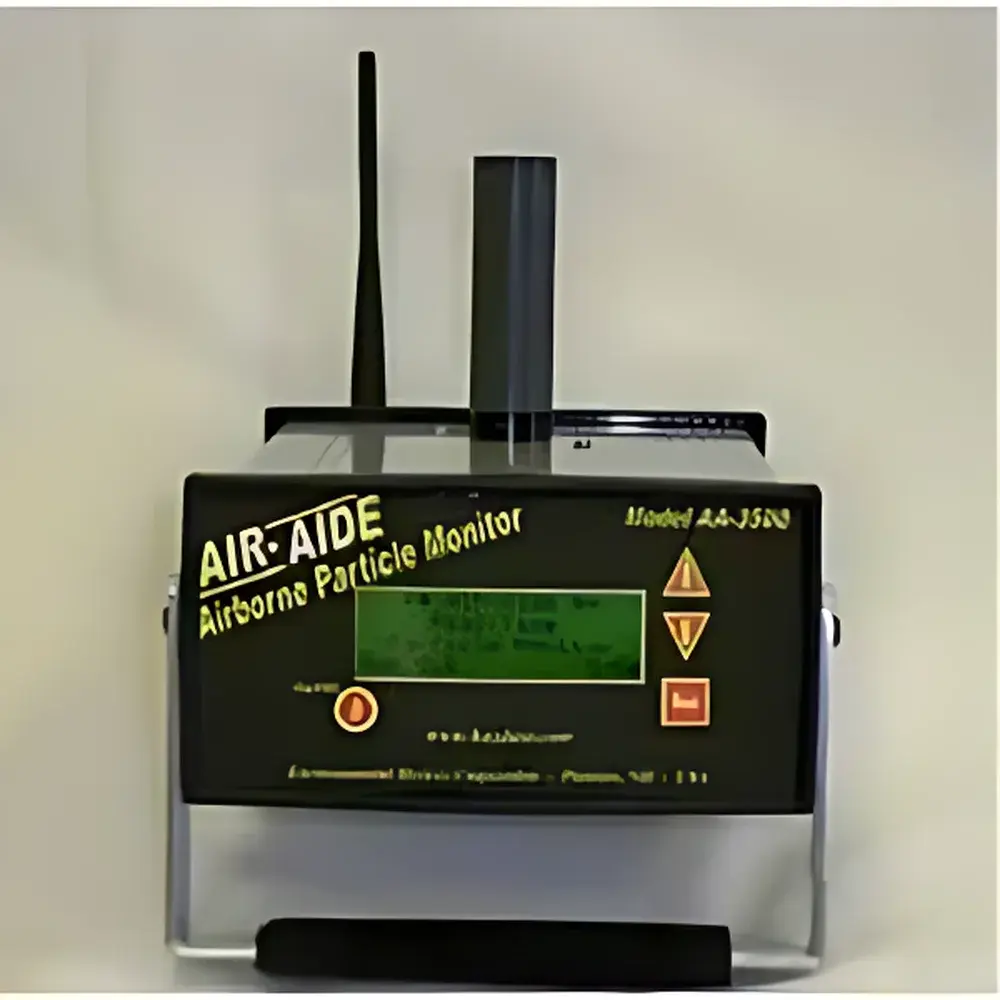
EDC Air Aide AA-3500 Real-Time Particulate Matter Monitor
| Brand | EDC |
|---|---|
| Origin | USA |
| Model | Air Aide AA-3500 |
| Measurement Principle | Nephelometric Light Scattering (90° detection geometry) |
| Safety Rating | Non-explosion-proof |
| Measurement Ranges | 0.001–20.0 mg/m³ and 0.01–200 mg/m³ (user-selectable dual range) |
| Resolution | 0.001 mg/m³ |
| Accuracy (2σ stability) | ±0.004 mg/m³ |
| Temperature Drift (2σ) | ±0.0025 mg/m³/°C |
| Analog Output | 0–2 VDC |
| Certifications | CE, ETL |
| Sampling Inlet Options | PM₁₀, PM₂.₅, PM₁.₀, and Respirable Dust (4.5 µm D₅₀ cutoff) |
Overview
The EDC Air Aide AA-3500 is a portable, real-time particulate matter (PM) monitor engineered for quantitative assessment of airborne dust concentrations in occupational, environmental, and building health applications. It employs calibrated nephelometric light scattering—measuring scattered intensity at 90° from a stable LED source—to deliver immediate mass concentration readings traceable to gravimetric reference methods. Unlike filter-based samplers requiring post-collection lab analysis, the AA-3500 provides continuous, second-by-second data with no consumables or membrane handling. Its dual-range capability (0.001–20.0 mg/m³ and 0.01–200 mg/m³) enables high-sensitivity indoor air quality (IAQ) monitoring as well as robust industrial hygiene surveys across diverse aerosol loadings. The instrument meets the functional requirements of ISO 16000-8 (indoor air—particulate matter), ASTM D6245 (indoor air quality assessment), and OSHA Technical Manual Section II: Chapter 2 (air contaminants), supporting compliance-driven exposure monitoring programs.
Key Features
- Real-time nephelometric sensor with 0.001 mg/m³ resolution and ±0.004 mg/m³ (2σ) baseline stability
- User-selectable inlet cyclones for PM₁₀, PM₂.₅, PM₁.₀, and respirable dust (4.5 µm D₅₀ cutoff per ISO 7708)
- Integrated long-life diaphragm pump with brushless motor design and accessible internal filter maintenance
- Rechargeable NiMH battery (up to 12 hours runtime) with AC/DC dual-power operation and auto-switching circuitry
- Backlit LCD display with intuitive menu navigation for sampling setup, alarm thresholds, and position-code labeling
- Configurable audible and visual alarms with user-defined safety codes to prevent unauthorized parameter changes
- Ergonomic rotating carry handle optimized for field deployment and vertical/horizontal orientation flexibility
- Onboard memory capacity supporting ≥15 months of timestamped, location-coded data at 1-minute logging intervals
Sample Compatibility & Compliance
The AA-3500 is validated for use with ambient, indoor, and process-generated aerosols including mineral dusts, metal fumes, carbon black, cellulose fibers, and combustion-derived particulates. Its optical calibration supports both coarse-mode (e.g., cement, silica) and fine-mode (e.g., diesel soot, welding fume) aerosols via selectable built-in correction factors aligned with MPPD model assumptions. The device carries CE marking per EU Directive 2014/30/EU (EMC) and 2014/35/EU (LVD), and ETL certification to UL 61010-1 for electrical safety. While not intrinsically safe, its non-explosion-proof classification complies with general-purpose industrial environments where hazardous area classification is not required. Data output conforms to ISO/IEC 17025 documentation expectations for field instruments when used within defined operating conditions (10–40°C, 15–90% RH non-condensing).
Software & Data Management
The included Windows-compatible software (compatible with Windows XP through Windows 11) enables full configuration, data download, and statistical reporting. Through the RS-232 interface (9-pin null-modem cable supplied), users retrieve time-stamped datasets containing TWA (time-weighted average), STEL (short-term exposure limit), ceiling values, min/max concentrations, and location-tagged records (up to 99 unique position codes). The software generates ISO-compliant graphical reports—including trend plots, histogram distributions, and cumulative exposure summaries—and exports CSV/Excel files for integration into enterprise EHS platforms. Audit-trail functionality logs all parameter changes with timestamps and operator IDs, supporting GLP-aligned recordkeeping. Optional wireless data transmission modules (IEEE 802.15.4) allow secure over-the-air transfer to local gateways without physical cabling.
Applications
- Occupational hygiene surveys for OSHA PEL and ACGIH TLV compliance verification
- Indoor air quality assessments in schools, hospitals, offices, and HVAC system commissioning
- Construction site dust control validation (e.g., demolition, grinding, sandblasting)
- Industrial process monitoring for baghouse efficiency, fugitive emission tracking, and stack bypass detection
- Research-grade aerosol characterization in laboratories studying particle dynamics and filtration performance
- Post-remediation verification following mold, asbestos, or lead abatement activities
FAQ
What calibration standards does the AA-3500 support?
The instrument uses factory-applied optical calibrations traceable to NIST-traceable PSL (polystyrene latex) spheres and verified against ISO 12103-1 A2 test dust. Field recalibration is performed using zero-air and span aerosol challenges per manufacturer protocol.
Can the AA-3500 differentiate between PM₂.₅ and PM₁₀ in real time?
No—it operates with a single optical channel and requires mechanical size-selective inlets; simultaneous dual-fraction measurement requires two independent units or sequential sampling with inlet swaps.
Is the data export format compatible with LIMS or EHS software?
Yes—CSV and Excel outputs include ISO 8601 timestamps, location codes, concentration units, and metadata fields required for ingestion into common industrial hygiene information systems.
Does the device meet FDA 21 CFR Part 11 requirements?
While the AA-3500 itself is not Part 11–certified, its software supports electronic signatures, audit trails, and role-based access controls when deployed in validated environments under site-specific SOPs.
What is the recommended maintenance interval for the internal filter and pump?
The integrated filter should be inspected after every 40 hours of operation and cleaned or replaced based on visible loading; the pump assembly requires no scheduled maintenance but benefits from annual inspection per EDC Service Bulletin AA-3500-MNT-2023.







