
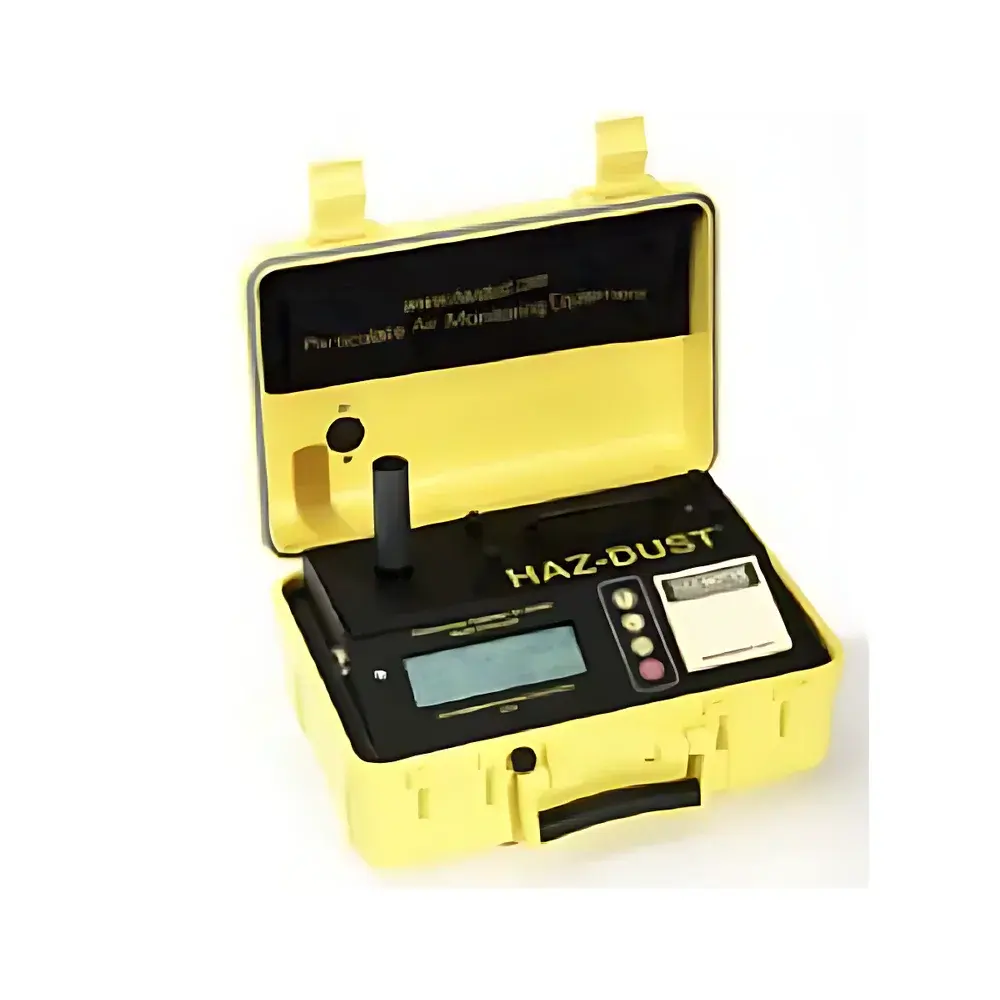
EDC EPAM-5000 Environmental Particulate Matter Monitor
| Brand | EDC |
|---|---|
| Origin | USA |
| Model | EPAM-5000 |
| Measurement Principle | Integrated Optical Scattering & Gravimetric Filtration |
| Safety Rating | Non-Explosive |
| Measurement Range | 0.01–200.0 mg/m³ |
| Resolution | 0.01 mg/m³ |
| Accuracy | ±0.003 mg/m³ |
| Relative Error | ±0.003 mg/m³ |
| Particle Size Range | 0.1–100 µm |
| Flow Rate | 1.0–5.0 L/min |
| Filter Diameter | 47 mm FRM-compliant |
| Alarm Output | 90 dB at 3 ft |
| Analog Output | 0–2 VDC |
| Data Logging Interval | 1 sec to 30 min |
| Memory Capacity | 21,600 data points |
| Internal Clock Backup | >5 years |
| Operating Temperature | –10 °C to +50 °C |
| Storage Temperature | –20 °C to +70 °C |
| Humidity Range | ≤95% RH non-condensing |
| Dimensions (H×W×D) | 35.6 × 15.2 × 25.4 cm |
| Weight | 5.4 kg |
| Power | Rechargeable battery (24 h runtime) or AC adapter (22 h recharge time) |
Overview
The EDC EPAM-5000 Environmental Particulate Matter Monitor is a field-deployable, dual-method ambient and occupational aerosol monitoring system engineered for regulatory-grade particulate mass concentration measurement. It combines real-time optical scattering detection with simultaneous gravimetric sampling on standardized 47 mm filter media—enabling concurrent, traceable mass quantification and dynamic particle concentration trending. Unlike single-principle instruments, the EPAM-5000 satisfies both immediate exposure assessment needs (e.g., TWA, STEL, peak excursion tracking) and compliance-aligned filter-based analysis (e.g., EPA Method PM-10, PM-2.5, PM-1.0, and TSP). Its architecture supports interchangeable cyclone inlets certified to ISO 7708 and EPA reference method specifications, ensuring aerodynamic size-selective sampling across the full respirable and inhalable range (0.1–100 µm). The instrument operates autonomously under variable environmental conditions and meets functional requirements for long-term unattended deployment in ambient air quality networks, construction site monitoring, industrial hygiene surveys, and emergency response scenarios.
Key Features
- Dual-sensor architecture: Real-time laser scattering photometer synchronized with precision gravimetric filtration on FRM-compliant 47 mm filters
- Four selectable inlet configurations: PM-1.0, PM-2.5, PM-10, and TSP cyclones—each calibrated per ISO 25358 and EPA Compendium Method IO-3.2
- High-resolution analog and digital outputs: 0–2 VDC analog signal + RS-232 serial interface for integration into SCADA or central data acquisition systems
- Intelligent flow compensation: Active pump control maintains 1.0–5.0 L/min across pressure differentials, minimizing sampling bias during extended deployments
- Self-cleaning optical path: Automated periodic purge cycle reduces maintenance frequency and preserves optical calibration stability
- Extended onboard memory: Stores 21,600 timestamped records with full metadata (concentration, TWA, MAX/MIN/STEL, date/time, temperature, humidity)
- Robust environmental rating: Operates continuously from –10 °C to +50 °C; non-condensing humidity tolerance up to 95% RH
- Battery + AC operation: 24-hour field runtime on rechargeable Li-ion pack; hot-swappable power option available via optional external battery module
Sample Compatibility & Compliance
The EPAM-5000 is designed to support regulatory and research-grade particulate sampling protocols. All cyclone inlets are dimensionally and aerodynamically validated against EPA Reference Methods (e.g., Method 201A for PM-2.5, Method 202 for PM-10) and ISO 7708:1995 for inhalable, thoracic, and respirable fractions. Filter substrates comply with Federal Reference Method (FRM) specifications (glass fiber, quartz, or PTFE membranes), enabling subsequent laboratory analysis (e.g., gravimetric mass, elemental carbon, ion chromatography). Data logging adheres to GLP principles: each record includes embedded UTC timestamp, instrument ID, flow rate, temperature, and internal diagnostics. While not intrinsically rated for Class I Div 1 hazardous locations, its non-explosive design meets OSHA 29 CFR 1910.1200 and ACGIH TLV® reporting conventions for workplace exposure monitoring.
Software & Data Management
DUSTCOMM PRO software provides native Windows-compatible configuration, visualization, and export functionality. It supports real-time graphing of concentration trends (mg/m³ vs. time), automatic calculation of occupational exposure metrics (TWA, STEL, ceiling limits), and batch export to CSV, Excel, or XML formats compatible with EPA AIRS, AQS, and EU Air Quality Directive reporting frameworks. Audit trails include user login timestamps, parameter changes, and calibration event logs—supporting 21 CFR Part 11–aligned data integrity workflows when paired with electronic signature modules. Firmware updates and remote diagnostics are accessible via serial or optional wireless telemetry (LTE-M or LoRaWAN adapters).
Applications
- Ambient air quality monitoring networks (urban, rural, roadside)
- Construction and demolition site dust compliance verification
- Industrial hygiene assessments for cement, mining, foundry, and pharmaceutical manufacturing
- Wildfire smoke dispersion modeling and community exposure mapping
- Indoor air quality investigations in schools, hospitals, and office buildings
- Controlled emission testing of dust suppression systems (water mist, foam, chemical binders)
- Emergency response to fugitive emissions, chemical spills, or structural collapse events
- Research on aerosol dynamics, coagulation behavior, and hygroscopic growth effects
FAQ
Does the EPAM-5000 meet EPA equivalency requirements for PM-2.5 monitoring?
Yes—the PM-2.5 cyclone inlet and gravimetric sampling protocol are aligned with EPA Reference Method EQPM-0303-112, and correlation studies demonstrate R² ≥ 0.94 against tapered element oscillating microbalance (TEOM) reference systems under controlled field conditions.
Can the instrument operate unattended for more than one week?
Yes—internal memory supports up to 21,600 records; with a 30-minute logging interval, data retention exceeds 15 months. Optional solar charging kits extend operational autonomy indefinitely in sun-exposed deployments.
Is filter weighing performed in situ or off-site?
Gravimetric analysis requires post-sampling laboratory balance measurement per EPA Method 201A or ISO 12103-1. The EPAM-5000 collects and archives the filter for transport to an accredited lab.
What calibration standards are recommended?
Optical channel calibration uses NIST-traceable polystyrene latex (PSL) spheres (1.0 µm and 2.5 µm); flow calibration employs primary-standard dry gas meters per ISO 6145-2. Annual factory recalibration is recommended.
How is data integrity ensured during power interruption?
Non-volatile flash memory retains all logged data and clock settings during battery depletion or AC loss. Real-time clock backup exceeds five years without power.
Related Products







