
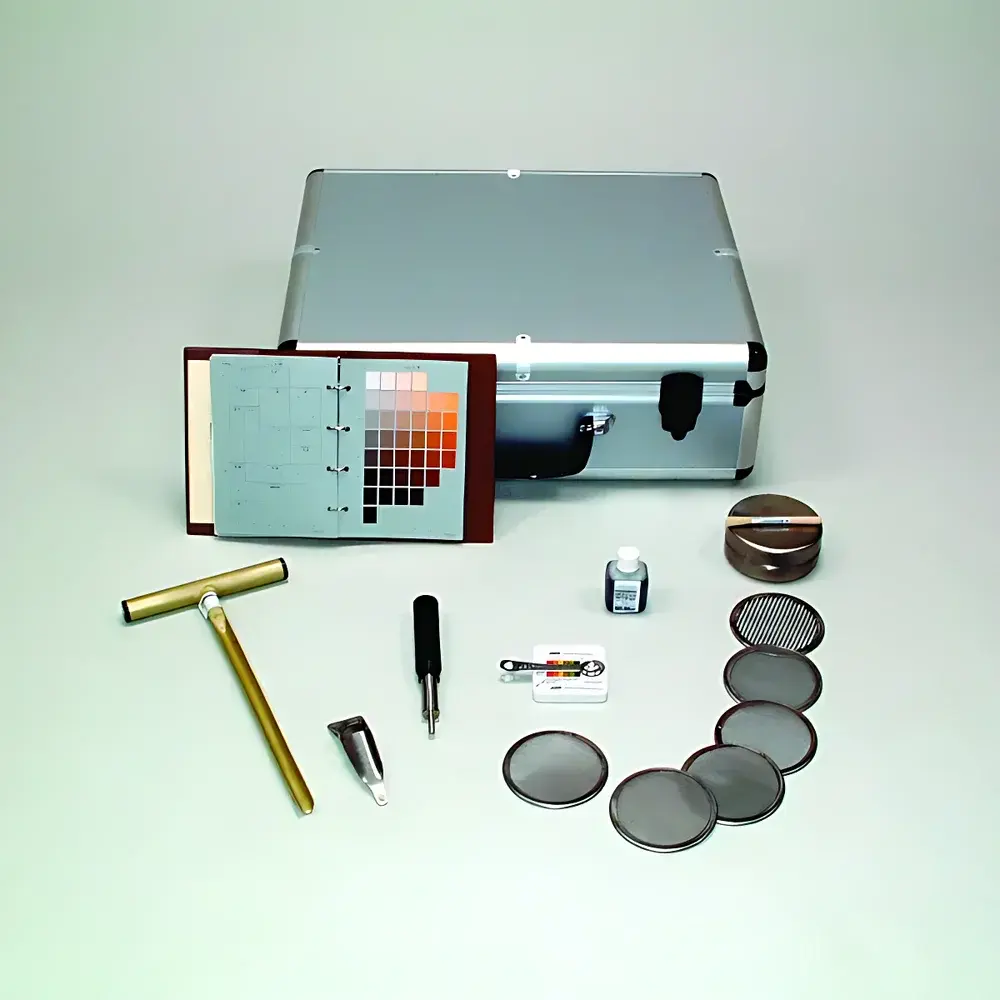
Eijkelkamp Munsell Soil Color Chart
| Brand | Eijkelkamp |
|---|---|
| Origin | USA |
| Manufacturer Type | Authorized Distributor |
| Origin Category | Imported |
| Model | Munsell |
| Pricing | Available Upon Request |
Overview
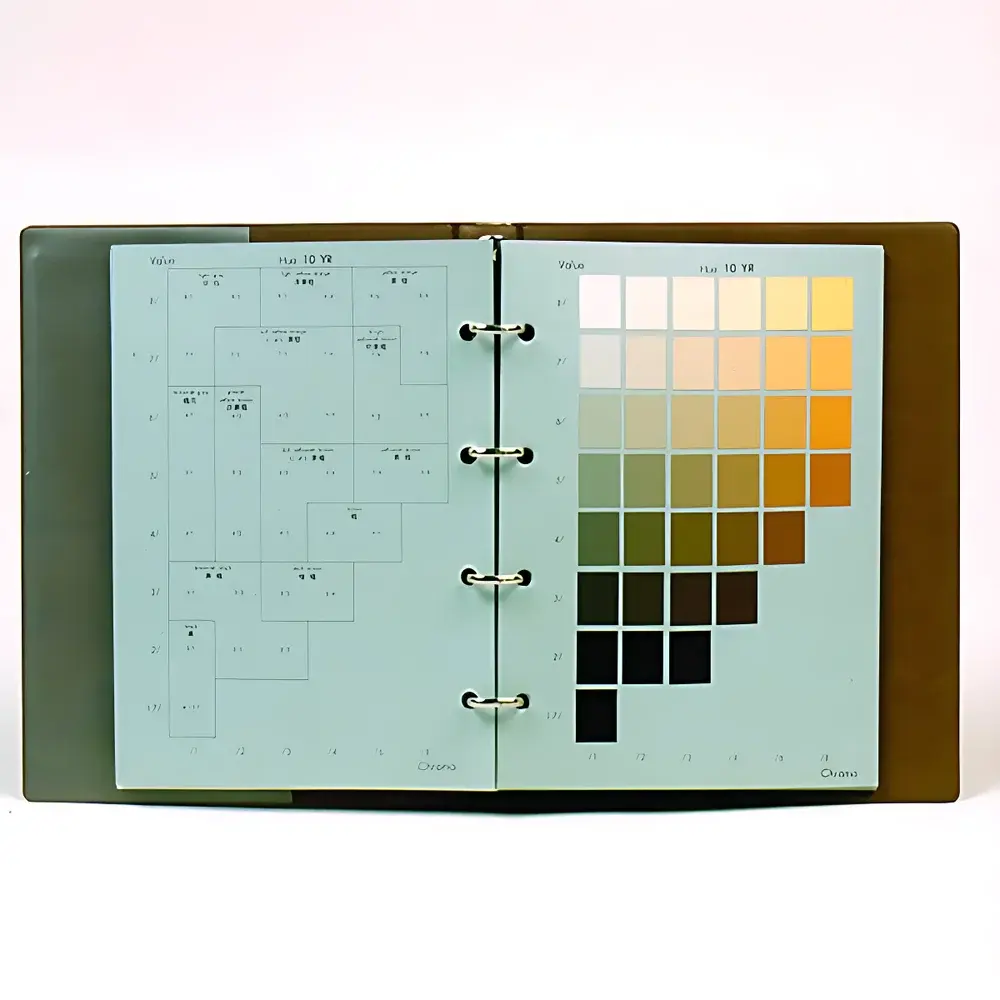
The Eijkelkamp Munsell Soil Color Chart is a field-deployable, standardized visual reference tool engineered for precise soil color identification in accordance with the internationally recognized Munsell Color System. Unlike subjective color descriptions or digital imaging under variable lighting, this chart enables consistent, repeatable soil color classification through direct side-by-side comparison of air-dried or moist soil samples against calibrated matte-finish color chips. Soil color serves as a critical diagnostic indicator in pedology—correlating strongly with organic matter content, iron oxide mineralogy (e.g., hematite vs. goethite), drainage class, redox status, and weathering intensity. The chart supports both field reconnaissance and laboratory-based horizon description workflows, fulfilling foundational requirements in USDA Soil Taxonomy, WRB (World Reference Base) classification, and ISO 11277:2023 (soil description and sampling). Its design adheres to ASTM D2488–22 (“Standard Practice for Description and Identification of Soils”) and integrates seamlessly into GLP-compliant soil survey protocols.
Key Features
- Calibrated Munsell color chips printed on acid-free, UV-stabilized cardstock to prevent fading during extended field exposure
- Comprehensive coverage of the Munsell hue circle (10R–10P) across value (N 2–8) and chroma (2–8) dimensions relevant to natural soils
- Dual moisture-state capability: includes designated chips for both air-dry and moist (field-moist) soil conditions per USDA-NRCS guidelines
- Matte surface finish eliminates specular reflection, ensuring color assessment remains independent of ambient light angle or intensity
- Compact, laminated, pocket-sized format (15 × 10 cm) with durable hinge binding for repeated opening/closing in dusty or humid environments
- Includes quick-reference guide with Munsell notation syntax, common soil color correlations (e.g., 7.5YR 5/6 = typical well-drained loam), and interpretation notes for chroma suppression in high-organic or clay-rich matrices
Sample Compatibility & Compliance
The Eijkelkamp Munsell Soil Color Chart is compatible with all soil textures—from coarse sands to heavy clays—and accommodates both undisturbed monoliths and disturbed bulk samples. It requires no power, calibration, or consumables; operation depends solely on trained visual assessment under natural daylight (CIE Standard Illuminant D65 equivalent) or consistent artificial lighting (e.g., ISO 3664–compliant viewing booths). The chart conforms to ISO 11277:2023 Annex A (soil description methodology), supports compliance with USDA-NRCS Field Operations Handbook (FOH) Chapter 20, and provides traceable documentation for QA/QC reporting in environmental site assessments (ESAs), agricultural land evaluation, and archaeological stratigraphy studies. While not a quantitative instrument, its use satisfies data integrity requirements when paired with observer training records and inter-rater reliability checks per ASTM D2216–21.
Software & Data Management
This is a physical reference standard and does not incorporate embedded electronics or software. However, Munsell color codes generated using this chart are fully interoperable with digital soil mapping platforms—including USDA SSURGO, ISRIC World Soil Information database, and QGIS-based pedometric modeling workflows. Field-collected Munsell notations (e.g., “5YR 3/4”) can be directly imported into soil database schemas compliant with the International Soil Reference and Information Centre (ISRIC) metadata standards. For laboratories operating under 21 CFR Part 11 or ISO/IEC 17025, documented use of the chart—including operator certification logs and periodic verification against NIST-traceable Munsell reference standards—is recommended for audit readiness.
Applications
- Pedological field surveys and soil horizon characterization for national soil inventories
- Environmental due diligence (Phase I/II ESAs) to infer contaminant history (e.g., chroma reduction indicating hydrocarbon impact)
- Agricultural soil health monitoring—tracking organic carbon trends via value/chroma shifts over time
- Wetland delineation per U.S. Army Corps of Engineers (USACE) Wetland Delineation Manual criteria
- Archaeological excavation logging, where color stratigraphy informs depositional chronology
- Teaching resource in university-level soil science, geomorphology, and environmental geology curricula
FAQ
How does the Munsell system differ from RGB or HEX color models?
The Munsell system is perceptually uniform and based on human vision physiology; RGB/HEX are device-dependent additive models unsuitable for geological material description.
Is this chart suitable for wetland soil identification?
Yes—it includes low-chroma, high-value chips essential for gleyed and reduced soils, aligned with USACE hydric soil indicators.
Can it be used for non-soil materials like sediments or sludge?
While optimized for mineral and organic soils, it is routinely applied to lacustrine sediments and biosolids—provided samples are homogenized and presented at standardized moisture content.
Does Eijkelkamp provide calibration verification services?
Eijkelkamp distributes the chart as supplied by the official Munsell Color Company; users may request a Certificate of Conformance referencing Munsell Lot # and production date.
What lighting conditions are required for valid assessment?
Natural north-facing daylight (10:00–15:00 local time) is preferred; if indoors, use a CIE D65 illuminant with >90 CRI and controlled ambient light to avoid metamerism.
Related Products







