
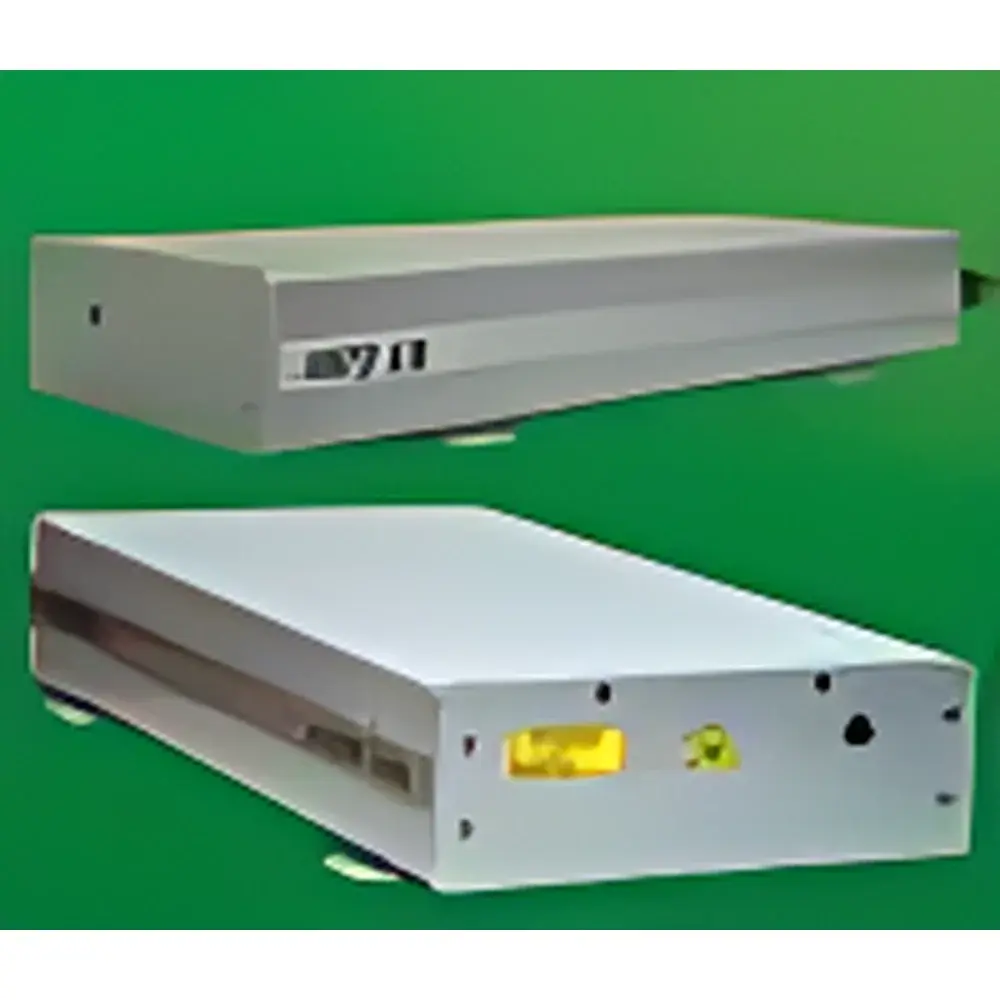
Ekspla Jazz Q-Switched Diode-Pumped Solid-State Nd:YVO4 Green Laser
| Brand | Ekspla |
|---|---|
| Origin | Lithuania |
| Manufacturer Type | Original Equipment Manufacturer (OEM) |
| Laser Type | Diode-Pumped Solid-State (DPSS) |
| Wavelength | 532 nm |
| Pulse Duration | <15 ns |
| Repetition Rate | Up to 100 kHz |
| Average Output Power | Up to 5.5 W |
| Beam Quality (M²) | <1.3 |
| Cooling | Air- or Water-Cooled Options |
| Compliance | CE, RoHS, IEC 60825-1 |
Overview
The Ekspla Jazz is a high-performance, nanosecond-pulsed, diode-pumped solid-state (DPSS) laser system engineered for precision industrial and scientific applications requiring stable green light at 532 nm. Based on a master oscillator–power amplifier (MOPA) architecture with Nd:YVO4 as the gain medium and intracavity frequency doubling via LBO or BBO nonlinear crystals, the Jazz delivers tightly controlled Q-switched pulses with sub-15 ns duration, excellent temporal stability, and high spatial coherence. Its design prioritizes long-term operational reliability under continuous duty cycles typical in semiconductor wafer scribing, thin-film ablation, micromachining of dielectrics, and time-resolved fluorescence excitation. Unlike lamp-pumped systems, the diode-pumping scheme ensures superior wall-plug efficiency, reduced thermal lensing, and extended cavity lifetime—critical attributes for integration into automated production lines and OEM instrumentation platforms.
Key Features
- Stable 532 nm green output with average power up to 5.5 W and pulse energy exceeding 55 µJ at 100 kHz
- Q-switched operation with pulse width 3 MW) for nonlinear interaction and minimal heat-affected zones
- Beam quality M² <1.3, supporting diffraction-limited focusing down to ~10 µm spot size for fine-feature processing
- Repetition rate tunable from single-shot to 100 kHz with jitter <1 ns RMS, synchronized via TTL/RS-232/Ethernet interfaces
- Robust monolithic resonator design with active thermal stabilization, ensuring <±0.3% power stability over 8-hour operation
- Flexible cooling options: air-cooled for compact integration; water-cooled for maximum power stability in high-duty-cycle environments
- Compliant with IEC 60825-1 Class 4 laser safety standards, equipped with integrated interlock circuits and emission indicators
Sample Compatibility & Compliance
The Jazz laser is routinely deployed in cleanroom-compatible material processing workflows involving silicon wafers, GaAs substrates, copper-clad laminates, alumina ceramics, polyimide films, and fused silica optics. Its 532 nm wavelength offers strong absorption in metals and many wide-bandgap semiconductors while maintaining sufficient transmission through certain transparent polymers—enabling selective layer removal without substrate damage. The system meets CE marking requirements for electromagnetic compatibility (EMC Directive 2014/30/EU) and low-voltage safety (LVD Directive 2014/35/EU). For regulated manufacturing environments, optional firmware supports audit-ready logging per FDA 21 CFR Part 11 and GLP/GMP traceability protocols when paired with Ekspla’s LaserControl software suite.
Software & Data Management
LaserControl v4.x provides full remote configuration, real-time monitoring, and parameter logging via USB 2.0, Ethernet, or RS-232. Users can define multi-segment pulse trains, set dynamic repetition rate ramps, and trigger external devices with programmable delay resolution of 10 ns. All operational parameters—including pulse energy, temperature readings, diode current, and interlock status—are timestamped and exportable in CSV or HDF5 format. The software architecture supports integration into LabVIEW, MATLAB, and Python-based automation frameworks via TCP/IP API. Firmware updates are performed securely over signed packages, preserving calibration integrity across maintenance cycles.
Applications
- Semiconductor manufacturing: Wafer dicing, via drilling, solder mask ablation, and laser-induced forward transfer (LIFT)
- Microelectronics: PCB depaneling, flex circuit trimming, resistor trimming, and thin-film capacitor patterning
- Optics fabrication: Coating removal from AR/HR mirrors, grating inscription in photosensitive glass, and waveguide writing
- Scientific instrumentation: Pump source for optical parametric oscillators (OPOs), time-of-flight mass spectrometry (TOF-MS), and pump-probe spectroscopy
- Medical device manufacturing: Precision cutting of nitinol stents and polymer-based catheter components
FAQ
What is the typical warm-up time required to achieve rated power stability?
The Jazz achieves ±0.5% power stability within 15 minutes after cold start under standard ambient conditions (20–25 °C, <60% RH).
Can the laser be operated in burst mode with variable intra-burst frequencies?
Yes—burst mode is supported via external TTL triggering with user-defined burst length, intra-burst spacing (≥10 µs), and inter-burst period.
Is OEM integration support available for custom mechanical or electrical interfaces?
Ekspla provides comprehensive OEM documentation, mechanical drawings (STEP/IGES), pinout schematics, and application engineering support for embedded integration.
Does the system include built-in pulse energy monitoring?
Optional internal photodiode-based energy monitor (PEM) module is available with ±2% calibration traceability to NIST standards.
What maintenance intervals are recommended for optimal long-term performance?
No routine optical alignment is required. Annual preventive maintenance includes diode current calibration, cooling system inspection, and interlock verification—documented per ISO 9001 procedures.





