
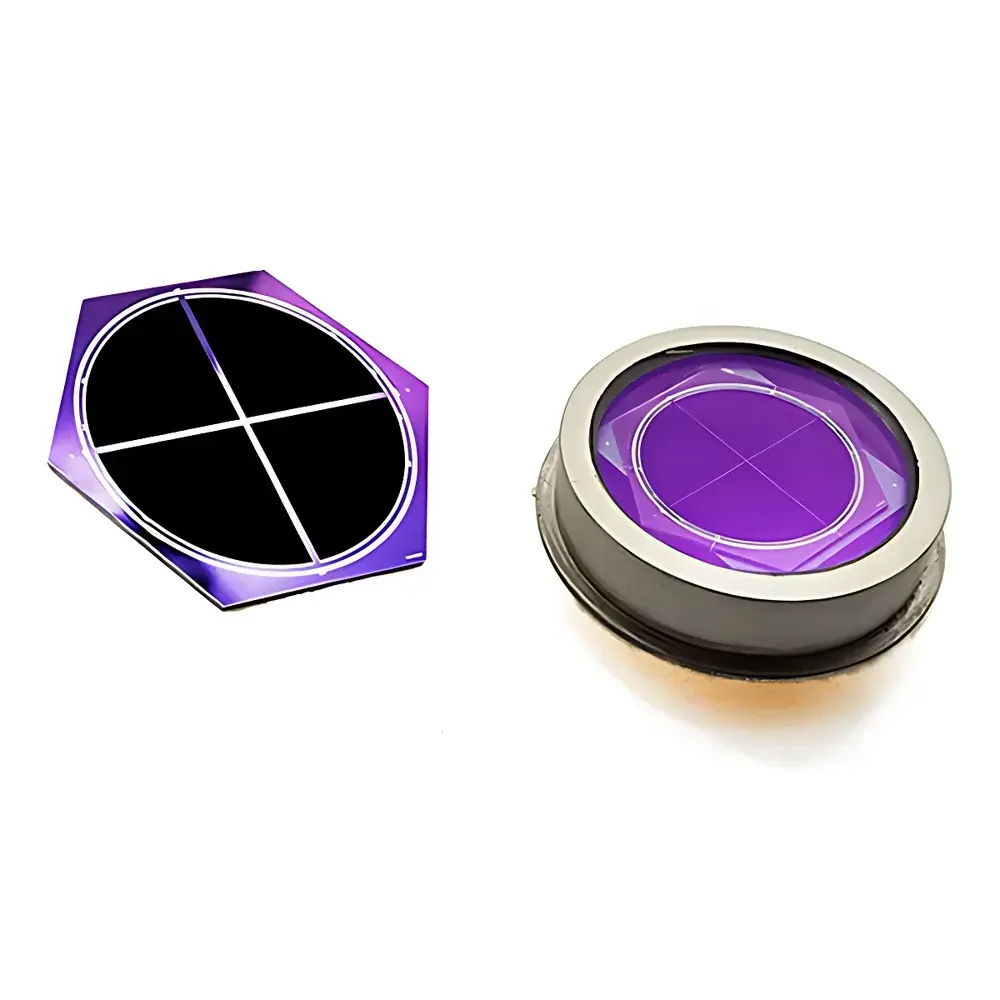
ELFYS QPD Black Silicon Quadrant Photodetector
| Brand | ELFYS |
|---|---|
| Origin | Finland |
| Model | QPD |
| Component Category | Optical Component |
| Technology | Black Silicon with Nanostructured Surface & ALD Coating |
| Spectral Range | UV to NIR (190–1100 nm) |
| Primary Wavelength Applications | 1064 nm (Nd:YAG), 850 nm, 940 nm |
| Operating Temperature | 25 °C (standard test condition) |
| Compliance | RoHS-compliant, ISO 9001-manufactured components |
Overview
The ELFYS QPD Black Silicon Quadrant Photodetector is a monolithic, four-segment silicon photodiode engineered for high-precision position-sensing and beam alignment in demanding optical systems. Unlike conventional quadrant detectors based on planar silicon, this device leverages black silicon technology—achieved through controlled nanotexturing of the silicon surface followed by atomic layer deposition (ALD) of anti-reflection and passivation layers. This architecture enables near-unity external quantum efficiency (EQE) across an exceptionally broad spectral range (190–1100 nm), including deep UV, visible, and near-infrared bands critical for Nd:YAG (1064 nm), VCSEL (850/940 nm), and free-space optical communication applications. The detector operates on the principle of differential photocurrent measurement: incident light focused onto the active area generates proportional photocurrents in each of the four quadrants; real-time comparison of these signals yields sub-microradian beam displacement resolution and centroid tracking accuracy. Its monolithic construction ensures intrinsic mechanical stability, thermal uniformity, and minimal inter-quadrant crosstalk—key requirements for closed-loop adaptive optics, laser cavity alignment, and satellite-based optical pointing systems.
Key Features
- Monolithic black silicon quadrant structure with <1% inter-quadrant crosstalk at 1064 nm
- Broadband spectral response: EQE >90% from 350 nm to 1064 nm; >75% at 1100 nm
- High shunt resistance (>1 GΩ at −5 V bias) and low dark current (<1 nA per quadrant at 25 °C)
- Active area: 4 × 2 mm² quadrants (total 4 mm × 4 mm), with 50 µm guard ring isolation
- Integrated backside contact metallization optimized for low-inductance readout in high-bandwidth configurations (up to 50 MHz small-signal bandwidth)
- RoHS-compliant packaging in hermetically sealed TO-5 can with AR-coated fused silica window (transmission >99.5% @1064 nm)
Sample Compatibility & Compliance
The QPD is compatible with standard optical breadboards, kinematic mounts, and OEM integration into laser interferometers, star trackers, and fiber-coupled alignment modules. It interfaces directly with transimpedance amplifiers (TIAs) and lock-in detection circuits without requiring external cooling or bias stabilization circuitry under ambient laboratory conditions (15–30 °C). All devices are manufactured in accordance with ISO 9001:2015 quality management systems. Materials and processing comply with EU Directive 2011/65/EU (RoHS 2). While not certified to IEC 61000-4-x immunity standards out-of-box, the detector meets electromagnetic compatibility prerequisites for integration into Class I laser safety systems per IEC 60825-1:2014 when housed in shielded enclosures.
Software & Data Management
ELFYS provides open-source Python-based reference firmware (GitHub-hosted) for interfacing the QPD with NI USB-6211 or similar DAQ hardware. The package includes real-time centroid calculation algorithms (X/Y displacement, beam ellipticity, and intensity normalization), timestamped ASCII logging, and HDF5 export for long-duration beam stability studies. For regulated environments, the firmware supports audit-trail-enabling metadata tagging (user ID, timestamp, configuration hash) compliant with GLP documentation workflows. Integration with LabVIEW™ and MATLAB® is supported via provided DLLs and .mex files. No proprietary drivers or cloud dependencies are required—full local control and data sovereignty are maintained.
Applications
- Laser beam steering and auto-alignment in ultrafast amplifier chains and regenerative amplifiers
- Real-time wavefront sensing in Shack–Hartmann systems using micro-lens array coupling
- Position-sensitive feedback for tip-tilt mirror control in adaptive optics for ground-based astronomy
- Free-space optical inter-satellite link acquisition and tracking (FSO-ATP)
- Non-contact vibration monitoring of optical tables via differential quadrant signal analysis
- Calibration reference for ISO 11146-compliant laser beam profiling systems
FAQ
What is the maximum linear dynamic range of the QPD at 1064 nm?
The detector maintains linearity within ±0.5% up to 100 µW total incident power per quadrant at room temperature and −5 V reverse bias.
Can the QPD be operated without active cooling?
Yes—specified performance parameters are guaranteed at 25 °C ambient; dark current increases by <15% per 10 K rise, but operation up to 45 °C is feasible with calibrated offset correction.
Is custom quadrant geometry or active area size available?
Yes—ELFYS offers design-for-manufacture services for non-standard layouts (e.g., circular symmetry, asymmetric segmentation) with minimum order quantities starting at 25 units.
Does the device support synchronous detection with modulated sources?
Yes—the low junction capacitance (<1.2 pF per quadrant) and high shunt resistance enable stable lock-in operation at frequencies up to 10 MHz with appropriate TIA selection.
Are calibration certificates traceable to NIST or EURAMET standards provided?
Upon request, individual units can be supplied with spectral responsivity calibration certificates traceable to VTT MIKES (Finland), accredited to ISO/IEC 17025:2017.



