
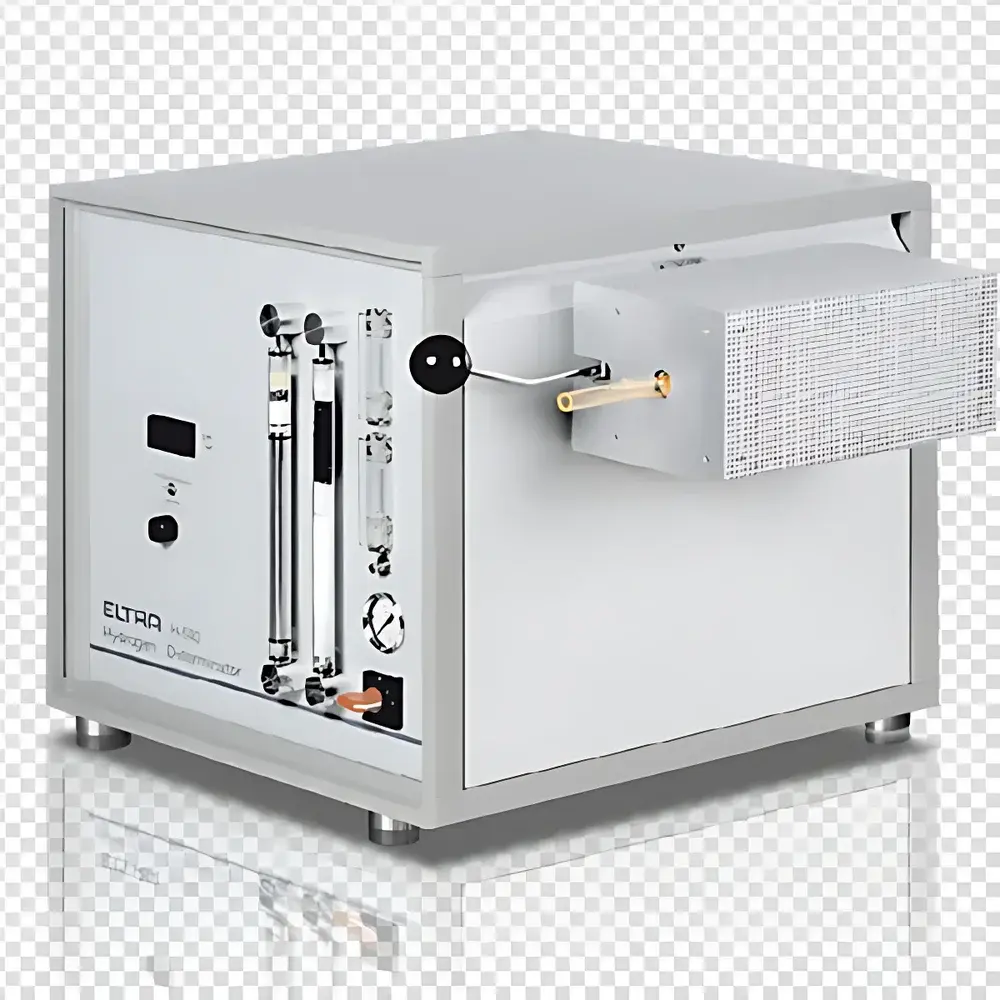
ELTRA H-500 Diffusible Hydrogen Analyzer
| Brand | ELTRA |
|---|---|
| Origin | Germany |
| Model | H-500 |
| Instrument Type | Diffusible Hydrogen Analyzer |
| Analysis Range | Low-level H: 0.1 ppm – 200 ppm |
| High-level H | 10 ppm – 2% |
| Accuracy | ±0.1 ppm or ±1% (low level) |
| Sensitivity | 0.01 ppm (H) |
| Analysis Time | 2–3 min (typical thermal extraction cycle) |
| Sample Mass | up to 10 g |
| Max Sample Dimensions | Ø13 mm × 60 mm |
| Furnace Type | Quartz tube resistance furnace, max temp 1000 °C (operating range 900–1000 °C) |
| Carrier Gas | Ultra-high-purity N₂ (99.995 %), 2–4 bar (30–60 psi) |
| Power Supply | 230 V, 50/60 Hz, 2 A, max 450 W |
| Dimensions (W×H×D) | 75 × 52 × 60 cm |
| Weight | ~40 kg |
| Required Ancillaries | PC with USB port, LCD monitor, analytical balance (0.0001 g resolution) |
Overview
The ELTRA H-500 Diffusible Hydrogen Analyzer is a high-precision, thermally driven elemental analyzer engineered for the quantitative determination of diffusible hydrogen in metallic materials—primarily ferrous alloys, weld metals, and high-strength steels. It operates on the principle of thermal extraction coupled with high-sensitivity thermal conductivity detection (TCD). In this method, a representative solid sample is heated under controlled inert gas flow (ultra-pure nitrogen) within a quartz tube furnace, causing lattice-bound hydrogen atoms to diffuse out of the metal matrix. The evolved hydrogen gas is swept through a series of chemical traps—including magnesium perchlorate (for water removal) and Schütze reagent (for CO/CO₂ scrubbing)—before entering a high-capacity, temperature-stabilized thermal conductivity cell. The resulting change in thermal conductivity is linearly proportional to hydrogen concentration and converted into quantitative results via calibrated response curves. Designed for both laboratory R&D and production-floor quality control environments, the H-500 delivers trace-level hydrogen quantification with metrological rigor, supporting critical failure prevention in welding, heat treatment, and component certification workflows.
Key Features
- Thermal extraction furnace with quartz tube and programmable resistance heating (up to 1000 °C; standard operating range 900–1000 °C) ensuring complete and reproducible hydrogen release from metallurgical matrices.
- High-capacity, low-drift thermal conductivity detector optimized for sub-ppm hydrogen detection, achieving a sensitivity of 0.01 ppm and accuracy of ±0.1 ppm (or ±1%) in low-concentration mode.
- Robust, maintenance-free mechanical architecture with no moving parts in the gas path—eliminating calibration drift associated with valves or pumps.
- Integrated multi-stage gas purification system: magnesium perchlorate (H₂O removal), Schütze reagent (CO/CO₂ oxidation and absorption), and sodium hydroxide (acidic impurity neutralization).
- Modular sample handling: accommodates specimens up to 10 g mass and Ø13 mm × 60 mm geometry; optional sample boats and crucibles compatible with steel, cast iron, titanium, and nickel-based superalloys.
- Intuitive multi-language software interface (English, German, French, Spanish, Chinese) supporting customizable report templates, real-time signal monitoring, and GLP-compliant audit trails.
Sample Compatibility & Compliance
The H-500 is validated for analysis of solid metallic samples including carbon steels, low-alloy steels, stainless steels, duplex grades, aluminum alloys, and titanium alloys. It complies with internationally recognized standards governing hydrogen testing in weldments and structural components—including ISO 3690 (metallic materials — determination of hydrogen content in weld metal), ASTM E1442 (standard test method for determination of hydrogen in titanium and titanium alloys), and EN 10260 (steel products — methods of determination of hydrogen content). All measurement protocols support full traceability per ISO/IEC 17025 requirements, and software functionality includes electronic signatures, user access levels, and 21 CFR Part 11–compliant data integrity controls when configured with optional audit trail modules.
Software & Data Management
ELTRA’s proprietary WinEva software provides comprehensive instrument control, data acquisition, and post-processing capabilities. It enables method-driven operation with pre-configured thermal ramp profiles, automatic baseline correction, peak integration, and internal standard normalization. Raw TCD signals are stored with full metadata (operator ID, timestamp, furnace parameters, gas flow rate, sample ID). Reports export to PDF, CSV, or XML formats and integrate seamlessly with LIMS environments via ODBC or OPC UA interfaces. Data archiving supports long-term retention compliant with GLP and GMP documentation practices, including version-controlled method files and immutable raw-data logs.
Applications
- Welding process qualification: verification of hydrogen levels in weld deposits to prevent cold cracking in high-strength steels.
- Metallurgical research: correlation of hydrogen content with embrittlement thresholds in pipeline steels and pressure vessel materials.
- Quality assurance in automotive and aerospace forging: screening of incoming billets and finished components for hydrogen-induced defects.
- Failure analysis laboratories: root-cause investigation of delayed fracture incidents in fasteners and bearing steels.
- Electroplating and surface treatment validation: assessment of hydrogen uptake during cathodic cleaning or electrochemical coating processes.
FAQ
What sample preparation is required prior to analysis?
Minimal preparation is needed: samples must be clean, dry, and free of surface oxides or coatings. Cylindrical or disc-shaped specimens are preferred; machining to ≤60 mm length and ≤13 mm diameter ensures optimal thermal contact and extraction efficiency.
Is carrier gas purity critical for accurate results?
Yes. Nitrogen carrier gas must meet ≥99.995 % purity (oxygen and moisture <1 ppm) to avoid interference with the thermal conductivity signal and ensure baseline stability over extended operation.
Can the H-500 analyze non-metallic materials such as ceramics or composites?
No—the H-500 is specifically engineered for diffusible hydrogen in conductive metallic lattices. Non-metals lack the requisite hydrogen diffusion kinetics under thermal extraction conditions and are outside its validated scope.
How often does the instrument require recalibration?
Calibration is performed using certified reference materials (CRMs) traceable to NIST or BAM; annual verification is recommended, though stability monitoring via daily blanks and control samples typically extends calibration intervals to 6–12 months under routine use.
Does the system support automated sample loading?
The base H-500 configuration is manually loaded; however, it is compatible with third-party autosamplers (e.g., ELTRA AS-200) for unattended batch processing of up to 20 samples—subject to mechanical integration and firmware upgrade.





