
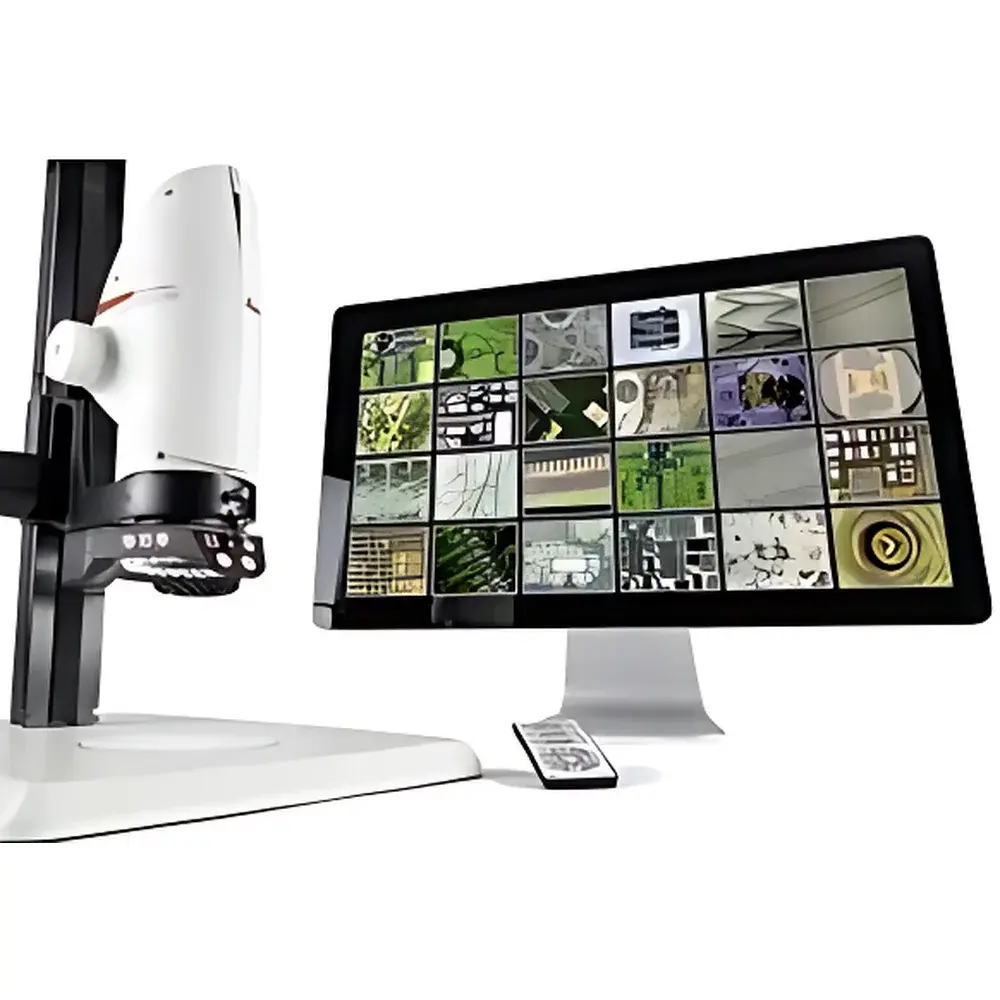
Leica DMS1000 Digital Stereo Microscope
| Brand | Leica |
|---|---|
| Origin | Germany |
| Model | DMS1000 |
| Type | Digital Stereo Microscope |
| Optical Design | Telecentric Pathway |
| Camera Sensor | Integrated 5 MP CMOS |
| Video Output | Full HD (1920 × 1080) at up to 30 fps |
| Measurement Capability | Encoded Zoom with Auto-Scale Calibration |
| Standalone Operation | Yes (SD card storage, IR remote control) |
| Software Integration | Leica LAS (Leica Application Suite) for 2D metrology and image analysis |
| Ergonomic Interface | Monitor-based viewing, no eyepieces required |
| Compliance | Designed for GLP/GMP-aligned documentation workflows |
Overview
The Leica DMS1000 is a discontinued but technically significant digital stereo microscope engineered for precision visual inspection, metrology, and documentation in quality control laboratories, electronics manufacturing, life science research, and materials characterization. Unlike conventional stereo microscopes relying on ocular observation, the DMS1000 employs a fully digital optical pathway—eliminating eyepieces and enabling direct high-fidelity imaging onto external monitors or integrated displays. Its core optical architecture features a telecentric light path, which ensures minimal perspective distortion across the field of view and enables traceable, repeatable 2D measurements without parallax error. This design is particularly critical for applications requiring dimensional stability under varying magnification settings, such as PCB solder joint evaluation, micro-component alignment, or biological specimen morphometry.
Key Features
- Telecentric optical system delivering consistent magnification scaling and reduced depth-induced measurement deviation
- Encoded zoom mechanism with automatic scale factor registration—each zoom position stores calibrated pixel-to-micron conversion data for real-time on-screen measurement
- Integrated 5-megapixel CMOS sensor capable of capturing static images and Full HD (1080p) video at up to 30 frames per second, minimizing motion blur and latency during dynamic sample assessment
- Standalone operation mode: all core functions—including image capture, video recording, zoom control, and brightness adjustment—are accessible via infrared remote control; no PC connection required for basic use
- Onboard SD card storage supports lossless image export and time-stamped video clips, facilitating rapid documentation in regulated environments
- Ergonomically optimized workflow: eliminates inter-user eyepiece repositioning; display height, angle, and brightness are independently adjustable to accommodate diverse operator anthropometrics
Sample Compatibility & Compliance
The DMS1000 accommodates opaque, translucent, and reflective samples typical of industrial and academic settings—including printed circuit boards, metallurgical cross-sections, botanical specimens, entomological preparations, and polymer components. Its long working distance (configurable via optional stands) permits manipulation of samples beneath the objective without obstruction. While the instrument itself does not carry active regulatory certification, its output—when used with Leica LAS software—supports compliance with documentation integrity requirements outlined in ISO/IEC 17025, ASTM E2971 (Standard Guide for Digital Imaging in Microscopy), and FDA 21 CFR Part 11 when deployed with appropriate system validation protocols. Image metadata (timestamp, magnification, calibration status, user ID) is embedded automatically, supporting audit readiness in GLP and GMP contexts.
Software & Data Management
Leica LAS (Leica Application Suite) serves as the primary platform for advanced image processing, annotation, multi-frame stitching, and quantitative 2D metrology—including line, area, angle, and particle count analysis. The software supports DICOM and TIFF export formats, facilitates batch processing of image series, and logs all measurement parameters with timestamps for traceability. When configured with networked storage and role-based access controls, LAS can meet internal SOPs for data integrity and electronic record retention. Although the DMS1000 operates autonomously, USB 2.0 and HDMI interfaces enable seamless integration into centralized lab informatics systems.
Applications
- Electronics inspection: solder joint integrity verification, component placement accuracy, wire bond analysis
- Materials science: grain structure documentation, coating thickness estimation, fracture surface characterization
- Life sciences: dissection guidance, histology slide screening, small organism behavioral observation
- Forensics: toolmark comparison, fiber identification, document examination
- Education and training: collaborative sample review via shared monitor output; ideal for classroom or cleanroom environments where shared eyepieces pose hygiene or contamination risks
FAQ
Is the Leica DMS1000 still supported by Leica Microsystems?
Leica discontinued the DMS1000 in 2016; official hardware support and firmware updates are no longer available. However, third-party service providers continue to offer calibration, repair, and parts replacement for legacy units.
Can measurement data from the DMS1000 be exported for statistical process control (SPC)?
Yes—when used with Leica LAS, measurement results can be exported in CSV format for integration into SPC software packages such as Minitab or JMP.
Does the DMS1000 comply with FDA 21 CFR Part 11?
The standalone unit does not include electronic signature or audit trail functionality. Full Part 11 compliance requires validated deployment of Leica LAS with secure user authentication, electronic signatures, and immutable audit logging—typically implemented in conjunction with enterprise IT infrastructure.
What is the maximum usable field of view at lowest magnification?
While exact specifications are no longer published, typical configurations achieve approximately 70 mm diagonal FOV at 7× magnification using standard 10× eyepiece-equivalent optics—subject to stand and adapter selection.
Is remote focus adjustment possible?
No—the DMS1000 lacks motorized focus; focusing is performed manually via coaxial knob. Optional motorized Z-axis stages may be added externally via third-party integration.



