
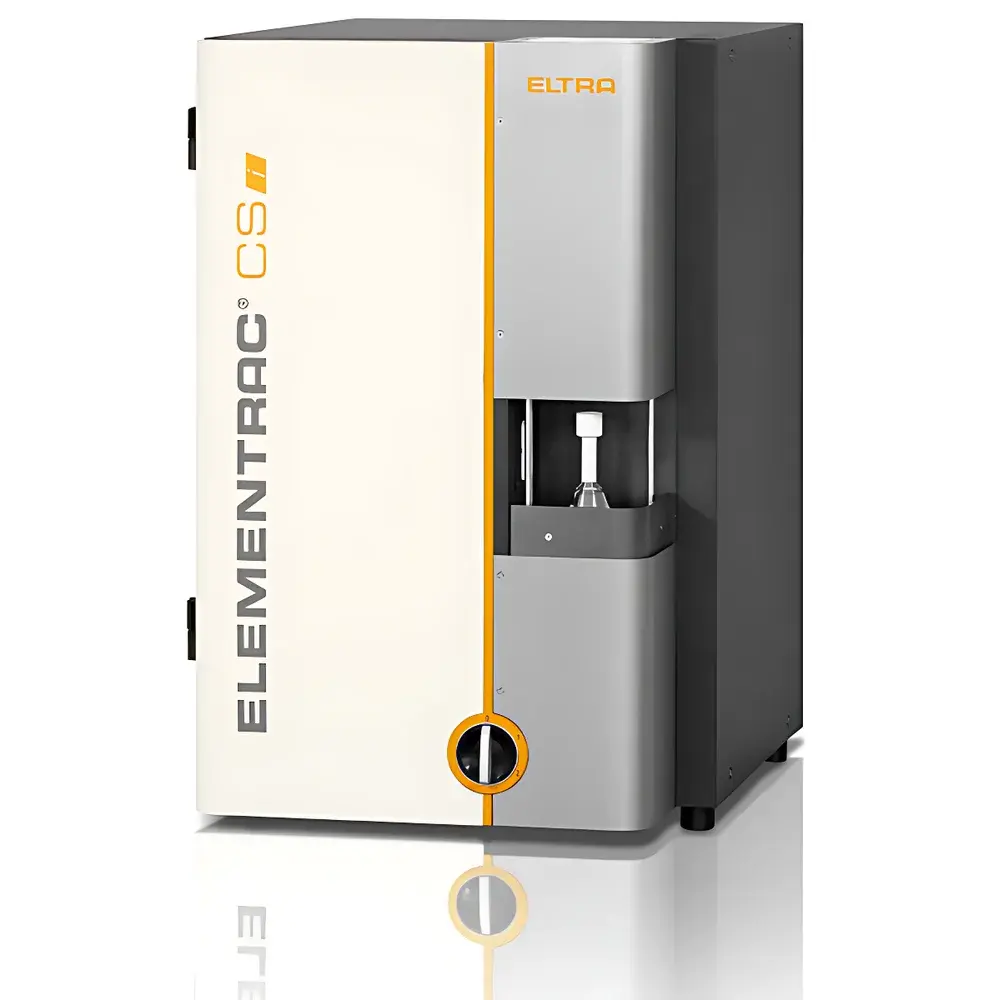
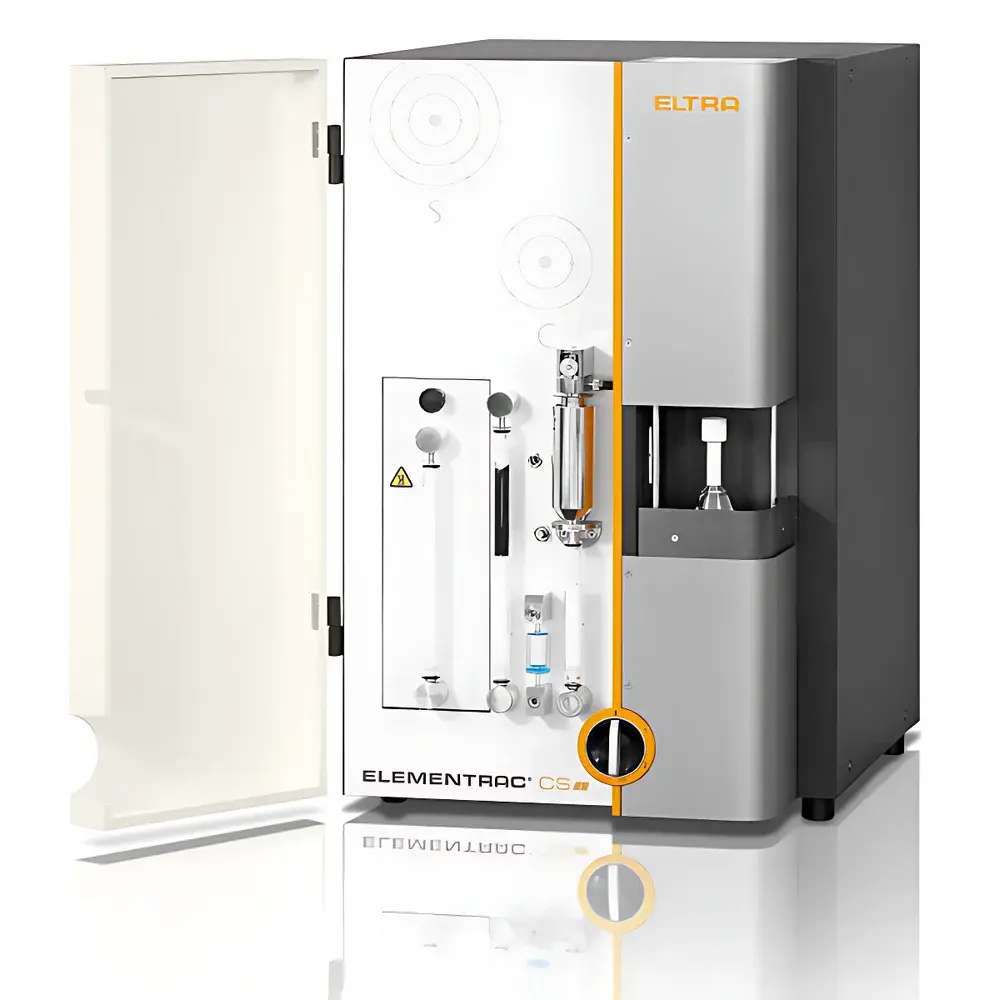
Eltra CS-i High-Frequency Induction Carbon-Sulfur Analyzer
| Brand | Eltra |
|---|---|
| Origin | Germany |
| Model | CS-i |
| Measurement Principle | Infrared Absorption |
| Heating System | High-Frequency Induction Furnace (2.2 kW, up to 2,000 °C) |
| Measurement Range | C: 0.6 ppm – 6.0 wt%, S: 0.6 ppm – 4.5 wt% |
| Sensitivity | C: 0.1 ppm, S: 0.1 ppm |
| Accuracy | ±0.2 ppm |
| Analysis Time | 40 s |
| Detector Configuration | Up to 4 tunable infrared cells (including optional gold-plated cells for halogen- or acid-resistant applications) |
| Compliance | Designed for GLP/GMP environments |
Overview
The Eltra CS-i is a high-precision, high-frequency induction carbon-sulfur analyzer engineered for trace-to-major-level quantification of total carbon and sulfur in inorganic solid materials. It operates on the principle of combustion-infrared absorption: samples are combusted quantitatively in a pure oxygen atmosphere within a high-frequency induction furnace, converting carbon to CO and CO₂, and sulfur to SO₂. The evolved gases undergo sequential purification—dust removal via an integrated vacuum-driven filtration system, water removal via selective desiccants, and catalytic oxidation (CO → CO₂; SO₂ → SO₃)—before entering dedicated infrared detection cells. Each cell employs dual-wavelength non-dispersive infrared (NDIR) technology optimized for specific concentration ranges, enabling simultaneous, independent measurement of carbon and sulfur with sub-ppm sensitivity. The instrument’s architecture reflects decades of refinement in elemental combustion analysis, emphasizing thermal stability, gas-path integrity, and signal reproducibility under routine laboratory and production control conditions.
Key Features
- High-frequency induction furnace (2.2 kW) with fully adjustable power output and maximum operating temperature of 2,000 °C—optimized for low-melting-point alloys and refractory metals without thermal degradation.
- Modular infrared detection system supporting up to four independently configurable NDIR cells; optional gold-plated cells resist corrosion from halogenated or acidic sample matrices (e.g., fluxed slags, fluorinated ceramics).
- Automated vacuum-assisted dust filtration system minimizes particulate carryover, enhancing long-term baseline stability and reducing recalibration frequency.
- Thermostatically controlled sulfur filter unit maintains constant temperature during SO₂ detection, mitigating condensation-related drift and improving sulfur recovery accuracy.
- Integrated catalytic converter ensures complete oxidation of CO to CO₂ and SO₂ to SO₃ prior to IR detection—critical for accurate carbon quantification in carbide-rich or low-oxygen-efficiency samples.
- Robust mechanical design with minimal consumables: only ceramic crucibles, reagents (e.g., tungsten or iron flux), and replaceable filters require periodic maintenance—no routine optical alignment or detector recalibration needed.
Sample Compatibility & Compliance
The CS-i accommodates a broad spectrum of inorganic solids, including ferrous and non-ferrous metals (steel, cast iron, copper, titanium, nickel-based superalloys), geological materials (ores, minerals, sands), construction products (cement, clinker, refractories), and advanced ceramics and carbides. Sample mass ranges from 0.1 g to 1.0 g, with automatic weight transfer from analytical balance to software via RS232/USB interface. All hardware and firmware comply with IEC 61000-6-3 (EMC) and IEC 61010-1 (safety) standards. When operated with ELEMENTS software configured in audit-trail mode, the system meets FDA 21 CFR Part 11 requirements for electronic records and signatures—including user access control, change logging, and immutable result archiving—making it suitable for regulated QA/QC laboratories adhering to ISO/IEC 17025, ASTM E1019, and ISO 15350.
Software & Data Management
ELEMENTS is Eltra’s proprietary Windows-based analysis platform, built on a modular, database-driven architecture. It provides real-time graphical display of combustion profiles (gas evolution curves), automatic peak integration, and dynamic background compensation. Analytical functions include single-point and multi-point calibration with polynomial fitting, statistical evaluation (RSD, confidence intervals), batch grouping, customizable report generation (PDF, Excel, CSV), and LIMS integration via ASTM E1384-compliant HL7 or ODBC protocols. Diagnostic tools monitor furnace performance, gas flow integrity, detector response decay, and filter saturation status—generating preventive maintenance alerts. All raw signals, processed results, metadata (operator ID, sample ID, timestamp, method version), and audit logs are stored in encrypted SQLite databases, supporting full traceability for GLP and GMP audits.
Applications
The CS-i delivers reliable carbon/sulfur data across metallurgical process control (e.g., monitoring residual C/S in stainless steel melts), quality assurance of raw materials (e.g., sulfur content in limestone for cement kiln feed), certification testing of high-purity ceramics (e.g., SiC wafers), and regulatory compliance screening (e.g., RoHS-relevant sulfur in recycled metals). Its adaptability extends to research applications such as phase diagram validation in Ti-Al intermetallics, sulfur segregation analysis in pipeline steels, and carbon speciation studies in synthetic graphite electrodes—where consistent stoichiometric accuracy directly impacts material performance modeling.
FAQ
What types of samples can be analyzed on the CS-i?
Solid inorganic materials including metals, ores, cements, ceramics, glasses, and refractory compounds—provided they are homogeneous, non-volatile, and compatible with high-temperature oxygen combustion.
Is calibration required before each analysis run?
No. The CS-i supports robust multi-point calibration stored per application method; daily verification using certified reference materials (CRMs) is recommended per ISO/IEC 17025 guidelines.
How does the instrument handle sulfur loss in sulfide-rich samples?
The catalytic oxidation stage and thermostatically stabilized sulfur cell minimize SO₂ adsorption and condensation losses, while optimized oxygen flow and combustion time ensure quantitative release—even from pyritic or complex sulfide matrices.
Can the CS-i integrate with existing LIMS or ERP systems?
Yes. Native ODBC connectivity and ASTM E1384-compliant export modules enable seamless bidirectional data exchange with major laboratory informatics platforms.
What maintenance is required beyond routine consumables?
None. The sealed optical path, self-diagnostic firmware, and solid-state electronics eliminate periodic optical alignment, detector recalibration, or gas chromatography column replacement—reducing total cost of ownership over its service life.




