
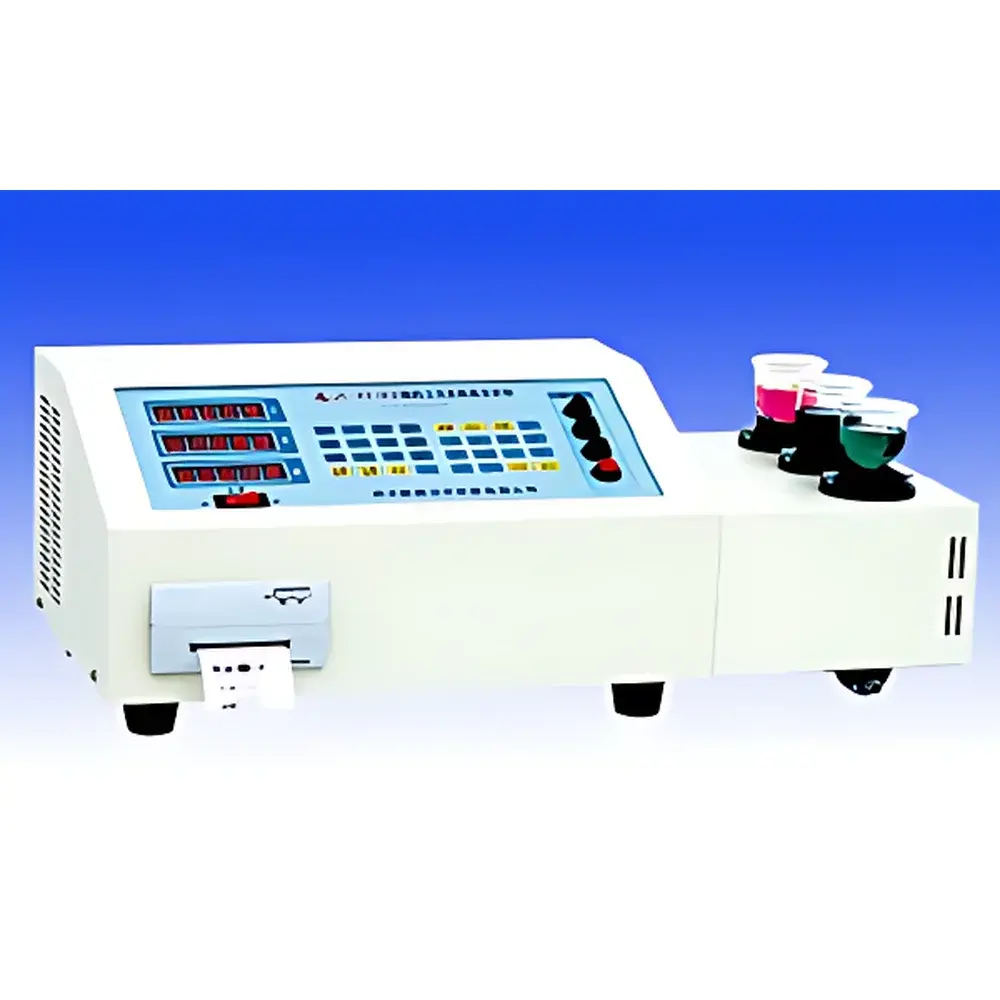
QL-BS3B Triple-Element Analyzer by Qilin
| Brand | Qilin |
|---|---|
| Model | QL-BS3B |
| Origin | Jiangsu, China |
| Type | Benchtop Optical Emission Analyzer (Cold Light Source) |
| Measurement Principle | Photometric Colorimetry with Dual-Wavelength Compensation |
| Elements Measured | Si, Mn, P, Cr, Mo, Mg (expandable via interchangeable light sources) |
| Range | Mn 0.10–15.00%, Si 0.10–5.00%, P 0.005–0.80%, Cr 0.010–25.0%, Mo 0.010–6.00%, Mg 0.010–0.99% |
| Detection Method | Solid-state photodiode (imported silicon photovoltaic cell) |
| Calibration | Auto-zero and auto-full-scale calibration |
| Curve Storage | 15 preloaded calibration curves |
| Interface | Touch-sensitive membrane keypad with audible feedback |
| Sample Preparation | External fusion (crucible-based), no fluidic valves or tubing |
| Compliance | Designed for ISO/IEC 17025-aligned metallurgical QC labs |
| Power Supply | AC 220 V ±10%, 50 Hz |
Overview
The QL-BS3B Triple-Element Analyzer is a benchtop photometric elemental analyzer engineered for rapid, high-reproducibility quantification of key metallic elements—including silicon (Si), manganese (Mn), phosphorus (P), chromium (Cr), molybdenum (Mo), and magnesium (Mg)—in ferrous and non-ferrous alloys. Unlike atomic absorption or ICP-based systems, the QL-BS3B employs cold-light photometric colorimetry: samples are dissolved or fused externally, then reacted with selective chromogenic reagents to generate stable colored complexes. Absorbance is measured at dual optimized wavelengths using an imported silicon photovoltaic cell, enabling built-in compensation for matrix interference and background drift. This principle delivers robust performance in demanding production environments—particularly furnace-side quality control, incoming material inspection, and finished product verification—where speed, operator independence, and long-term stability outweigh ultra-trace sensitivity requirements.
Key Features
- Cold-light optical architecture eliminates thermal drift and lamp aging effects, ensuring consistent photometric baseline over extended operational cycles.
- Auto-calibrating photodetector system performs real-time zero-point and full-scale reference correction before each measurement cycle.
- Microcontroller-based embedded system stores up to 15 user-configurable calibration curves, supporting multi-element sequential analysis without software dependency.
- Capacitive touch membrane keypad with tactile audio feedback enables glove-compatible operation in foundry or workshop settings.
- External crucible fusion design removes all internal fluidic pathways—eliminating valve clogging, tubing degradation, and reagent carryover—significantly extending mean time between maintenance (MTBM).
- Modular cold-light source interface allows field replacement with wavelength-matched LEDs or filtered halogen emitters to extend elemental coverage (e.g., Ni, Cu, V, Ti) without hardware redesign.
Sample Compatibility & Compliance
The QL-BS3B accepts solid metal samples (chips, turnings, drill shavings) and pre-dissolved solutions prepared via acid digestion or borax fusion. It is routinely deployed in ASTM E30/E1019-compliant workflows for carbon steel, stainless steel, cast iron, aluminum alloys, and nickel-based superalloys. While not a GLP/GMP-certified instrument per se, its deterministic calibration logic, auditable curve storage, and absence of volatile consumables support traceable documentation under ISO 9001 and ISO/IEC 17025 quality management systems. All reagent protocols align with standard methods published in ASTM E1019 (determination of Mn, Si, P in steel) and ISO 4940 (chromium in ferrochromium).
Software & Data Management
The analyzer operates autonomously without PC connectivity; all data handling occurs onboard. Each measurement logs element name, concentration value, curve ID, date/time stamp, and operator code (via keypad entry). Results are displayed on a high-contrast LCD and can be printed via optional RS-232–enabled thermal printer (not included). For integration into centralized QA databases, the unit supports ASCII-formatted serial output compliant with Modbus RTU protocol—enabling direct ingestion into LIMS platforms that accept serial telemetry. Audit trails are maintained internally for the last 500 measurements, including calibration events and curve modifications, satisfying basic FDA 21 CFR Part 11 record-keeping expectations for non-critical QC applications.
Applications
- Furnace-side composition monitoring during alloy melting and tapping in electric arc and induction furnaces.
- Rapid verification of raw material certificates of analysis (CoA) for scrap, ferroalloys, and master alloys prior to charge blending.
- Final product release testing for structural steels, tool steels, and austenitic stainless grades where Mn/Si/P/Cr ratios define mechanical properties.
- Process validation in heat treatment facilities requiring confirmation of surface decarburization or intergranular segregation effects on bulk chemistry.
- Educational laboratories conducting quantitative analytical chemistry experiments on redox-based colorimetric assays.
FAQ
What sample preparation methods are supported?
Standard protocols include HCl/HNO₃ dissolution for low-alloy steels and borax–lithium carbonate fusion for high-Cr/Ni alloys. Detailed SOPs are provided in the English-language operating manual.
Can the instrument measure nitrogen or sulfur?
No—nitrogen and sulfur require combustion-based detection (e.g., IR or thermal conductivity); the QL-BS3B is limited to colorimetrically active elements with validated wet-chemistry protocols.
Is third-party calibration certification available?
Yes—certified reference materials (CRMs) from NIST, BCS, or CRM-Steel are supported; users may request traceable calibration reports from authorized Qilin service centers.
What is the typical measurement repeatability?
At mid-range concentrations (e.g., Mn 2.5%, Si 1.2%, P 0.05%), RSD is ≤1.2% (n=10), consistent with ASTM E30 precision guidelines for routine metallurgical analysis.
Does the analyzer comply with CE or RoHS directives?
The QL-BS3B meets RoHS 2011/65/EU requirements for hazardous substance restrictions. CE marking is not applicable, as it falls outside the scope of EU Directive 2014/30/EU (EMC) and 2014/35/EU (LVD) for laboratory instruments without integrated power supplies exceeding 75 V AC.
Related Products






