
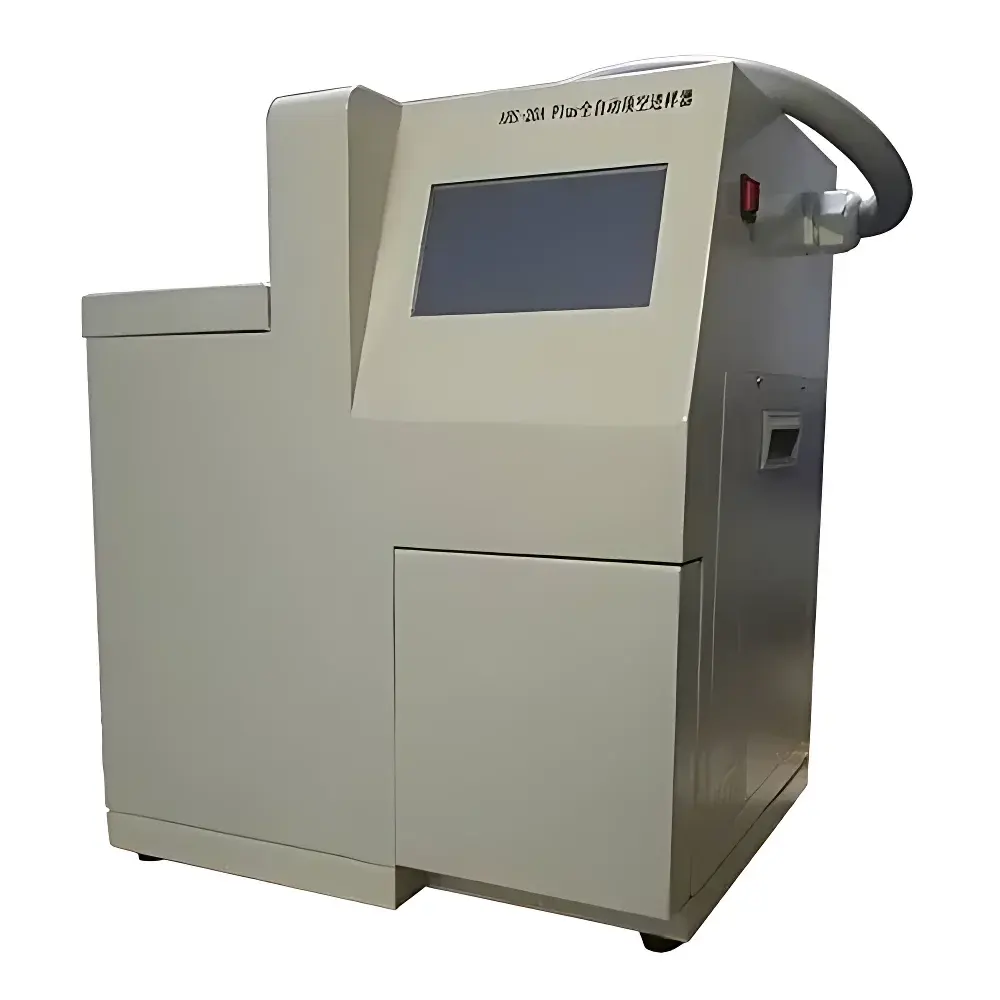
English Product Name
| Brand | Beifen Sanpu |
|---|---|
| Origin | Beijing, China |
| Manufacturer Type | Direct Manufacturer |
| Model | WAHS-20A Plus |
| Sample Positions | 20 |
| Heating Range (Sample/Valve/Transfer Line) | 40–220 °C (configurable up to 300 °C) |
| Temperature Accuracy | ±0.5 °C |
| Temperature Stability | <±0.5 °C |
| Pressurization Time | 0–999 s |
| Sampling Time | 0–30 min |
| Injection Time | 0–999 s |
| Purge Time | 0–30 min |
| Minimum Time Resolution | 1 ms |
| Pressurization Pressure | 0–0.25 MPa (continuously adjustable) |
| Quantitative Loop Volume | 1 mL (customizable: 0.5/2/5 mL) |
| Vial Capacity | 10 mL or 20 mL (customizable: 50/100 mL) |
| Simultaneous Heating | 1 or 2 vials |
| RSD | <1.0% (100 ppm ethanol in water) |
| Purge Flow Rate | 0–100 mL/min (adjustable) |
| Interface | USB |
| Compliance | ASTM D6866, ISO 17025-compatible operation, GLP/GMP-ready audit trail via software logging |
Overview
The Beifen Sanpu WAHS-20A Plus Fully Automated Headspace Sampler is an engineered solution for reproducible, unattended volatile organic compound (VOC) extraction from solid and liquid matrices prior to gas chromatographic analysis. Based on the principle of equilibrium headspace sampling—where analytes partition between a sealed sample phase and its overlying vapor phase—the instrument precisely controls temperature, pressure, and timing to ensure thermodynamic equilibrium is achieved and maintained during sample pressurization, transfer, and injection. Designed for integration with benchtop and high-throughput GC systems, it delivers robust performance in regulated environments including environmental testing labs, pharmaceutical QC, food safety screening, and forensic toxicology workflows. Its architecture adheres to fundamental analytical requirements: minimal dead volume, inert flow path integrity, thermal homogeneity across critical zones, and deterministic sequence execution—all validated under routine operational conditions.
Key Features
- 20-position rotary sample carousel with automatic vial detection and positional fault avoidance—mechanically verifies vial presence before movement to prevent collision or misalignment.
- Triple-zone independent heating system: sample oven, six-port valve housing, and transfer line—all maintained within ±0.5 °C stability (40–220 °C standard; optional 300 °C configuration available).
- Electronically controlled pressurization (0–0.25 MPa) and purge flow (0–100 mL/min), eliminating reliance on external gas cylinders and enhancing lab safety and footprint efficiency.
- High-inertness fluidic path: de-activated fused-silica-lined quantitative loop (1 mL standard), PTFE/siliconized septa, and heated valve-to-GC interface—minimizing adsorption, carryover, and cross-contamination.
- Seven-inch graphical LCD interface with animated workflow guidance; supports both front-panel and USB-hosted parameter configuration—enabling seamless transition between standalone and networked operation.
- Multi-mode sampling logic: single-vial repeated injections, single-shot per vial, or sequential multi-vial analysis—programmable with sub-millisecond timing resolution (1 ms minimum step).
- Self-diagnostics at power-on: automatic mechanical initialization, position encoder validation, heater continuity check, and real-time thermal drift monitoring with audible/visual alerting.
Sample Compatibility & Compliance
The WAHS-20A Plus accommodates standard 10 mL and 20 mL crimp-top or screw-cap headspace vials; custom vial support (e.g., 50 mL, 100 mL) is available upon request. It handles aqueous solutions, polymers, soils, pharmaceutical tablets, beverages, and semi-solid foodstuffs without modification. All thermal and pneumatic parameters meet traceability requirements for ISO/IEC 17025-accredited laboratories. When paired with compliant GC data systems, the sampler supports full 21 CFR Part 11 audit trails—including user authentication, parameter change logging, run history timestamps, and electronic signature capture—ensuring alignment with pharmaceutical GMP and clinical laboratory GLP frameworks. Method validation documentation (including precision, accuracy, LOD/LOQ, and carryover studies) is provided per ICH Q2(R2) guidelines.
Software & Data Management
Instrument control and method development are performed via native Windows-based software accessible through USB 2.0. The application enables full remote scheduling, real-time status monitoring (temperature profiles, valve actuation events, pressure transients), and export of raw timing logs in CSV format. Sequence files include embedded metadata (operator ID, calibration date, vial barcode mapping) and support version-controlled method archiving. Integration with third-party chromatography data systems (e.g., Thermo Chromeleon, Agilent OpenLab CDS, Shimadzu LabSolutions) is achieved via hardware-triggered TTL signals or Ethernet-based protocol emulation—ensuring synchronized GC oven start, detector activation, and data acquisition initiation. Audit trail records are cryptographically hashed and stored locally with write-protection enabled by default.
Applications
This headspace sampler is routinely deployed in: residual solvent analysis per USP , ethanol quantification in pharmaceutical excipients, BTEX detection in groundwater per EPA Method 502.2, flavor compound profiling in dairy products (ISO 11019), monomer release testing in medical device packaging (ISO 10993-12), and forensic blood alcohol determination (AOAC 933.04). Its low RSD (<1.0% at 100 ppm ethanol) and high thermal fidelity make it suitable for reference material certification and interlaboratory comparison studies where metrological rigor is mandated.
FAQ
Does the WAHS-20A Plus support method transfer between different GC platforms?
Yes—its trigger interface and timing logic are vendor-agnostic; synchronization is achieved via TTL pulses or software handshake protocols compatible with all major GC manufacturers.
Can the instrument be validated for GMP use?
Yes—full IQ/OQ documentation packages, including temperature mapping reports, pressure linearity verification, and repeatability test protocols, are supplied with each unit.
Is remote monitoring possible over a LAN?
While native Ethernet is not integrated, USB-over-IP solutions or dedicated industrial PCs enable secure remote access within internal networks.
What maintenance intervals are recommended?
Quarterly inspection of septa, quantitative loop integrity, and heater calibration is advised; annual full-system performance verification is recommended for regulated environments.
Are consumables such as vials and septa included?
No—standard 10/20 mL headspace vials and pre-slit silicone/PTFE septa must be sourced separately to ensure compatibility with user-specific matrix requirements.
Related Products





