
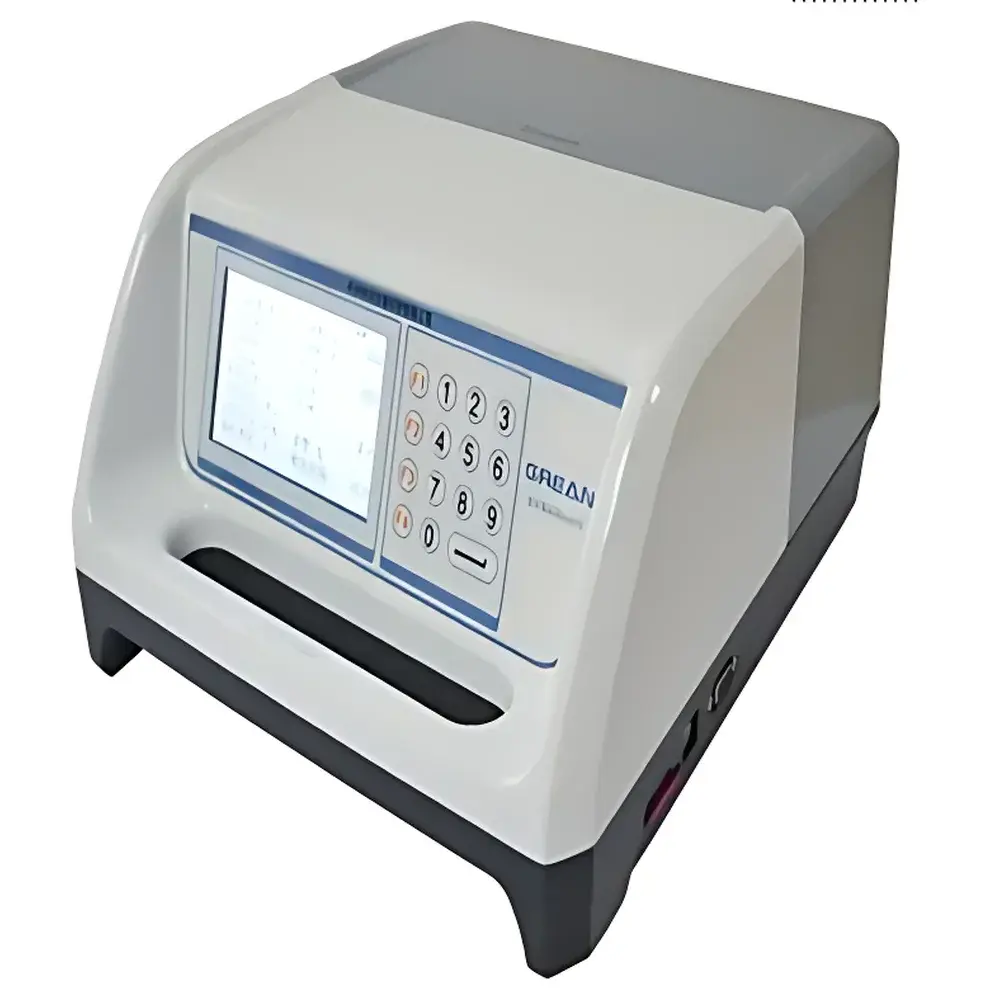
English Product Name
| Origin | Beijing, China |
|---|---|
| Manufacturer Type | Authorized Distributor |
| Origin Category | Domestic (China) |
| Model | 1500A |
| Instrument Type | Laboratory Benchtop Analyzer |
| Power Supply | 220 V AC, 50 Hz |
| Optical Source | Laser Diode |
| Detection Principle | Laser Light Attenuation / Absorption |
| Particle Size Range | 2–400 µm |
| Number of Adjustable Size Channels | 8 |
| Minimum Detectable Size | 2 µm |
| Resolution | ≤9% @ 2 µm |
| Signal-to-Noise Ratio | 3:1 |
| Counting Efficiency | ≥50% @ 1 µm |
| Maximum Particle Concentration | 18,000 counts/mL |
| Coincidence Loss (at max concentration) | 10% |
| Flow Rate | 60 mL/min (controlled via overflow tube & hydraulic pressure) |
| Flow Accuracy | ≤2% |
| Sensor MTBF | 60,000–80,000 hours |
| Communication Interface | RS-485 (4-wire Modbus), optional 4–20 mA output |
| Baud Rate | 9600 bit/s |
| Data Modes | Cumulative or Time-Segmented |
| Maximum Display Value | 9,999,999 (cumulative count) |
| Sample Path Flushing | Semi-Automatic |
Overview
The IBR 1500A Benchtop Laser-Based Suspended Solids Analyzer is an engineered solution for quantitative, real-time characterization of particulate matter in aqueous matrices using the principle of laser light attenuation. Unlike turbidity meters—which provide only an integrated optical density proxy—the 1500A delivers direct physical measurements: particle count per milliliter and size-resolved distribution across eight user-configurable channels within the 2–400 µm range. The instrument employs a collimated laser diode beam oriented orthogonally to the sample flow path; as particles traverse the beam, they induce transient reductions in transmitted light intensity proportional to their projected cross-sectional area. These attenuations are captured by a high-stability photodiode, converted into voltage pulses, and classified in real time by amplitude thresholding. This approach ensures traceable, physics-based quantification—critical for process validation, regulatory compliance, and mechanistic understanding of coagulation, flocculation, and filtration dynamics in water treatment systems.
Key Features
- Laser-based detection with calibrated sensitivity down to 2 µm—validated against ISO 13320-compliant reference standards
- Eight independent, programmable size channels enabling granulometric profiling tailored to specific process control points (e.g., pre-flocculation, post-sedimentation, filter effluent)
- Integrated flow control via precision overflow tube and hydraulic pressure regulation—ensuring consistent 60 mL/min throughput and minimizing laminar distortion
- Patented bubble suppression design that mitigates air entrainment artifacts without requiring degassing or vacuum modules
- Real-time flow compensation algorithm correcting for minor fluctuations to maintain counting accuracy within ±2%
- Semi-automatic sample path flushing routine reducing carryover and biofilm accumulation between analyses
- Robust optical sensor architecture rated for 60,000–80,000 hours of continuous operation under laboratory conditions
- RS-485 Modbus RTU interface (9600 baud) with optional 4–20 mA analog output for integration into SCADA or LIMS environments
Sample Compatibility & Compliance
The 1500A is optimized for low-viscosity, non-corrosive aqueous samples—including raw surface water, clarified effluent, filtered drinking water, membrane permeate, and pilot-scale coagulation test samples. It complies with key methodological frameworks used in regulated water laboratories: ASTM D3977 (Standard Practice for Sampling and Analysis of Suspended Solids), ISO 7027-1:2016 (Water quality — Determination of turbidity — Part 1: Quantitative methods), and USP (Particulate Matter in Injections) for coarse particle screening. While not a replacement for EPA Method 180.1 (turbidity) or ISO 11929 (uncertainty evaluation), its particle-counting output supports GLP-aligned data integrity when paired with audit-trail-capable software. The system meets IEC 61000-4 electromagnetic compatibility requirements and operates safely within Class II electrical environments per IEC 61010-1.
Software & Data Management
Data acquisition and configuration are managed via IBR’s proprietary PC-based software (Windows 10/11 compatible), supporting both manual batch analysis and scheduled automated runs. The software logs timestamped particle counts per channel, cumulative totals, flow rate metadata, and system diagnostics—including sensor health indicators and coincidence loss metrics. All datasets export to CSV or Excel formats with embedded metadata headers compliant with ALCOA+ principles (Attributable, Legible, Contemporaneous, Original, Accurate, Complete, Consistent, Enduring, Available). Optional firmware upgrade enables Modbus TCP bridging for cloud-connected monitoring platforms. Audit trails record user actions, parameter changes, and calibration events—facilitating FDA 21 CFR Part 11 readiness when deployed with electronic signature modules.
Applications
- Coagulation/flocculation optimization: Quantifying shifts in particle number and size distribution before/after dosing enables precise determination of optimal coagulant dosage and mixing energy.
- Filtration performance assessment: Detecting breakthrough events >2 µm at filter effluent—correlating with Cryptosporidium/Giardia removal efficacy per USEPA LT2ESWTR guidance.
- Membrane integrity monitoring: Identifying early-stage fiber breakage or seal failure through sudden increases in sub-10 µm particle counts in permeate streams.
- Distribution system surveillance: Comparing particle load profiles between plant outlet and remote network nodes to localize biofilm sloughing or corrosion-related contamination.
- Pilot-plant and bench-scale studies: Supporting jar test validation, filter media selection, and backwash interval optimization with statistically robust, size-resolved data.
FAQ
Does the 1500A require daily calibration with standard particles?
No—its optical detection system is factory-calibrated using NIST-traceable polystyrene latex (PSL) standards. Routine verification (weekly or per batch) is performed using a certified 10 µm PSL suspension; full recalibration is recommended annually or after sensor replacement.
Can it measure particles in colored or highly turbid samples?
Yes—unlike imaging or scattering-based analyzers, laser attenuation is minimally affected by dissolved colorants or background absorbance, provided sample opacity does not exceed 95% beam attenuation at the detector.
Is the 4–20 mA output linear with total particle count or channel-specific?
Configurable: users may assign the analog output to represent either total counts/mL or the dominant channel (e.g., 2–10 µm band), with zero/span adjustment via software.
What maintenance is required beyond semi-automatic flushing?
Annual inspection of optical window cleanliness, flow path integrity, and photodiode baseline stability. No consumables (e.g., lamps, filters, reagents) are required.
How is data traceability ensured during multi-user lab operations?
Each measurement file embeds operator ID, instrument serial number, timestamp (with UTC sync), and software version—enabling full forensic reconstruction per ISO/IEC 17025 Clause 7.7 requirements.
Related Products







