
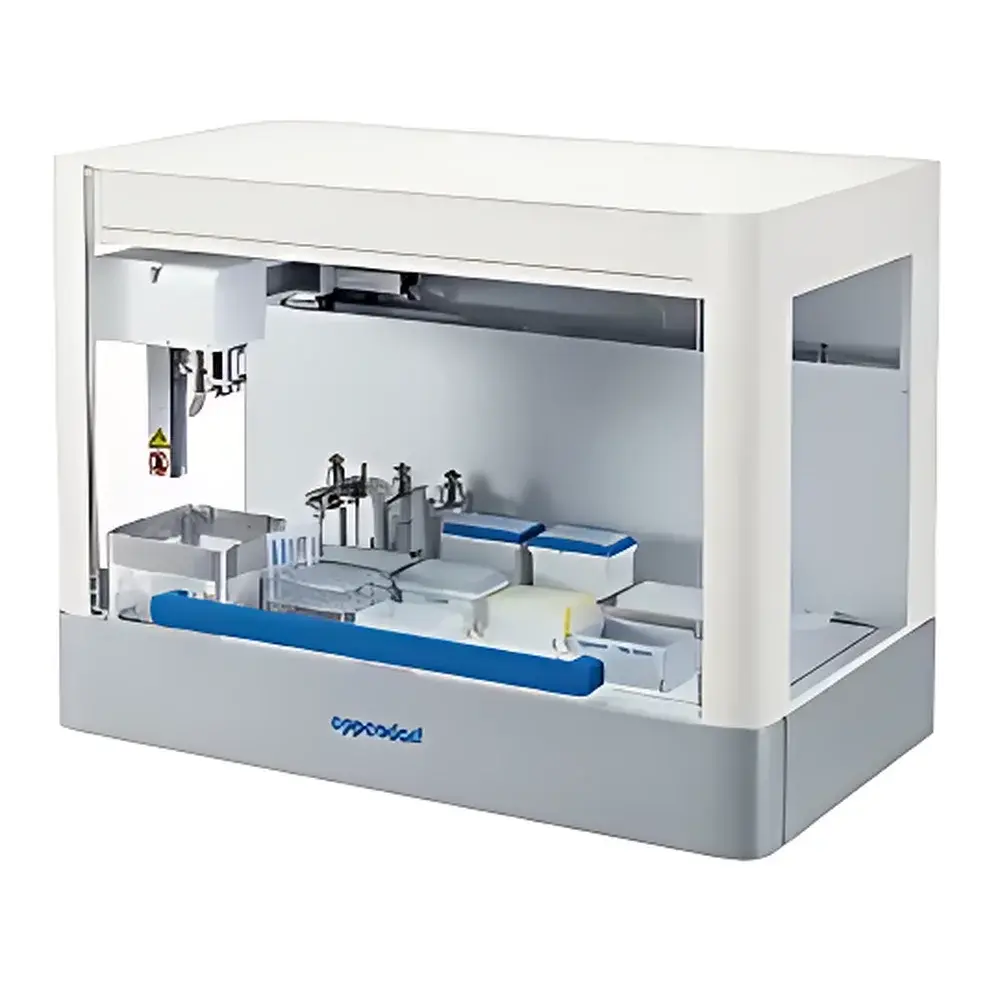
Eppendorf epMotion 5075v Nucleic Acid Purification Workstation
| Brand | Eppendorf |
|---|---|
| Origin | Germany |
| Manufacturer Type | Original Equipment Manufacturer (OEM) |
| Import Status | Imported |
| Model | epMotion 5075v / 5075vt |
| Plate Positions | 12 |
| Liquid Handling Range | 0.2 µL – 1,000 µL |
| Sample Throughput | 12 samples per run |
| Dimensions (W × D × H) | 108 × 62 × 87 cm |
Overview
The Eppendorf epMotion 5075v is a fully automated nucleic acid purification workstation engineered for high-integrity vacuum-based solid-phase extraction workflows. It implements a precisely controlled vacuum manifold system—integrated directly into the instrument chassis—to drive consistent, reproducible binding, washing, and elution steps across diverse sample matrices. Unlike hybrid platforms relying on external vacuum sources or manual intervention, the 5075v features an embedded, low-noise diaphragm vacuum pump with programmable pressure regulation, enabling closed-loop control over vacuum intensity and duration per step. This architecture ensures uniform flow dynamics across all wells of 96-well plates or filter-based spin columns, minimizing well-to-well variability and carryover risk. Designed for routine use in molecular biology core facilities, clinical diagnostics labs, and regulated biopharma QC environments, the system supports both standard vacuum filtration protocols and advanced applications requiring thermal conditioning or orbital mixing—especially when upgraded to the 5075vt configuration.
Key Features
- Fully integrated vacuum manifold with built-in diaphragm pump—no external vacuum source required; pressure profiles are software-defined and repeatable.
- 12-position ANSI/SBS-compliant deck accommodating standard microplates (96- and 384-well), deep-well plates, filter plates, centrifuge tubes (0.2–50 mL), and custom carriers.
- Automated liquid handling with dynamic tip exchange: supports single-channel, 4-channel, and 8-channel pipetting heads; all tool changes executed without user intervention.
- Optical liquid level detection and consumables recognition: real-time monitoring of tip presence, plate type, and residual volume via integrated optical sensors.
- MultiCon controller with pre-installed epBlue software and Pipetting Assistant interface; operation via touchscreen or mouse-driven GUI with intuitive workflow builder.
- Scalable thermal and mixing capabilities: optional upgrade path to epMotion 5075vt adds two independently controllable temperature zones (–15 °C to +95 °C) and a 2DMix-Control orbital shaker (up to 2,000 rpm, auto-calibrated for vessel geometry).
Sample Compatibility & Compliance
The epMotion 5075v processes a broad spectrum of biological input materials—including whole blood, buffy coat, cultured cells, tissue homogenates, bacterial pellets, plant lysates, and viral supernatants—using silica-membrane, magnetic bead, or anion-exchange chemistries. Its vacuum-driven architecture maintains optimal binding kinetics for low-abundance targets while preserving RNA integrity during total RNA isolation. The platform complies with fundamental laboratory automation standards including ISO/IEC 17025 requirements for method validation, and its software architecture supports traceability frameworks aligned with GLP, GMP, and FDA 21 CFR Part 11. Audit trail logging, electronic signatures, and LIMS/ELN integration (via barcode scanning module and REST API) are available through validated software upgrades.
Software & Data Management
epBlue software provides protocol-driven automation with drag-and-drop step sequencing, parameter validation, and real-time execution monitoring. All methods are stored as encrypted XML files with version history and change logs. The system supports export of raw data (time-stamped event logs, pressure curves, pipetting volumes, and error codes) in CSV and PDF formats. For regulated environments, the 21 CFR Part 11-compliant software package includes role-based access control, biometric or token-based electronic signatures, and immutable audit trails covering user actions, method modifications, and instrument events. Integration with enterprise systems is achieved via HL7, ASTM E1384, or custom middleware supporting bidirectional data exchange with LIMS and ELN platforms.
Applications
- High-yield plasmid DNA purification from bacterial cultures using alkaline lysis and vacuum filtration.
- Genomic DNA isolation from clinical specimens (e.g., EDTA blood, FFPE tissue sections) with carrier RNA co-purification.
- Total RNA extraction with DNase I on-column digestion and quality-controlled elution.
- PCR product cleanup, Sanger sequencing reaction purification, and NGS library size selection using dual SPRI bead protocols.
- Automated solid-phase extraction of circulating cell-free DNA (cfDNA) from plasma with optimized binding buffer delivery and low-volume elution.
- Parallel processing of up to 12 samples under identical vacuum and timing parameters—critical for inter-assay comparability in biomarker studies.
FAQ
Does the epMotion 5075v require an external vacuum source?
No—the system includes an integrated, maintenance-free diaphragm vacuum pump calibrated for nucleic acid purification pressure ranges.
Can the 5075v be upgraded to support temperature control and mixing?
Yes—conversion to the 5075vt configuration adds two independent temperature modules and a 2DMix-Control shaker with automatic speed optimization.
Is the software compliant with FDA 21 CFR Part 11 out of the box?
No—Part 11 compliance requires installation of the validated software option, including audit trail activation, electronic signature enrollment, and role-based permissions setup.
What consumables are supported for vacuum filtration workflows?
Standard 96-well silica-membrane filter plates (e.g., QIAGEN QIAprep, Macherey-Nagel NucleoSpin), custom filter plates, and column-based kits compatible with vacuum manifolds.
How does optical liquid level detection improve pipetting accuracy?
It enables real-time detection of meniscus position during aspiration and dispense, dynamically adjusting pipette depth and speed to prevent air aspiration or overfilling—particularly critical for viscous lysates and low-volume elutions.
Related Products



