
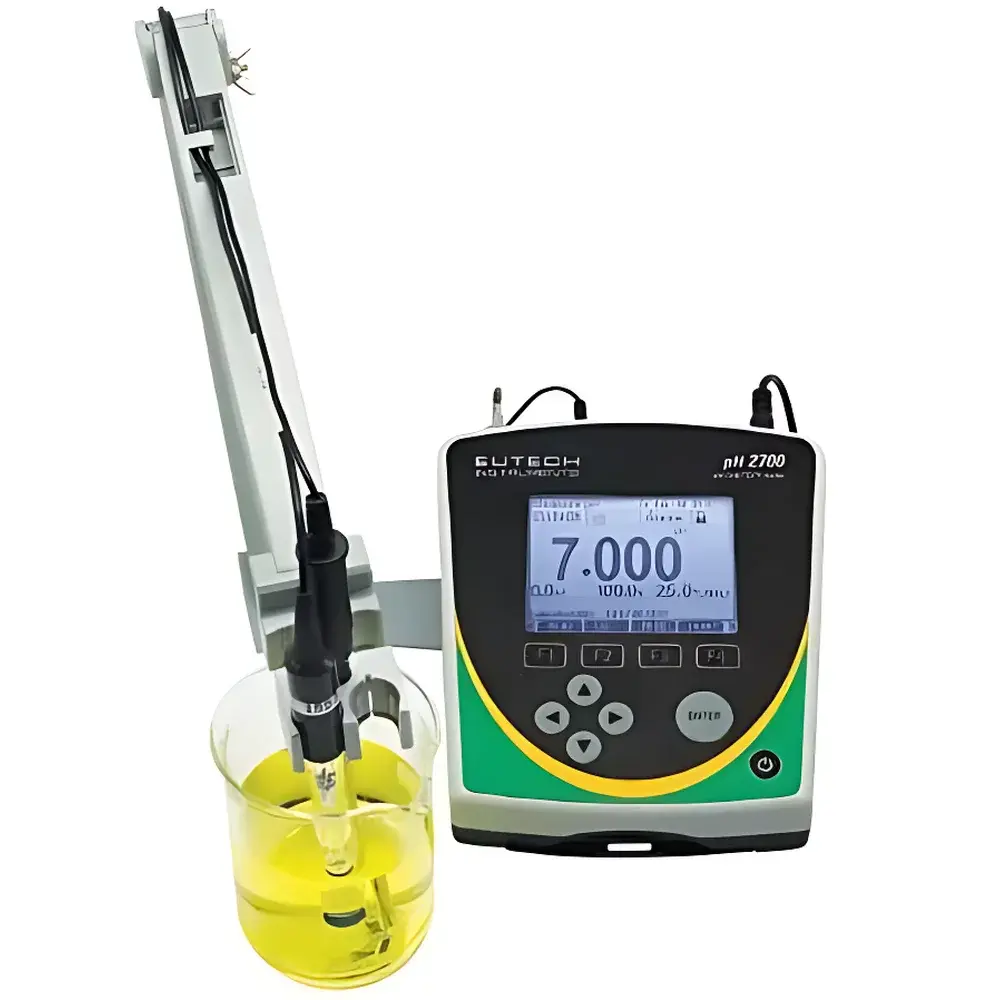
Eutech PH2700 Benchtop pH/ORP/Temperature Meter
| Origin | Singapore |
|---|---|
| Manufacturer Type | Authorized Distributor |
| Origin Category | Imported |
| Model | Eutech PH2700 |
| Instrument Type | Benchtop |
| Parameter Types | Dual (pH + ORP) |
| pH Measurement Range | -2.000 to 20.000 pH |
| pH Resolution | 0.1 / 0.01 / 0.001 pH |
| pH Accuracy | ±0.002 pH + 1 LSD |
| Temperature Range | 0.0–100.0 °C |
| Temperature Resolution | 0.1 °C |
| Temperature Accuracy | ±0.3 °C |
| ORP/mV Range | ±2000.0 mV |
| ORP/mV Resolution | 0.1 mV |
| ORP/mV Accuracy | ±0.2 mV |
| Calibration Points | Up to 6-point, auto-buffer recognition (USA, NIST, DIN, User 1, User 2, Custom) |
| Electrode Diagnostics | Slope & Offset Display |
| Data Storage | 500 GLP-compliant entries with timestamp |
| Temperature Compensation | Automatic or Manual (0–100 °C) |
| Display | Backlit LCD (5.9 × 7.8 cm) |
| Connectivity | BNC (pH/ORP), Phono (ATC probe), Phono (Reference), RS232C output |
| Power | 9 V DC regulated adapter (100–240 VAC SMPS) |
| Dimensions (W×D×H) | 17.5 × 15.5 × 6.9 cm |
| Weight | 650 g (unit only) |
Overview
The Eutech PH2700 is a high-precision benchtop pH/ORP/temperature meter engineered for routine and regulated laboratory applications requiring traceable, reproducible electrochemical measurements. Based on potentiometric measurement principles, the instrument measures hydrogen ion activity via a glass pH electrode (or redox potential via inert metal electrodes) referenced against a stable Ag/AgCl reference system. Its triple-parameter capability—simultaneous display of pH, ORP (mV), and temperature—enables real-time compensation and contextual interpretation of electrochemical data. Designed and assembled under quality-controlled conditions in Singapore, the PH2700 meets international design expectations for benchtop electrochemical instrumentation, supporting compliance-driven workflows in environmental testing, pharmaceutical QC, academic research, and industrial process monitoring.
Key Features
- High-resolution backlit LCD (5.9 × 7.8 cm) with large-font, multi-field display showing pH/ORP value, temperature, electrode slope (%), offset (mV), calibration status, date/time, and battery/power indicator simultaneously
- Up to six-point pH calibration with automatic buffer recognition across five standard sets (USA, NIST, DIN, and two user-defined), minimizing manual entry errors and accelerating setup
- Comprehensive electrode diagnostics: real-time calculation and display of electrode slope (ideal 59.16 mV/pH at 25 °C) and asymmetry potential (offset), enabling proactive electrode maintenance and validation
- GLP-compliant data management: 500 measurement records stored with full metadata—including timestamp, calibration history, electrode ID (if tagged), and operator ID—supporting audit readiness
- Configurable password protection for menu navigation, calibration access, and data deletion, ensuring procedural integrity in shared-lab environments
- Flexible temperature compensation: automatic (via ATC probe) or manual input (0.0–100.0 °C), applied to both pH and ORP readings per IUPAC-recommended algorithms
- Dual-input architecture: isolated BNC for sensing electrodes, dedicated phono jacks for ATC and reference electrodes, and RS232C serial interface for external data logging or LIMS integration
Sample Compatibility & Compliance
The PH2700 interfaces with standard combination pH electrodes (e.g., double-junction gel-filled or refillable types), redox electrodes (Pt or Ag/AgCl), and industry-standard ATC probes (e.g., 10 kΩ thermistors). It supports aqueous and low-ionic-strength samples within standard pH electrode operational limits. The instrument conforms to ISO/IEC 17025 documentation requirements for measurement equipment and incorporates features aligned with FDA 21 CFR Part 11 expectations—including electronic signatures (via password-protected calibration), audit-trail-capable storage, and calibration expiration alerts. While not certified as GMP-grade hardware, its GLP functionality (timestamped records, calibration verification logs, and operator traceability) makes it suitable for pre-GMP and QC environments governed by USP , ASTM D1293, and ISO 10523.
Software & Data Management
Data export is supported via RS232C to PC-based terminal software (e.g., HyperTerminal or custom LabVIEW/VB.NET applications) or third-party LIMS platforms using ASCII text protocol. Each stored record includes: measured parameter value, temperature at time of reading, electrode slope and offset, calibration date, buffer IDs used, and full timestamp (YYYY-MM-DD HH:MM:SS). The built-in calibration reminder system triggers visual alerts when user-defined calibration intervals (e.g., every 24 h or per shift) expire—reducing nonconformance risk. No proprietary software is required for basic operation; firmware updates (if released) are delivered via serial interface with documented version control.
Applications
- Environmental labs: monitoring pH and redox potential in wastewater effluents, surface water, and soil extracts per EPA Method 150.1 and APHA Standard Methods 4500-H+
- Pharmaceutical manufacturing: verifying pH of purified water (PW), water for injection (WFI), and buffer solutions during formulation and cleaning validation
- Food & beverage QA: measuring acidity in juices, dairy products, and fermented foods where precise pH control impacts microbial stability and shelf life
- Academic teaching labs: demonstrating Nernst equation behavior, electrode kinetics, and buffer capacity through multi-point titration and stability studies
- Industrial process support: inline spot-checking of rinse baths, plating solutions, and bioreactor media where ORP correlates with oxidation state or sanitizer concentration
FAQ
Does the PH2700 support automatic temperature compensation for ORP measurements?
Yes—temperature compensation is applied to ORP readings when an ATC probe is connected and enabled, improving comparability across variable thermal conditions.
Can custom buffer definitions be saved and recalled without recalibration?
Yes—up to two user-defined buffer sets (User 1/User 2) can be programmed with pH values and nominal temperatures, and retained across power cycles.
Is the RS232 interface optically isolated?
No—the RS232 port is electrically isolated but not optically isolated; use of a grounded USB-to-serial adapter with surge suppression is recommended in noisy industrial settings.
What does “±0.002 pH + 1 LSD” accuracy mean in practice?
This specification indicates combined error: ±0.002 pH systematic uncertainty plus one least-significant digit (e.g., ±0.001 pH at 0.001-resolution mode), consistent with metrological best practices for Class A pH meters.
How is GLP compliance implemented without onboard user authentication?
GLP adherence relies on procedural controls: password-protected calibration, timestamped records, and mandatory operator ID entry prior to data storage—enabling lab managers to enforce accountability through documented SOPs rather than embedded biometrics.





