
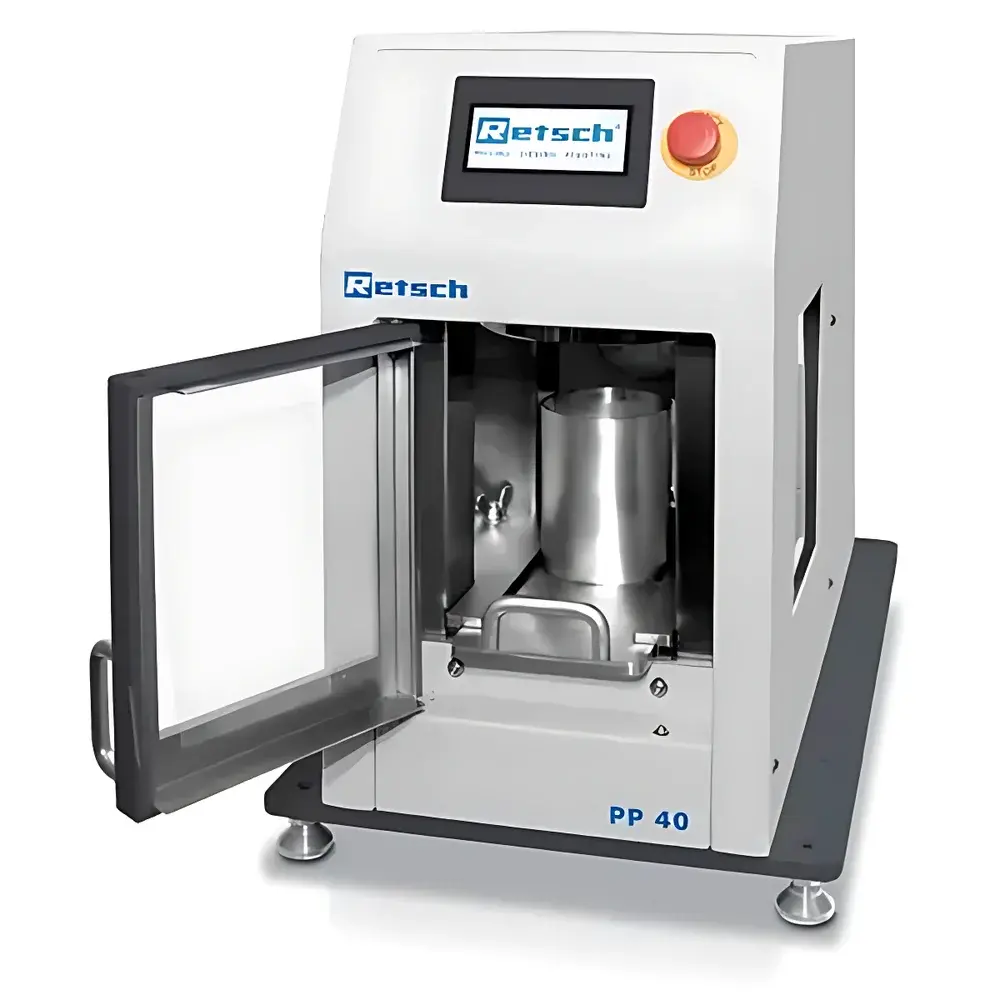
RETSCH PP 40 Automatic Pellet Press
| Brand | RETSCH |
|---|---|
| Origin | Germany |
| Model | PP 40 |
| Type | Fully Automatic Pellet Press |
| Maximum Pressure | 40 t (400 kN) |
| Adjustable Pressure Range | 5–40 t (50–400 kN) |
| Pressure Ramp/Hold/Release Time | 5–600 s |
| Predefined Programs | 32 |
| Steel Ring Dimensions (OD/ID) | 51.5/35 mm, 40/35 mm (max. 20 t), 40/32 mm |
| Aluminum Cup OD | 40 mm |
| Power Supply | 220–230 V, 50/60 Hz, Single-Phase |
| Dimensions (W×H×D) | 836 × 1220 × 780 mm |
| Net Weight | 345 kg |
| Compliance | CE |
Overview
The RETSCH PP 40 Automatic Pellet Press is an industrial-grade, fully programmable hydraulic press engineered for reproducible, high-precision sample compaction in analytical laboratories. Designed specifically to support quantitative spectroscopic analysis—including X-ray fluorescence (XRF), Fourier-transform infrared (FTIR), and near-infrared (NIR) spectroscopy—the PP 40 applies controlled uniaxial pressure to homogenize powdered samples into mechanically stable, flat pellets with minimal binder interference and consistent density. Its core operation follows ISO 12844 (XRF pellet preparation) and ASTM E1621 (standard guide for XRF elemental analysis of solids), ensuring traceable, GLP-compliant sample preparation workflows. The press utilizes a dual-stage hydraulic system with closed-loop digital pressure feedback, enabling precise force application across the full 5–40 t (50–400 kN) range without manual calibration drift.
Key Features
- Fully automatic operation with 32 user-configurable processing programs stored in non-volatile memory—each defining independent pressure ramp time, dwell duration, release profile, and target force.
- Digital touchscreen interface with intuitive navigation, real-time pressure monitoring, and on-screen parameter validation prior to execution.
- Modular die set compatibility: accommodates steel rings with external/internal diameters of 51.5/35 mm, 40/35 mm (rated up to 20 t), and 40/32 mm; plus standardized 40 mm aluminum cups for low-force organic or moisture-sensitive applications.
- Integrated safety architecture compliant with EN 61000-6-2 (immunity) and EN 61000-6-4 (emissions), including light-curtain interlock, emergency stop circuitry, and mechanical overload protection.
- Robust cast-steel frame and precision-ground platens ensure long-term dimensional stability and parallelism tolerance ≤ ±2 µm over full stroke—critical for uniform pellet thickness and spectral baseline consistency.
Sample Compatibility & Compliance
The PP 40 supports a broad spectrum of inorganic and organic powders—including oxides, carbonates, silicates, polymers, pharmaceutical excipients, and environmental filter residues—without requiring chemical binders in most routine applications. Its pressure control fidelity (±0.5% FS) and repeatability (RSD < 0.8% at 30 t) meet method validation requirements under ISO/IEC 17025 for accredited testing laboratories. All operational logs—including date/time stamps, applied force, cycle duration, and program ID—are automatically recorded and exportable via USB for audit trails aligned with FDA 21 CFR Part 11 (electronic records and signatures) when integrated with validated LIMS environments.
Software & Data Management
While the PP 40 operates as a standalone instrument with embedded firmware (v3.2+), it supports optional RS-232 and USB host connectivity for remote parameter upload/download and batch log extraction. No proprietary software installation is required: exported CSV files contain timestamped force-time profiles and program metadata compatible with common laboratory data systems (e.g., LabWare LIMS, Thermo Fisher SampleManager). Audit trail functionality includes operator ID entry (via alphanumeric keypad), session start/stop logging, and tamper-evident file hashing—enabling full traceability during regulatory inspections.
Applications
- XRF analysis of geological core samples, slag, ores, and cement clinker—where pellet homogeneity directly impacts matrix correction accuracy.
- FTIR quantification of polymer blends and additive concentrations, leveraging consistent pellet thickness for reliable absorbance normalization.
- NIR calibration development for agricultural feedstuffs and pharmaceutical granules, where density-controlled compaction minimizes scattering variability.
- Environmental solid waste characterization per EPA Method 6010D, using binder-free pellets to avoid spectral interference from cellulose or wax binders.
- Quality control of ceramic raw materials and refractory powders, where green-body strength correlates directly with applied pressure history.
FAQ
What is the maximum recommended pressure for aluminum cup compaction?
Aluminum cups (40 mm OD) are rated for pressures up to 20 t; exceeding this may cause irreversible cup deformation and inconsistent pellet geometry.
Does the PP 40 require periodic recalibration?
No routine recalibration is needed—the integrated load cell is factory-calibrated to DIN 51309 and retains accuracy for ≥12 months under normal use; optional annual verification against traceable dead-weight standards is recommended for ISO 17025 compliance.
Can custom die geometries be integrated?
Yes—RETSCH offers OEM-compatible die holders for non-standard ring dimensions upon request; engineering drawings and mechanical interface specifications must be submitted for compatibility assessment.
Is the PP 40 suitable for GMP-regulated pharmaceutical labs?
Yes—when deployed with documented IQ/OQ protocols, electronic log archiving, and operator access controls, the PP 40 satisfies Annex 11 (EU GMP) and USP requirements for analytical instrument qualification.
What maintenance intervals are specified for hydraulic fluid and seals?
Hydraulic oil (RETSCH HLP 46) and O-rings require replacement every 5,000 operating hours or biannually—whichever occurs first—as defined in the Maintenance Manual (Doc. No. PP40-MNT-EN Rev. 4.1).
Related Products



