
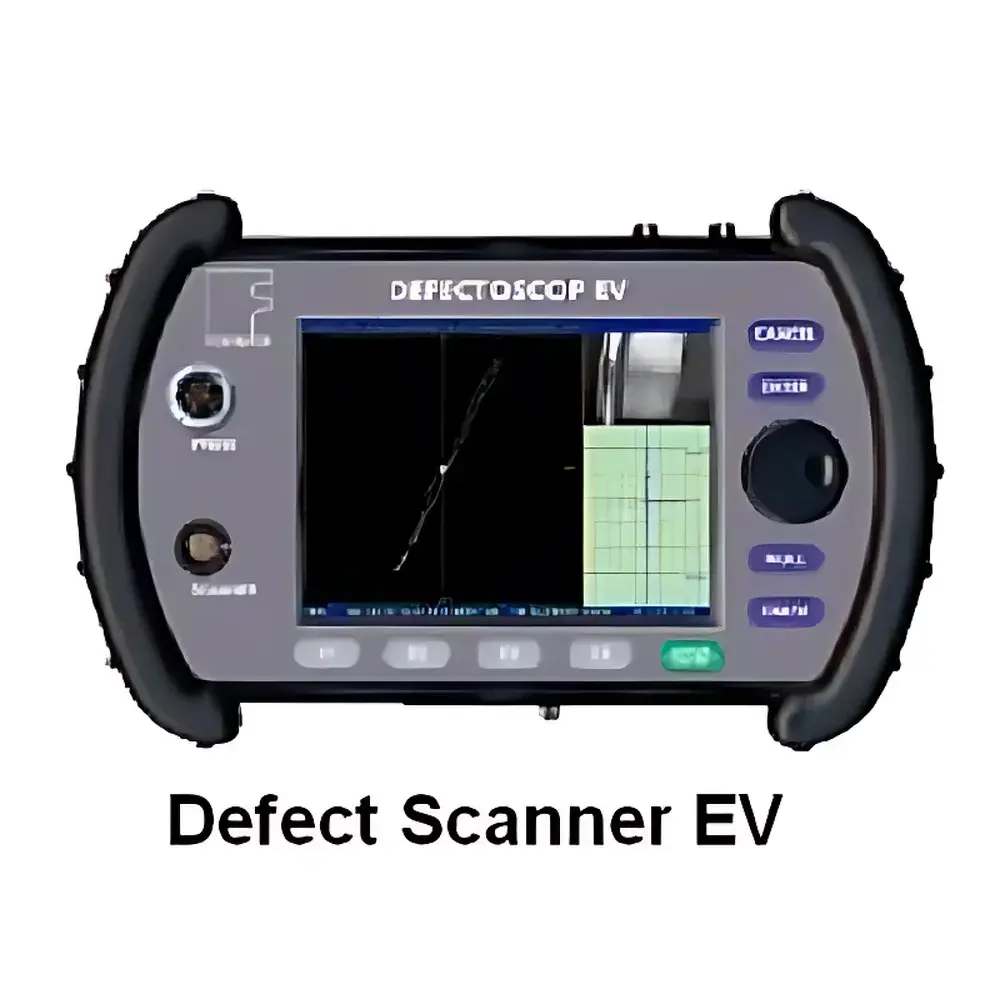
EV Series Portable Eddy Current Flaw Detector
| Origin | USA |
|---|---|
| Manufacturer Type | Authorized Distributor |
| Origin Category | Imported |
| Model | EV Series |
| Pricing | Available Upon Request |
Overview
The EV Series Portable Eddy Current Flaw Detector is a battery-powered, handheld non-destructive testing (NDT) instrument engineered for high-fidelity surface and near-surface flaw detection in conductive materials. Based on the principle of electromagnetic induction, it generates alternating magnetic fields via probe coils to induce eddy currents in the test material; disruptions caused by cracks, corrosion, conductivity variations, or dimensional changes alter the impedance response, which is analyzed in real time on the instrument’s multi-mode display. Designed for field-deployable inspection integrity, the EV Series meets the operational rigor required in aerospace maintenance, power generation, and precision manufacturing environments—where portability, signal fidelity, and repeatability are critical under variable ambient conditions.
Key Features
- Wide frequency range: 10 Hz to 10 MHz, supporting both single- and dual-frequency operation (F1 & F2, F1 + F2, F1 − F2) for optimized lift-off compensation and defect discrimination
- Precision gain control: 0–99.9 dB adjustable in 0.1 dB increments, enabling fine-tuned signal-to-noise optimization across diverse material thicknesses and probe configurations
- Configurable analog filtering: Selectable low-pass and high-pass filters (0–10 kHz, 1 Hz resolution) to suppress electromagnetic interference and enhance defect signature clarity
- 6.5-inch full-color LCD display with simultaneous multi-view capability: Real-time overlay of impedance plane (X-Y), strip-chart (time-domain), and external video feed (NTSC/RGB)
- Flexible display scaling: Sensitivity ranges of 0.2, 0.5, 1.0, 2.0, and 5.0 V/division; ring-scan sweep speeds from 1 ms/div to 10 ms/div; user-defined auto-refresh interval (0–10 s, 1 s step)
- Probe compatibility: Supports absolute, differential, reflection, and differential-reflection probe types; 8-pin LEMO probe interface and 16-pin scanner interface
- Ruggedized enclosure: Molded, IP54-rated housing with integrated ergonomic handle; operating temperature range: 0 °C to 70 °C; storage range: −20 °C to +70 °C
Sample Compatibility & Compliance
The EV Series is validated for use on aluminum, titanium, stainless steel, copper alloys, and other electrically conductive metals commonly found in airframe structures, turbine components, heat exchanger tubing, and welded joints. It supports ASTM E309 (Standard Practice for Eddy Current Examination of Steel Tubular Products), ASTM E566 (Standard Practice for Electromagnetic (Eddy Current) Sorting of Ferrous Metals), and ISO 15549 (Non-destructive testing — Eddy current testing — General principles). While not FDA-regulated, its data logging architecture—including timestamped parameter sets and traceable alarm triggers—aligns with GLP/GMP documentation expectations for in-service inspection records. All firmware and calibration routines are traceable to NIST-traceable reference standards.
Software & Data Management
The instrument stores up to 100 programmable test setups internally, each preserving gain, frequency, filter settings, display configuration, and alarm thresholds. Internal memory retains up to 10 complete inspection sessions, while removable SD cards capture synchronized eddy current waveforms, NTSC video frames, and strip-chart logs. Data export is supported via RS-232 serial interface (±10 V, 16-bit A/D and D/A conversion) for integration with third-party analysis platforms or enterprise NDT databases. Screen dumps and setup reports can be printed directly via parallel port output. The system does not require proprietary software for basic operation but supports optional PC-based analysis tools compliant with ASTM E2339 (Standard Practice for Digital Imaging and Communication in Nondestructive Evaluation).
Applications
- Aircraft structural inspection: Detection of fatigue cracks in fuselage skins, wing spars, rivet rows, engine compressor blades, and helicopter rotor shafts
- Corrosion mapping: Identification of subsurface pitting and exfoliation beneath paint or clad layers in aluminum airframes
- Bolt hole and fastener inspection: High-speed rotary scanning of threaded holes using optional motorized scanners for circumferential coverage
- Heat-affected zone (HAZ) evaluation: Discrimination of microstructural changes induced by localized overheating or improper welding
- Weld inspection: Detection of lack-of-fusion, cold laps, and transverse cracking in conductive weldments without couplant or surface preparation
- Manufacturing QA/QC: In-line verification of raw stock, forgings, extrusions, and machined components prior to final assembly
FAQ
What probe types are compatible with the EV Series?
Absolute, differential, reflection, and differential-reflection probes—both standard and custom-configured—are supported via the 8-pin LEMO interface.
Does the instrument support regulatory-compliant audit trails?
While the base unit does not implement 21 CFR Part 11 electronic signatures, all stored setups and inspection logs include timestamps, operator IDs (if entered), and parameter metadata suitable for internal GLP/GMP audit readiness.
Can video input be synchronized with eddy current signals?
Yes—NTSC or RGB video feeds (e.g., from borescopes or video probes) are time-aligned with impedance and strip-chart displays for correlated visual–electromagnetic interpretation.
Is battery life sufficient for full-shift field use?
The 10.8 V, 5400 mAh lithium-ion pack provides ≥6 hours of continuous operation under typical gain and display settings; LED indicators show remaining capacity in 25% increments.
How is zero-balance calibration performed?
A dedicated “Null” function allows rapid coil balancing—displaying real-time null point offset on the LCD—to compensate for probe drift or temperature-induced baseline shifts.



