
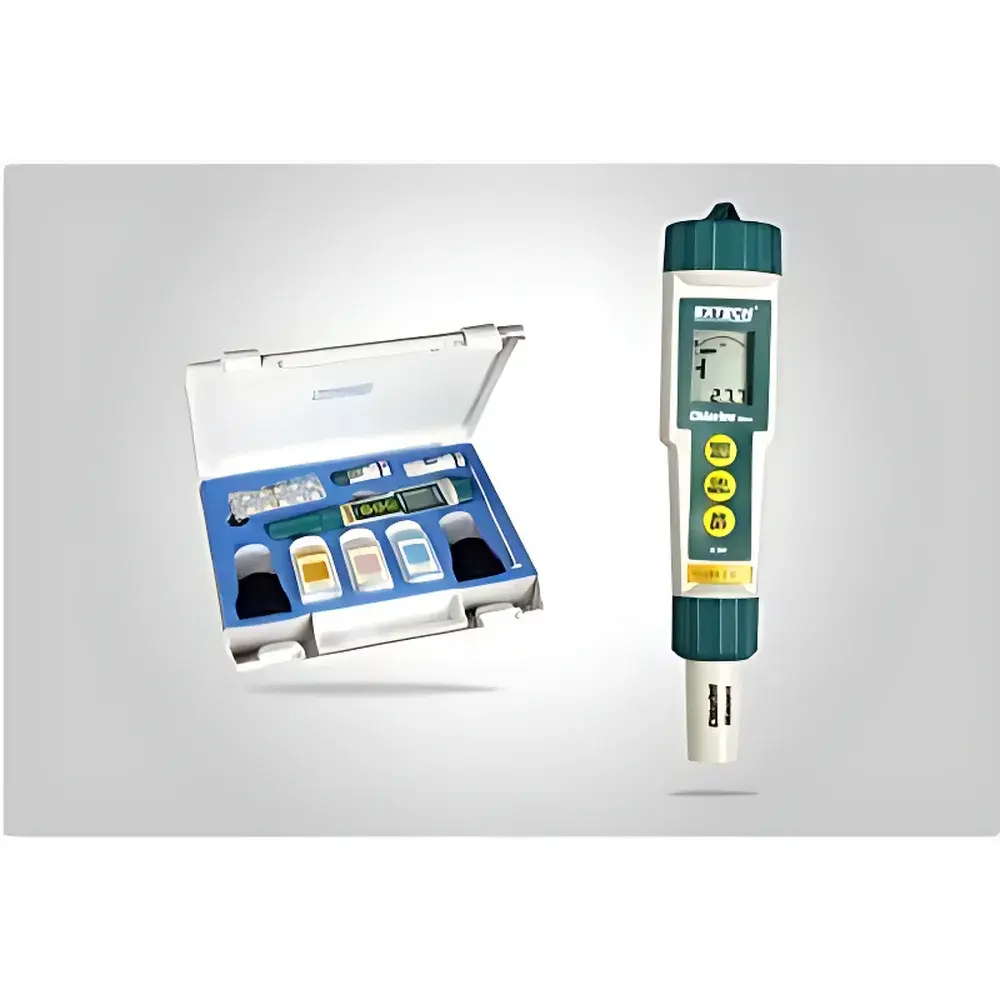
ExStik CL200+ Waterproof Pocket-Sized Residual Chlorine and Total Chlorine Analyzer
| Brand | ExStik |
|---|---|
| Origin | Shanghai, China |
| Model | CL200+ |
| Measurement Principle | Amperometric Electrode with Solid-State Platinum/Graphite Composite Sensor |
| Range | 0.01–10.00 ppm (Total/Free Chlorine) |
| Accuracy | ±10% of reading ±0.01 ppm (0.05–5.00 ppm) |
| Temperature Compensation | Automatic (–5 to 90 °C) |
| Temp. Accuracy | ±1 °C (–5 to 50 °C), ±3 °C (50 to 90 °C) |
| Display | Multi-segment LCD with bar graph |
| Data Storage | 15 readings |
| Power | 4 × SR-44 (1.5 V) button cells |
| Auto-off | After 10 min idle |
| Electrode Compatibility | Interchangeable residual chlorine, pH, and ORP sensors with auto-detection |
Overview
The ExStik CL200+ is a compact, IP67-rated pocket analyzer engineered for field-deployable, electrochemical measurement of free chlorine, total chlorine, and related oxidizing disinfectants in aqueous systems. Unlike colorimetric methods—whose accuracy degrades under turbid, colored, or highly variable pH conditions—the CL200+ employs an amperometric detection principle using a solid-state platinum/graphite composite sensor. This electrode architecture enables direct, real-time current response proportional to active chlorine species (Cl₂, HOCl, OCl⁻, and chloramines), independent of sample optical properties. The instrument operates on the principle of constant-potential amperometry at a fixed bias voltage optimized for chlorine redox kinetics, delivering stable output even in dynamic flow environments such as cooling towers, potable water distribution points, and swimming pool circulation lines. Its design conforms to foundational analytical requirements outlined in ASTM D1253 (Standard Test Method for Total Chlorine in Water) and supports routine compliance verification per WHO Guidelines for Drinking-water Quality and EPA Method 334.0 (Amperometric Titration for Residual Chlorine).
Key Features
- IP67-certified waterproof enclosure—fully submersible up to 1 m for 30 minutes, enabling safe operation in rain, splashing zones, or submerged sampling ports.
- Integrated solid-state total chlorine electrode with large-surface-area platinum sensing element and stable graphite reference—eliminates liquid-filled junctions and minimizes drift during extended field use.
- Auto-identifying sensor interface: single meter body accepts interchangeable residual chlorine, pH, and ORP electrodes; firmware detects connected probe type and configures display units (ppm, pH, mV) accordingly.
- Real-time automatic temperature compensation (ATC) across –5 to 90 °C, with dual-parameter LCD showing both concentration (ppm) and measured temperature simultaneously.
- Onboard data logging for up to 15 sequential measurements, accessible via recall function—supports basic traceability without external software.
- Low-power architecture powered by four SR-44 button cells (1.5 V each); battery status indicator (“BAT”) alerts users prior to critical depletion; auto-shutdown after 10 minutes of inactivity extends operational life.
- One-step reagent integration: compatible with ExTab™ chlorine test tablets—no pipettes, dilutions, or buffer solutions required. Each tablet delivers precise reagent dosing for rapid (<60 s) electrochemical equilibration.
Sample Compatibility & Compliance
The CL200+ is validated for use across municipal drinking water, recirculating cooling systems, food processing rinse water, thermal spa effluent, and wastewater disinfection contact basins. It measures both free available chlorine (HOCl/OCl⁻) and total chlorine (including monochloramine, dichloramine, and nitrogen trichloride) within the specified 0.01–10.00 ppm range. Performance remains unaffected by suspended solids, dissolved organic carbon (DOC), or chromatic interference—critical for monitoring chlorination efficacy in raw surface water intakes or post-filtration distribution networks. While not certified to ISO/IEC 17025 for accredited laboratory testing, its measurement repeatability (≤±5% RSD at 2 ppm Cl₂) meets field verification criteria referenced in US EPA Guidance for Disinfectant Residual Monitoring (2021) and aligns with GLP-aligned operational procedures for non-regulated QC checks.
Software & Data Management
The CL200+ operates as a standalone field instrument with no proprietary software dependency. All configuration, calibration, and data review occur directly on-device via tactile membrane buttons and the segmented LCD. No Bluetooth, USB, or cloud connectivity is included—intentionally omitting digital attack surfaces to ensure long-term reliability in industrial edge environments. Stored readings retain timestamp-equivalent sequence indexing (1–15), supporting manual transcription into LIMS or paper-based logbooks compliant with 21 CFR Part 11 Annex 11 documentation practices when paired with controlled procedural SOPs. Calibration is performed using two-point standardization (zero and span) with NIST-traceable chlorine standards; calibration history is not stored but may be recorded externally per facility QA protocols.
Applications
- Municipal water utilities: spot-checking residual chlorine at entry points, storage reservoirs, and distant service connections to verify disinfectant persistence.
- HVAC maintenance: continuous monitoring of biocide levels in closed-loop cooling towers to prevent Legionella pneumophila proliferation while avoiding over-chlorination-induced corrosion.
- Recreational water facilities: daily compliance verification against CDC Model Aquatic Health Code (MAHC) thresholds for public pools and spas (e.g., 1–3 ppm free chlorine, pH 7.2–7.8).
- Food & beverage production: verification of sanitizing rinse concentrations on conveyor belts, fillers, and CIP lines per FDA Food Code §3-301.12 and SQF Edition 9 requirements.
- Wastewater treatment plants: monitoring chlorine contact chamber effluent to meet NPDES permit limits prior to environmental discharge.
FAQ
Does the CL200+ measure both free and total chlorine separately?
Yes—the instrument distinguishes free chlorine (hypochlorous acid/hypochlorite ion) and total chlorine (free + combined chloramines) through sequential tablet-assisted measurement protocols defined in the user manual.
Is electrode replacement possible without sending the unit to service?
Yes—electrodes mount via threaded bayonet coupling and require no tools; full replacement takes <90 seconds and preserves instrument calibration coefficients.
Can the device be used in seawater or high-salinity brines?
While IP67-rated for immersion, prolonged exposure to >35,000 ppm chloride may accelerate electrode passivation; we recommend rinsing with deionized water after marine applications.
What is the recommended calibration frequency?
Daily calibration is advised for regulatory reporting; weekly calibration suffices for internal process monitoring when using fresh ExTab™ reagents and maintaining documented temperature stability.
Does it comply with drinking water regulations in the EU or USA?
It supports adherence to measurement objectives in the U.S. Safe Drinking Water Act (SDWA) and EU Directive 98/83/EC, though final compliance responsibility rests with the operator’s validated method and QA program—not the instrument alone.
Related Products







