
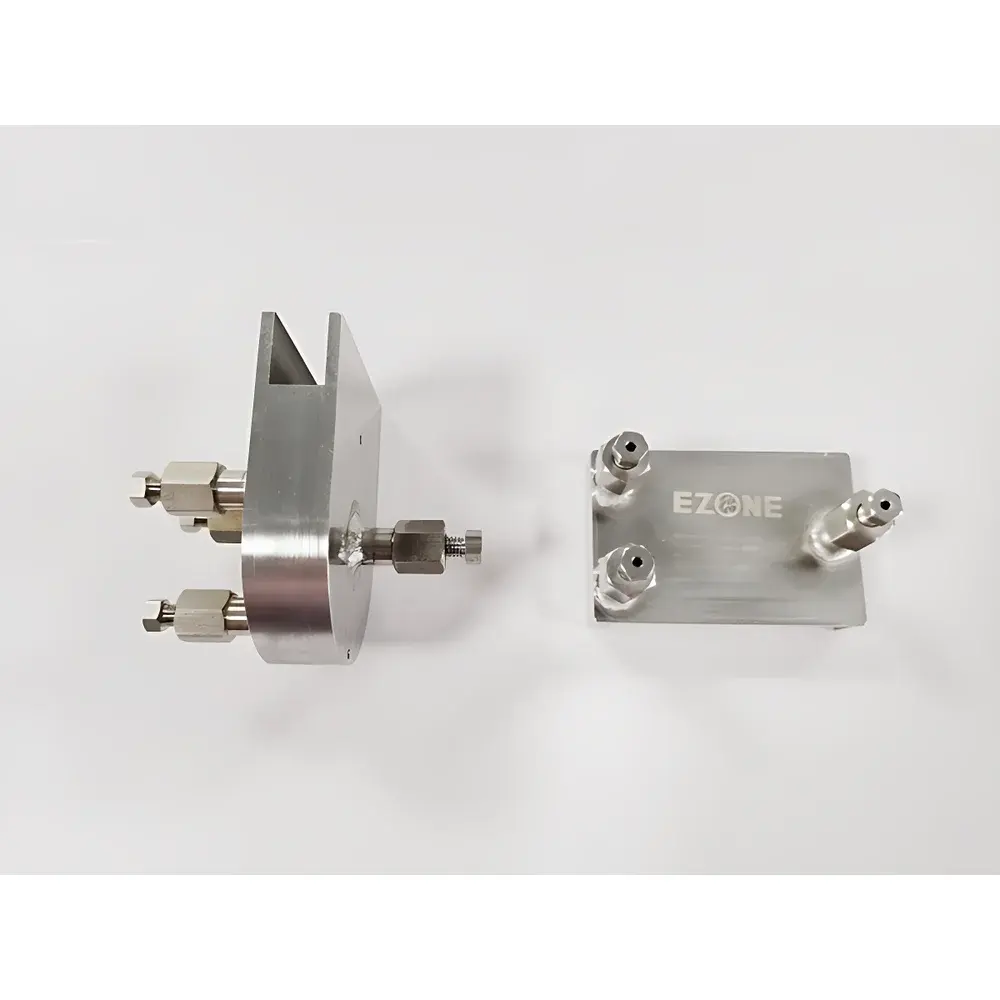
EZONE CHEMIST Micro Mixer
| Brand | EZONE CHEMIST |
|---|---|
| Origin | Guangdong, China |
| Manufacturer Type | Authorized Distributor |
| Country of Origin | China |
| Model | Accessory- |
| Quotation | Upon Request |
| Material | ASTM A276 316L Stainless Steel |
| Mixing Principle | Static (Zig-Zag or Multi-Layer High-Throughput Geometry) |
| Channel Dimensions | 0.2 mm × 0.25 mm and 0.5 mm × 0.5 mm |
| Temperature Range | −20 °C to +200 °C |
| Pressure Rating | 0–100 bar |
Overview
The EZONE CHEMIST Micro Mixer is a precision-engineered static mixing element designed for integration into continuous flow chemical synthesis, process intensification, and lab-scale reaction systems. Operating on the principle of passive fluid division, reorientation, and radial convection—without moving parts—the device achieves rapid, reproducible homogenization of immiscible liquid phases (e.g., aqueous/organic), gas–liquid systems (e.g., H₂ in solvent, CO₂ absorption), and multi-component reagent streams (A + B → P; A + B + C → P). Its monolithic 316L stainless steel construction ensures compatibility with aggressive reagents, elevated temperatures, and high-pressure environments typical of catalytic hydrogenation, nitration, halogenation, and photochemical workflows. The mixer’s compact footprint and modular design enable seamless coupling with syringe pumps, HPLC manifolds, microreactors, and inline IR/UV monitoring cells.
Key Features
- Monolithic 316L stainless steel body conforming to ASTM A276 and ASME BPE surface finish standards (Ra ≤ 0.4 µm), ensuring corrosion resistance and cleanability.
- Two standardized internal geometries: (1) Zig-Zag laminar-splitting architecture optimized for low-Reynolds-number viscous blending; (2) Multi-layer high-throughput configuration enabling turbulent-like dispersion at moderate flow rates.
- Microchannel cross-sections available in two configurations: 0.2 mm × 0.25 mm (high shear, residence time < 0.8 s at 1 mL/min) and 0.5 mm × 0.5 mm (balanced throughput/residence time, suitable for heterogeneous catalysis).
- Rated for continuous operation from −20 °C to +200 °C, compatible with thermal jackets, cryogenic sleeves, and integrated heating cartridges.
- Pressure-certified to 100 bar (1450 psi) at 20 °C per EN 13480-3, with hydrostatic test pressure of 150 bar; threaded end connections comply with ISO 228-1 (G1/8″, G1/4″) and NPT standards.
- No internal gaskets or elastomers—fully metal-sealed assembly eliminates leaching, swelling, or degradation under organic solvents or supercritical fluids.
Sample Compatibility & Compliance
The EZONE CHEMIST Micro Mixer demonstrates broad compatibility across chemically diverse streams: polar/non-polar solvent pairs (e.g., water/THF, MeOH/DCM), low-solubility gases (O₂, Cl₂, NH₃) dissolved in liquid carriers, slurries containing <5 wt% solid catalysts (Pd/C, Raney Ni), and thermally sensitive intermediates (e.g., diazonium salts, epoxides). It supports GLP-compliant process development when installed in validated flow rigs meeting FDA 21 CFR Part 11 data integrity requirements. While not certified to ISO 9001 as a standalone component, its material traceability (heat number documented), dimensional repeatability (<±2 µm via CNC wire-EDM manufacturing), and surface passivation (per ASTM A967) align with ICH Q5D and USP analytical instrument qualification protocols.
Software & Data Management
As a hardware-only static element, the Micro Mixer requires no embedded firmware or driver software. However, it integrates transparently into digital lab infrastructure via upstream flow controllers (e.g., Teledyne ISCO, Equilibar) and real-time analytics platforms (e.g., ReactIR™, FlowNMR). When paired with programmable syringe pumps and time-stamped sensor arrays (pressure, temperature, conductivity), mixer performance metrics—including mixing efficiency (quantified via Danckwerts intensity of segregation), residence time distribution (RTD), and interfacial area generation—are fully traceable and exportable in CSV/JSON formats for audit trails compliant with ALCOA+ principles.
Applications
- Continuous-flow exothermic reactions requiring instantaneous heat dissipation (e.g., Grignard additions, lithiations).
- In-line quenching of reactive intermediates prior to downstream separation.
- Pre-mixing of reagent streams ahead of photochemical reactors (e.g., UV-LED modules) to ensure uniform photon exposure.
- Gas–liquid mass transfer enhancement in hydrogenation, oxidation, and carbonylation processes.
- Scale-down modeling for API process validation: identical mixing physics between lab (µL/min) and pilot (L/min) scales due to geometric similarity and Reynolds-number matching.
FAQ
Is the Micro Mixer compatible with fluorinated solvents such as HFIP or TFEE?
Yes—316L stainless steel exhibits excellent resistance to fluorinated alcohols and ethers below 150 °C; prolonged exposure above this threshold requires evaluation of stress-corrosion cracking risk.
Can it be sterilized using autoclaving?
Autoclaving at 121 °C / 2 bar is permissible; however, repeated cycles may accelerate surface oxide layer fatigue—passivation post-sterilization is recommended.
What is the maximum recommended Reynolds number for laminar operation?
For the 0.2 mm × 0.25 mm channel, Re < 200 maintains predictable laminar dispersion; beyond Re ≈ 400, secondary flows begin to dominate, altering RTD profiles.
Does EZONE CHEMIST provide computational fluid dynamics (CFD) models for this mixer?
Yes—validated ANSYS Fluent geometry files and boundary condition templates are available under NDA for process simulation and scale-up studies.
How is leak integrity verified during installation?
Helium leak testing to ≤1 × 10⁻⁹ mbar·L/s is performed on every unit pre-shipment; users should conduct bubble testing or pressure decay verification at operating conditions prior to first use.



