
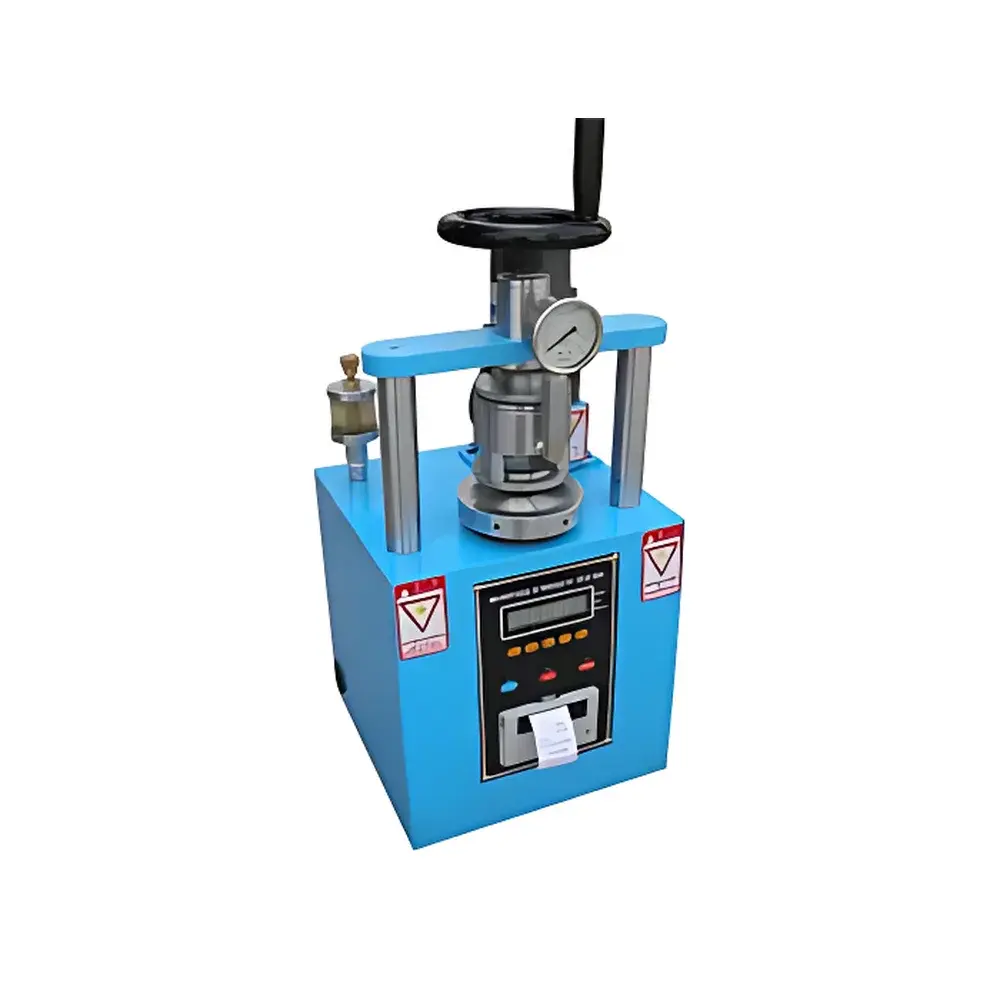
Fangyuan FY-630 Series Bursting Strength Tester
| Brand | Fangyuan |
|---|---|
| Model | FY-630A / FY-630B |
| Measurement Range | 0–100 kgf/cm² (0.01 kgf/cm² resolution) |
| Clamp Ring Diameter | 31.50 mm |
| Hydraulic Fluid | 85% glycerin + 15% distilled water |
| Pressure Rise Rate | 95 ± 10 mL/min |
| Drive Motor | 1/4 HP anti-vibration motor |
| Power Supply | 1-phase, AC 220 V, 2 A |
| Compliance | ISO 2759, GB/T 6545, JIS P8112, L1018, ASTM D2210, TAPPI T403 |
Overview
The Fangyuan FY-630 Series Bursting Strength Tester is a precision-engineered instrument designed for the quantitative determination of bursting strength—the maximum hydraulic pressure required to rupture flat sheet materials under controlled, standardized conditions. Based on the Mullen-type principle, the device applies uniformly increasing hydraulic pressure via a diaphragm beneath a rigid clamped specimen until failure occurs. The resulting burst resistance value—expressed in kgf/cm²—is captured digitally at the moment of rupture and retained for traceable reporting. This method is widely adopted across global packaging quality control laboratories to assess structural integrity, fiber network cohesion, and resistance to localized stress in corrugated board, solid fiberboard, kraft paper, linerboard, sanitary tissue, plastic laminates, and composite flexible packaging films.
Key Features
- Two operational configurations: FY-630A (manual operation with digital hold function) and FY-630B (fully automated cycle including pressure ramping, rupture detection, peak value retention, and automatic platen retraction)
- High-stability clamping system with precisely machined 31.50 mm diameter stainless steel annular rings (304 grade), ensuring consistent sample confinement and minimal edge effects
- Calibrated pressure transducer with 0.01 kgf/cm² resolution and full-scale range of 0–100 kgf/cm², traceable to national metrological standards
- Hydraulic actuation using a temperature-stable glycerin–water mixture (85:15 v/v) to minimize compressibility drift and thermal expansion artifacts
- Controlled pressure rise rate of 95 ± 10 mL/min—aligned with ISO 2759 and ASTM D2210 requirements for reproducible loading kinetics
- Robust mechanical architecture: base plate fabricated from heat-treated JIS G4051 S45C carbon steel (equivalent to AISI 1045), finished with industrial-grade epoxy coating; frame constructed from precision-cast iron with baked enamel finish
- Low-noise, anti-vibration 1/4 HP induction motor driving a positive-displacement gear pump for stable hydraulic delivery
Sample Compatibility & Compliance
The FY-630 Series accommodates planar specimens up to 150 mm × 150 mm, with minimum thickness of 0.1 mm and maximum of 8 mm—covering standard test coupons per ISO 2759 (corrugated board), GB/T 6545 (Chinese national standard for paperboard), JIS P8112 (Japanese Industrial Standard for paper and board), TAPPI T403 (bursting strength of paper and paperboard), ASTM D2210 (bursting strength of corrugated fiberboard), and L1018 (U.S. military specification for packaging materials). All mechanical and hydraulic subsystems are validated against repeatability limits defined in ISO 5725-2 (accuracy of measurement methods) and demonstrate inter-laboratory reproducibility within ±2.5% RSD when operated under GLP-compliant environmental conditions (23 ± 2 °C, 50 ± 5% RH).
Software & Data Management
While the FY-630A operates as a standalone analog-digital hybrid unit with front-panel numeric display and manual data logging, the FY-630B integrates optional RS-232 or USB serial output for direct connection to laboratory information management systems (LIMS) or custom QA databases. Exported data includes timestamp, test ID, operator code, burst value (kgf/cm²), burst time (s), and pass/fail status relative to user-defined specification limits. The firmware supports audit-trail functionality compliant with FDA 21 CFR Part 11 requirements when deployed with validated software interfaces—enabling electronic signatures, change history tracking, and secure user access levels (administrator/operator). Calibration records and maintenance logs can be archived in CSV or PDF format for internal quality audits and ISO 9001:2015 certification readiness.
Applications
- Quality assurance of incoming raw materials (e.g., linerboard, medium, recycled fiber blends) prior to corrugated box manufacturing
- In-process verification of wet-end additives (starch, CMC, AKD) impact on paper tensile and burst resistance
- Comparative evaluation of biodegradable packaging substrates (PLA-coated board, molded fiber trays) versus conventional fiber-based alternatives
- Stability testing of coated papers and metallized films under accelerated aging (40 °C/75% RH) to quantify hydrolytic degradation of burst performance
- Supplier qualification and batch release testing in contract packaging facilities serving pharmaceutical, food, and e-commerce logistics sectors
- Root cause analysis of field failures (e.g., carton collapse during pallet stacking or transit vibration) through correlation with lab-measured burst index and grammage
FAQ
What is the difference between bursting strength and tensile strength?
Bursting strength measures resistance to perpendicular force applied over a localized area (hydraulic diaphragm), reflecting combined contributions of tensile strength, elongation, and fiber bonding. Tensile strength, measured uniaxially via tensile tester, isolates longitudinal load-bearing capacity independent of thickness or compression effects.
Can the FY-630 test non-fibrous materials such as thin aluminum foil or PET film?
Yes—provided the specimen remains dimensionally stable under hydraulic clamping and does not exhibit excessive creep or slippage. For highly ductile or low-modulus films, use of auxiliary support screens (per ASTM D2210 Annex A) is recommended to prevent extrusion around the clamp ring.
Is calibration traceable to NIST or other national metrology institutes?
Factory calibration utilizes dead-weight pressure standards certified to ISO/IEC 17025-accredited laboratories. End-users may perform periodic verification using NIST-traceable hydraulic pressure calibrators (e.g., Fluke 7050 series) with uncertainty ≤ 0.1% FS.
How often should the glycerin–water mixture be replaced?
Recommended replacement interval is every 12 months under continuous operation or after 500 test cycles—whichever occurs first—to maintain viscosity stability and prevent microbial growth or phase separation.




