
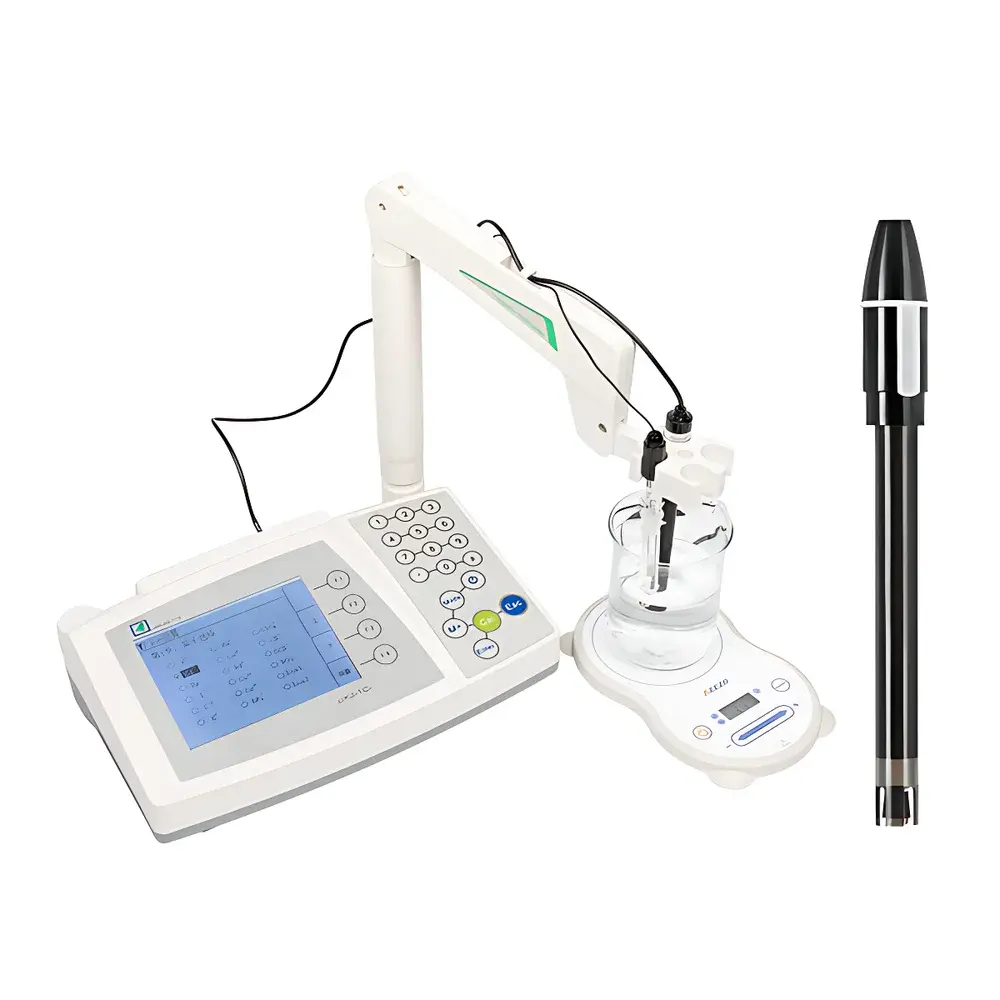
FangZhou PXJ-1C+ Silver and Sulfide Ion Analyzer
| Brand | FangZhou |
|---|---|
| Origin | Sichuan, China |
| Manufacturer Type | Authorized Distributor |
| Product Category | Domestic |
| Model | PXJ-1C+ Silver/Sulfide Ion Analyzer |
| Instrument Type | Benchtop |
| Ion Measurement Range | 0–99999 ppm |
| Detection Limit | 9999 ppm |
| Response Time | 3 s |
| Measurement Accuracy | ±0.5% FS ±1 digit |
| Temperature Range | −20.0–135.0 °C |
| Resolution | 0.001 pH / 0.01 mV / 0.1 °C |
| Input Impedance | ≥3×10¹² Ω |
| Data Storage | 4096 sets |
| GLP Compliance | Yes |
| Calibration Points | 2–9 points (ion), ≤5 points (pH) |
| Temperature Compensation | Automatic (ATC) or Manual |
| Communication Interfaces | USB, RS-232, 0–20 mV analog output |
Overview
The FangZhou PXJ-1C+ Silver and Sulfide Ion Analyzer is a high-precision benchtop potentiometric ion analyzer engineered for reliable quantification of Ag⁺ and S²⁻ ions in aqueous environmental and industrial samples. It operates on the principle of selective ion electrode (ISE) potentiometry—measuring the electromotive force (EMF) generated at the interface between a sample solution and an ion-selective membrane, which follows the Nernst equation. The instrument supports dual-mode detection: direct ion concentration measurement (pX mode) and indirect determination via calibration curve construction using up to nine standard points. Designed for regulatory-compliant water quality laboratories, it meets fundamental requirements for trace metal and anion monitoring in wastewater effluent, drinking water sources, and process streams—particularly where silver discharge control (e.g., photographic processing, electroplating) or sulfide toxicity assessment (e.g., anaerobic digestion, pulp & paper discharge) is mandated.
Key Features
- Benchtop architecture with robust ABS housing, optimized for stable operation in laboratory and field-deployable QC environments.
- Large backlit LCD display with dual time/date stamping—ensuring traceable data logging per GLP/GMP documentation standards.
- Multi-parameter capability: simultaneous measurement of ion activity (pX), pH, mV/Rel-mV/ORP, and temperature—with selectable resolution (0.001 pH, 0.01 mV, 0.1 °C).
- Integrated ATC (Automatic Temperature Compensation) using a Pt1000 sensor; manual compensation also supported across −20.0 to 135.0 °C.
- Advanced calibration flexibility: 2–9-point ion calibration with real-time slope calculation and R² evaluation; up to five-point pH calibration with auto-recognition of 18 preloaded standard buffers (including ASTM and ISO reference solutions).
- 13 concentration unit conversions—including pX, ppm, ppb, mol/L, mmol/L, µmol/L, ng/L, mg/L, g/L, %, µg/L—enabling seamless alignment with regional reporting requirements (e.g., EPA Method 300.0 for anions, ISO 10523 for pH).
- Onboard diagnostics, user-defined measurement modes (Auto, Real-time, Timed), and customizable key mapping for operator efficiency.
Sample Compatibility & Compliance
The PXJ-1C+ is validated for use with commercially available solid-contact and liquid-membrane ISEs for Ag⁺ and S²⁻, as well as combination pH electrodes and ORP sensors meeting DIN 19262 and IEC 60746-2 specifications. Sample matrices include raw and treated surface water, groundwater, municipal wastewater, leachate, and industrial process liquors—with appropriate sample conditioning (e.g., deaeration for sulfide, complex masking for interfering cations). It complies with core elements of GLP (Good Laboratory Practice) as defined in OECD Series No. 17 and US EPA SW-846 Chapter 1, including audit-trail-capable data storage (4096 entries with timestamp), electronic signature-ready calibration logs, and full traceability of electrode history and standard usage. While not certified for FDA 21 CFR Part 11 out-of-the-box, its data export protocols support validation under regulated pharmaceutical or food safety QA systems when deployed with documented SOPs.
Software & Data Management
The instrument interfaces seamlessly with “FangZhou pH-Link” PC software via USB or RS-232, enabling bidirectional communication for method transfer, real-time graphing, statistical analysis (mean, SD, RSD, linear regression), and PDF/CSV report generation. All stored measurements retain full metadata: date/time, electrode ID, calibration status, temperature, and operator code (user-definable). Raw analog output (0–20 mV) permits integration into SCADA or LIMS platforms for continuous compliance monitoring. Firmware updates are delivered through authenticated channels, and configuration backups can be archived locally or on network drives—supporting routine instrument qualification (IQ/OQ/PQ) workflows.
Applications
- Regulatory monitoring of silver concentrations in effluents from electronics manufacturing and jewelry plating facilities (per EU REACH Annex XVII limits).
- Quantification of dissolved sulfide in biogas scrubber liquids and anaerobic digesters to optimize H₂S removal efficiency.
- QC testing of silver-based antimicrobial agents in disinfectant formulations (ASTM E2149).
- Environmental site assessment of legacy mine drainage where Ag⁺ and S²⁻ co-occur with heavy metals.
- Educational labs performing Nernstian behavior studies and selectivity coefficient (Kpot) determinations for ISEs.
FAQ
Does the PXJ-1C+ support direct sulfide measurement in turbid or high-sulfate water?
Yes—when paired with a dedicated sulfide ISE and appropriate sample pretreatment (e.g., zinc acetate fixation and pH adjustment to ~12), it achieves reliable detection in complex matrices. Interference from Cu²⁺, Pb²⁺, and Hg²⁺ should be mitigated via chelation or electrode shielding.
Can calibration curves be imported/exported between instruments?
Calibration parameters (slope, intercept, R²) are exportable via pH-Link software; however, curve import requires manual re-entry unless embedded in a saved instrument profile.
Is temperature compensation mandatory during ion measurement?
While optional, ATC is strongly recommended—Nernst slope varies by ~0.198 mV/decade/°C for monovalent ions; uncorrected drift above ±2 °C introduces measurable bias in low-concentration ranges.
What electrode compatibility standards does the unit follow?
It accepts BNC, DIN, and 6-pin mini-DIN connectors via included adapter module, conforming to ISE physical interface conventions per ISO 8655-5 and ASTM D1293 Annex A2.
How is data integrity ensured during power interruption?
All measurements and calibrations are written to non-volatile memory immediately upon confirmation; no data loss occurs during unexpected shutdowns.







