
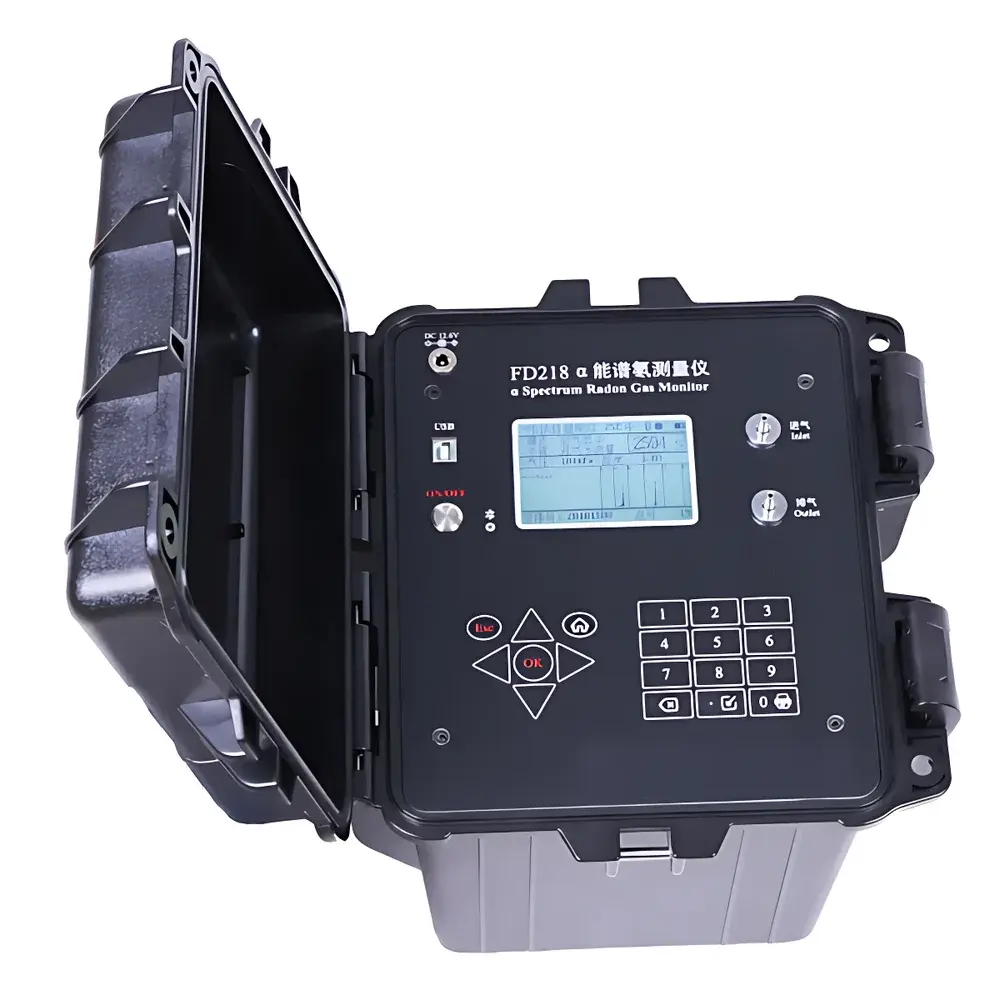
FD218-α Spectral Radon Monitor
| Brand | Beifen Sanpu |
|---|---|
| Origin | Beijing, China |
| Manufacturer Type | Direct Manufacturer |
| Regional Classification | Domestic (China) |
| Model | FD218 |
| Price | USD 6,700 (FOB Beijing) |
Overview
The FD218-α Spectral Radon Monitor is a laboratory-grade, active-sampling alpha spectrometric instrument engineered for high-precision, real-time quantification of radon-222 (²²²Rn) and its short-lived progeny (e.g., ²¹⁸Po, ²¹⁴Po) in ambient air, soil gas, and water-derived headspace. It operates on the principle of electrostatic collection coupled with pulse-height analysis of alpha particle energy spectra using a Passivated Implanted Planar Silicon (PIPS) detector. Unlike passive diffusion-based charcoal canisters or scintillation cells, the FD218 employs a built-in diaphragm pump to draw a controlled, metered air sample through a deposition chamber where positively charged radon progeny are electrostatically precipitated onto a polished, ultra-thin-contact PIPS detector surface. Each alpha decay event is resolved by energy (MeV), enabling isotope-specific identification and discrimination—critical for correcting for progeny disequilibrium, background interference, and thoron (²²⁰Rn) cross-talk. Its design adheres to the measurement fundamentals outlined in ISO 11665-2:2021 (Measurement of radioactivity — Radon-222 — Part 2: Integrated measurement method for determining average activity concentration) and supports traceable calibration per IAEA Technical Reports Series No. 471.
Key Features
- Passivated Implanted Planar Silicon (PIPS) alpha spectrometer detector with <1 keV FWHM energy resolution at 5.3 MeV (²⁴¹Am reference), low electronic noise, and mechanically robust, chemically inert surface suitable for repeated cleaning and long-term stability
- Integrated precision diaphragm pump with flow-rate control (0.1–1.0 L/min, ±2% accuracy) and real-time flow monitoring via thermal mass sensor
- Electrostatic collection chamber with adjustable high-voltage bias (0–3 kV DC) and optimized geometry for >95% deposition efficiency of Po isotopes under standard conditions
- Digital multi-channel analyzer (MCA) with 8192-channel spectrum acquisition, live-time correction, and automatic peak deconvolution for overlapping ²¹⁸Po (6.00 MeV), ²¹⁴Po (7.69 MeV), and ²¹⁰Po (5.30 MeV) emissions
- Onboard temperature, pressure, and relative humidity sensors for environmental compensation of volumetric activity calculations (Bq/m³)
- Rugged aluminum alloy chassis with EMI-shielded electronics enclosure; operating range: 5–40 °C, 20–90% RH non-condensing
Sample Compatibility & Compliance
The FD218 accepts gaseous samples directly from ambient air, soil gas probes (via stainless-steel tubing), or headspace extracted from water samples using standardized aeration modules (e.g., RAD7-style bubblers). It complies with EPA Method RPD-200 and ASTM D3613-21 for radon-in-soil-gas analysis, and supports data reporting formats required for ISO/IEC 17025-accredited laboratories. All spectral acquisition and decay-correction algorithms implement the ICRP Publication 137 decay chain model. Firmware includes audit-trail logging (user actions, calibration events, spectrum metadata) compliant with GLP and FDA 21 CFR Part 11 when paired with validated PC software.
Software & Data Management
The instrument interfaces via USB 2.0 or optional RS-485 to Windows-based RadonSpectrum Pro v3.x software. This application provides full spectral visualization, region-of-interest (ROI) integration, time-series activity plotting, automatic equilibrium factor (F) calculation, and export to CSV, XML, or PDF report templates. Raw spectrum files (.spc) retain full timestamp, environmental metadata, and detector calibration coefficients. Software supports batch processing of sequential measurements and generates uncertainty budgets per GUM (JCGM 100:2019). Data backups and user access controls (role-based permissions) are configurable for regulated environments.
Applications
- Indoor radon risk assessment in residential, school, and workplace buildings per WHO Handbook on Indoor Radon (2009) and national action levels (e.g., US EPA 148 Bq/m³, EU Council Directive 2013/59/Euratom)
- Geological surveying and uranium exploration via soil-gas radon mapping
- Validation of radon mitigation system efficacy (e.g., sub-slab depressurization, sealing interventions)
- Calibration transfer and inter-laboratory comparison studies for reference laboratories
- Research into radon progeny behavior, aerosol attachment kinetics, and dose coefficient modeling
- Environmental impact assessments for nuclear facility siting and decommissioning projects
FAQ
What is the minimum detectable activity (MDA) for ²²²Rn in a 60-minute measurement?
The MDA is 4.2 Bq/m³ at 95% confidence (Currie equation) under typical lab conditions (23 °C, 101.3 kPa, 50% RH) with 1.0 L/min flow and background count rate of 0.015 cpm in the 5.5–6.5 MeV window.
Can the FD218 distinguish thoron (²²⁰Rn) from radon (²²²Rn)?
Yes—by resolving the distinct alpha energies of ²¹⁶Po (6.78 MeV, t₁/₂ = 0.15 s) and ²¹²Po (8.78 MeV, t₁/₂ = 0.3 µs), provided sampling duration and delay times are optimized per ISO 11665-4 Annex C protocols.
Is the PIPS detector replaceable in the field?
No—the detector is hermetically sealed within a vacuum-tight module and requires factory recalibration after replacement; however, its rated operational lifetime exceeds 10 years under normal use.
Does the instrument support unattended long-term monitoring?
Yes—internal non-volatile memory stores up to 1,000 spectra (1 MB), and external 12 V DC power input enables continuous operation for >30 days with periodic automated data dump via scheduled USB or serial polling.
What calibration standards are supplied with the instrument?
Each unit ships with a NIST-traceable ²⁴¹Am point source (±2% uncertainty) for energy calibration, and a certified radon-in-air standard generator (Beifen SRG-222) for activity calibration, accompanied by full CoC and uncertainty budget documentation.







